There’s a meme which seems to regularly pop up on my social media feed. Taken from the Adventures of Tintin, it features an exhausted-looking Captain Haddock declaring in exasperation, “What a week, huh?” as he stares down at the table. Next to him sits Tintin, who replies: “Captain, it’s Wednesday.” In the age of Donald Trump, rolling commentary about bond market movements and Westminster’s never-ending soap opera, the meme seems to capture how I imagine most of us feel each week.
“Febrile” is the word which comes to my mind. Nothing feels settled, nothing secure. Perhaps it has always been this way; perhaps it is nostalgia on my part to believe the world was once a calmer place.…
There’s a meme which seems to regularly pop up on my social media feed. Taken from the Adventures of Tintin, it features an exhausted-looking Captain Haddock declaring in exasperation, “What a week, huh?” as he stares down at the table. Next to him sits Tintin, who replies: “Captain, it’s Wednesday.” In the age of Donald Trump, rolling commentary about bond market movements and Westminster’s never-ending soap opera, the meme seems to capture how I imagine most of us feel each week.
“Febrile” is the word which comes to my mind. Nothing feels settled, nothing secure. Perhaps it has always been this way; perhaps it is nostalgia on my part to believe the world was once a calmer place. And yet, I am not sure that is true. Prime ministers with landslide majorities did not find themselves fighting for political survival after just 18 months in office; presidents of the United States did not mobilise masked militias to kill ordinary American citizens.
Looking up the word “febrile” in the dictionary, I was presented with two definitions. The first: “characterised by a great deal of nervous excitement or energy”. While this certainly seems close, it does not quite capture the present state of affairs, which feels more nervous than excited, and possessed of too little energy to do much about anything at all.
The second definition comes a little closer: “having or showing the symptoms of a fever”. Are these feverish symptoms “morbid”, though, in the Gramscian sense – expressions of an old order dying before our eyes? Surely the genius of Gramsci’s diagnosis is that it is both unfalsifiable – for how can we know something is dying before it is too late? – and never inaccurate. Social, economic or geopolitical orders are always in flux, and therefore always – to the conservatively minded, at least – “decaying” in some sense. How much of this is decay and how much renewal is the stuff of politics to decide.
New year, new read. Save 40% off an annual subscription this January.
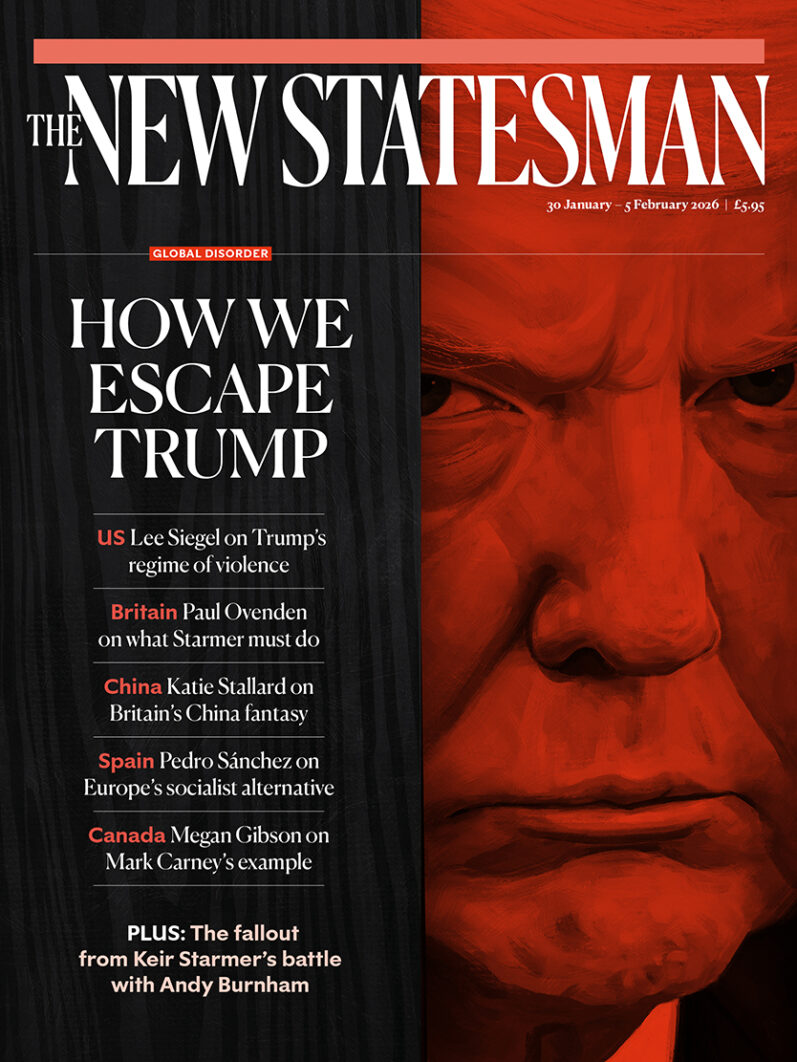
In the very first edition of the New Statesman, we declared that “in common with every thinking man and woman of today” we recognised vast social changes were imminent. We welcomed them. This was our bias – what made us progressive. Yet, in an era of reactionary upheaval, it is harder for the progressive to determine which social changes are to be welcomed and which are to be resisted. When, in other words, is it progressive to be conservative, and when is it merely conservative? It’s the question that connects the features in this issue, from our exclusive interview with the socialist prime minister of Spain, Pedro Sánchez, offering his own answer to this dilemma, to Paul Ovenden, Keir Starmer’s former director of strategy, who sets out another entirely.
Whether Britain’s symptoms are fatal or not, we certainly seem to be feverish: the temperature of our national life remains high, fits of delirium are now common. A pollster friend of mine came to see me the other day, unable to say with any convincing certainty where the public mood was likely to go this year. “They are all over the place,” he declared. Was Kemi Badenoch on the way up or stuck where she has always been? Was Keir Starmer showing signs of recovery or in as much trouble as ever?
At times like this, I have found it best to return to the fundamentals. Beyond the turmoil of the past week, the causes of our fever remain as they were: this government is unpopular because it is not changing enough. What it is changing, it is doing too slowly. Labour MPs will only stop plotting to remove their leader when the polls begin to shift. Donald Trump will never change. And New Statesman readers will continue to write the wittiest letters, pointing out what we have got right and what we have got wrong.
My favourite letter of this week came from Jonathan French of York, who jumped into the saga of the missing Theakston’s “e” which has been running for three weeks now in this Editor’s Note. There is an old Yorkshire joke about a missing “e” involving a gravestone inscription which was supposed to read “Lord, she is thine”, but the mason inscribed “Lord, she is thin” instead. When the exasperated relatives told him that he had left off the “e”, the mason agreed immediately to fix it. “The revised inscription was “e Lord, she is thin”. I feel like dedicating this to Captain Haddock. When it’s one of those weeks in the world, write a letter.
[Furthe reading: The only conspiracy at the Fabian Society conference]
Related
Topics in this article : Magazine