Google’s Gemini has rapidly evolved into one of the most widely deployed generative AI systems in the world. In fact, in Q4 2025, Gemini’s adoption rate was growing at around 30% compared to OpenAI’s ChatGPT at 5%. With the latest Gemini generation (Gemini Pro and Gemini Flash) now deeply integrated into Google Search, Workspace, and Google Cloud, many organizations are evaluating whether Gemini is accurate and reliable enough for real enterprise use.
As with other frontier AI models, Gemini’s strengths are undeniable. However, when applied to high-stakes business functions, such as compliance analysis, contract review, multilingual content generation, or d…
Google’s Gemini has rapidly evolved into one of the most widely deployed generative AI systems in the world. In fact, in Q4 2025, Gemini’s adoption rate was growing at around 30% compared to OpenAI’s ChatGPT at 5%. With the latest Gemini generation (Gemini Pro and Gemini Flash) now deeply integrated into Google Search, Workspace, and Google Cloud, many organizations are evaluating whether Gemini is accurate and reliable enough for real enterprise use.
As with other frontier AI models, Gemini’s strengths are undeniable. However, when applied to high-stakes business functions, such as compliance analysis, contract review, multilingual content generation, or decision support, its nature as a general-purpose Large Language Model (LLM) raises essential questions about accuracy, governance, and risk.
This analysis provides an impartial, enterprise-focused assessment of Google Gemini’s accuracy, placing it in context with broader industry trends and the growing adoption of task-specific and domain-adapted language models.
What does “accuracy” mean in an enterprise AI context?
In enterprise environments, AI accuracy is not simply a measure of linguistic fluency. It is a multi-dimensional requirement that determines whether an AI system can be trusted in production workflows.
From an enterprise perspective, accuracy typically includes:
- Factual correctness: avoidance of fabricated or unverifiable information
- Contextual and domain precision: correct interpretation of industry-specific language and rules
- Consistency and determinism: stable outputs for similar inputs
- Auditability and governance: traceability of how outputs are generated
- Data security and sovereignty: compliance with privacy and residency requirements
This framework mirrors the criteria enterprises use when evaluating other frontier models such as ChatGPT and DeepL (for translation), and it highlights why “sounding right” is not sufficient for business-critical use cases.
What is Google Gemini?
Google Gemini is a family of large, multimodal language models designed to process text, images, audio, video, and code within a unified architecture.
The current enterprise-relevant variants include:
- Gemini Pro: optimized for advanced reasoning and long-context analysis
- Gemini Flash: optimized for speed, scale, and cost efficiency
Gemini is tightly integrated with Google Workspace and Vertex AI, making it particularly accessible to organizations already operating within Google’s cloud ecosystem.
Fun Fact: Did you know that many LLM scientists like Ilya Sutskever (ex OpenAI CTO) or Adian Gomez (Cohere CEO) began their days in machine translation? Gomez was part of the Google Translate team. Sutskever wrote and co-wrote several papers on machine translation using Transformers, and encoder-decoder technologies before joining OpenAI. This reflects how closely related machine translation using Transformers and LLM-based Transformer technologies are.
Where Gemini performs well
1. Multimodal Understanding
Gemini’s native multimodal design allows it to reason across documents, images, charts, and code in a single workflow. This is a clear advantage for tasks such as document review, presentation analysis, and cross-media knowledge synthesis.
2. Long-Context Reasoning
Independent benchmarks and technical evaluations consistently show Gemini performing strongly on long-context reasoning tasks, where entire reports, manuals, or datasets must be processed without losing coherence.
3. Integration and Scalability
For enterprises already invested in Google Cloud, Gemini offers relatively low-friction deployment, native integration with productivity tools, and scalable infrastructure for experimentation and operational use.
Accuracy limitations enterprises and government should consider
1. Hallucinations remain a structural risk
Like all general-purpose LLMs, Gemini can generate fluent but incorrect information, particularly when operating outside well-defined or highly specialized domains. Hallucinations are not edge cases, they are a structural characteristic of probabilistic models.
Recent independent evaluations and benchmark analyses consistently show that while Gemini performs well on reasoning and comprehension tasks, incorrect answers are often delivered with high confidence, which poses a risk in enterprise decision-making contexts.
2. General knowledge does not equal domain expertise
Gemini’s training enables broad knowledge coverage, but it does not guarantee mastery of proprietary terminology, internal policies, or regulatory nuances. This limitation is especially relevant in legal, financial, medical, and technical domains.
3. Limited (or no) determinism and auditability
Enterprise workflows often require reproducible outputs and clear audit trails. Like other frontier models, Gemini’s probabilistic generation makes strict determinism and source traceability difficult without additional architectural controls.
Why enterprises and government are moving toward task-specific AI models
Industry analysts increasingly emphasize that general-purpose LLMs, while powerful, are not optimized for most production enterprise workloads. Instead, organizations are adopting task-specific and domain-adapted language models designed for narrowly defined business functions. This has been corroborated by industry analysts such as Gartner and McKinsey, and the increasing requests from governments and enterprises to reduce hallucinations in their specific domains/applications, plus the ever-growing concern about data leakage and privacy (known as data sovereignty, i.e., not sharing your data and knowledge outside your organization).
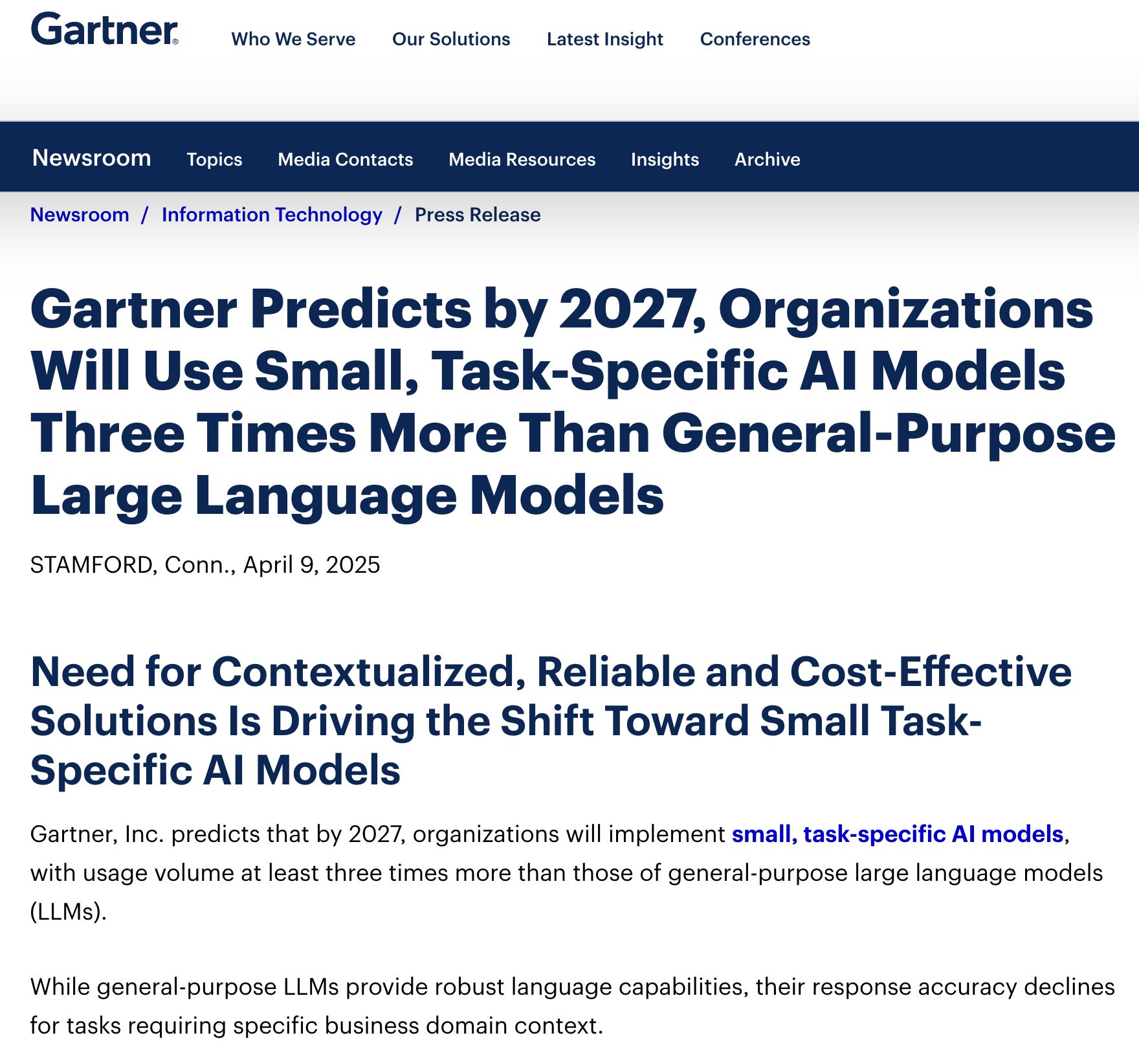
Task-specific small language models are built to:
- Operate within clearly bounded tasks
- Deliver higher factual and terminological accuracy
- Reduce hallucination risk
- Enable reproducibility and auditability
- Lower operational and inference costs
This shift mirrors the same trend observed in enterprise translation (DeepL) and general reasoning models (ChatGPT), reinforcing the move toward composite AI architectures. According to a September 2025 OpenAI technical report, GPT-5 has made strides, with a six-fold reduction in hallucinations on sensitive topics. Automatic scoring puts hallucination belo 1% in several cases, such as with Gemini, but user experience tells a different story, asrisk isstructural to the Transformer’s technology. Hallucinations cannot be fully “solved” in a probabilistic model, only managed. A growing understanding that developing or fine-tuning task-specific small language models pays off (or domain-specific small language models, as Gartner puts it), taking into account the perennial token costs, and greater concerns about explainability, is making organizations and governments seek help in building or fine-tuning small models for their specific use cases that they tend to host. The EU, for example, has several projects dedicated to public administrations adopting fine-tuned small models, in which some members of our staff have served as evaluators. The US federal government has also begun a series of calls to deploy on-device, private AI for government agencies.
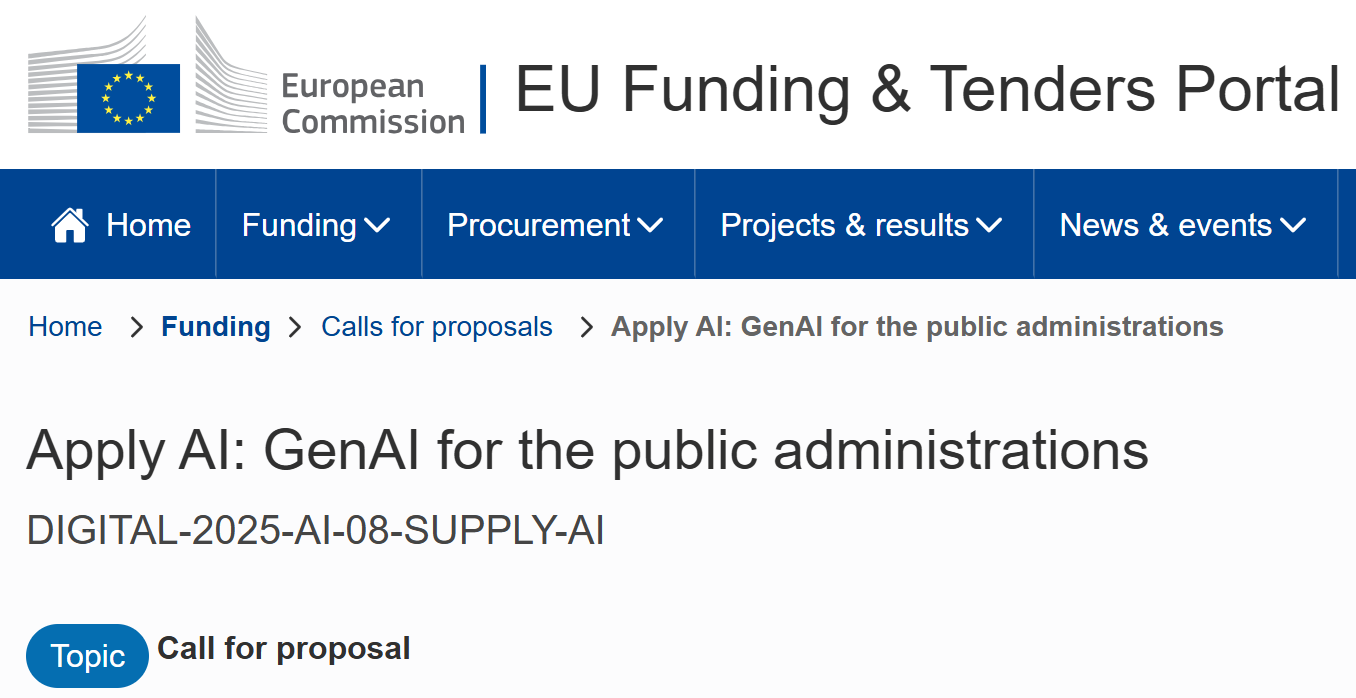 In Europe, the initiative to scale and replicate Generative Artificial Intelligence (GenAI) solutions across EU public administrations is a comprehensive and strategic effort aimed at enhancing efficiency and innovation in the public sector. By developing tools such as starter kits and replicability assessments, the initiative provides a framework for public administrations to adopt and adapt successful GenAI solutions. This approach not only saves time and resources but also ensures consistency and effectiveness in implementing AI technologies across different regions and sectors. In Europe, the initiative to scale and replicate Generative Artificial Intelligence (GenAI) solutions across EU public administrations is a comprehensive and strategic effort aimed at enhancing efficiency and innovation in the public sector. By developing tools such as starter kits and replicability assessments, the initiative provides a framework for public administrations to adopt and adapt successful GenAI solutions. This approach not only saves time and resources but also ensures consistency and effectiveness in implementing AI technologies across different regions and sectors. | 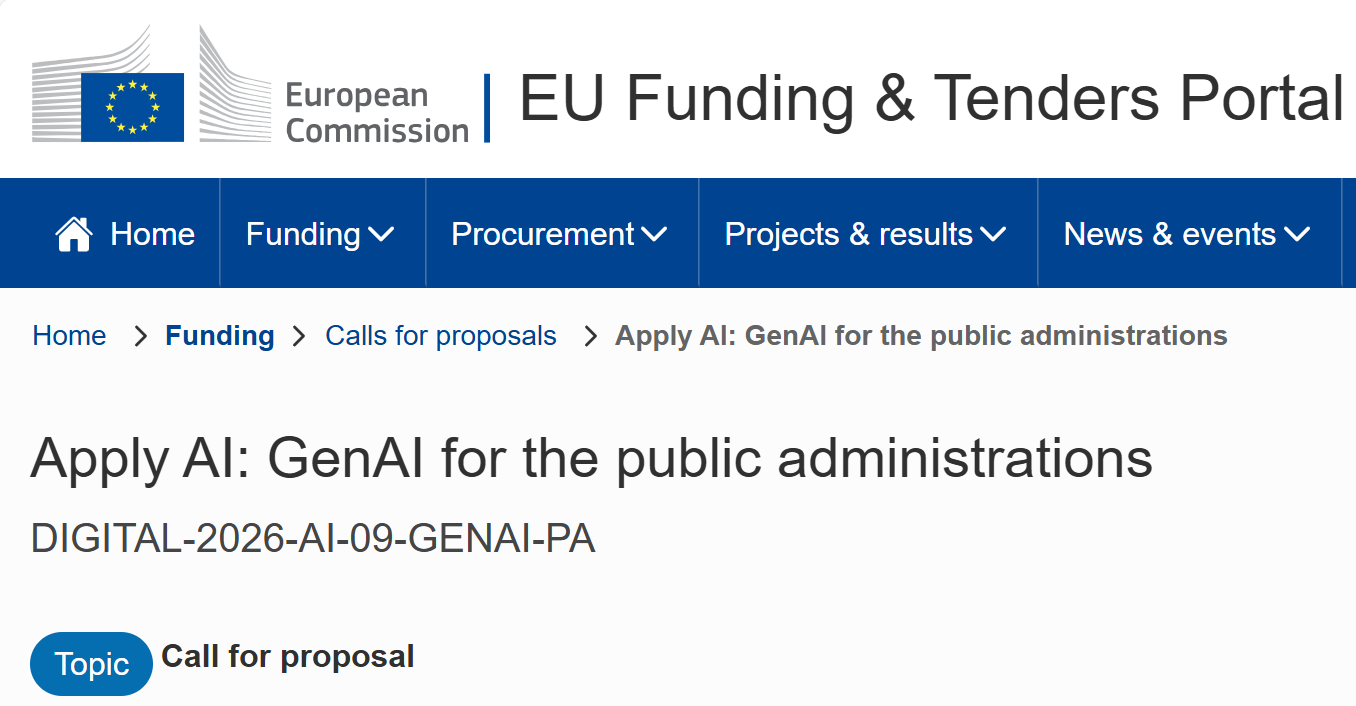 The initiative also emphasizes collaboration between public administrations and startups, fostering a culture of innovation and practical problem-solving. Through outreach and awareness-raising activities, the initiative educates public officials about the benefits of GenAI and encourages wider adoption. By integrating with broader European AI initiatives and platforms, the public sector can leverage shared knowledge and resources, further enhancing the impact of GenAI technologies. Ultimately, this initiative aims to create a sustainable, collaborative community of practice that drives the adoption of GenAI and improves public service delivery across Europe. The initiative also emphasizes collaboration between public administrations and startups, fostering a culture of innovation and practical problem-solving. Through outreach and awareness-raising activities, the initiative educates public officials about the benefits of GenAI and encourages wider adoption. By integrating with broader European AI initiatives and platforms, the public sector can leverage shared knowledge and resources, further enhancing the impact of GenAI technologies. Ultimately, this initiative aims to create a sustainable, collaborative community of practice that drives the adoption of GenAI and improves public service delivery across Europe. |
The EU Calls for AI adoption of task-specific small models for Public Administrations, 2025 and 2026
When Google Gemini is appropriate... and when it is not
| Enterprise Use Case | Gemini Suitability | Recommended Approach |
|---|---|---|
| Ideation and brainstorming | Strong fit | Gemini Flash or Pro |
| General summarization | Suitable | Gemini with human validation |
| Multimodal document analysis | Strong fit | Gemini Pro |
| Gist translation | Conditional | Gemini with human validation; minor errors may occur |
| Code generation | Conditional | Gemini with human validation; minor errors may occur |
| Customer support drafting | Conditional | Gemini + verified knowledge sources |
| Technical documentation | Moderate risk | Gemini + domain-specific validation |
| Professional translation (content facing the public/users/consumers) | High risk | Task-specific models (custom machine translation; see Pangeanic’s DoD Iron Bank use case for law enforcement) |
| Legal or contract analysis | High risk | Specialized legal models + HITL |
| Financial or compliance reporting | Not suitable | Task-specific models with audit trails |
| Multilingual enterprise translation | Limited control | Domain-adapted language models |
Final verdict
Google Gemini is a powerful, state-of-the-art general-purpose AI model. It excels at multimodal reasoning, long-context analysis, and enterprise productivity tasks.
However, for business processes where accuracy means precision, consistency, and accountability, Gemini’s generalist nature introduces measurable risk. Hallucinations and limited determinism are not exceptions—they are inherent characteristics that must be actively managed.
As with ChatGPT and DeepL, the most robust enterprise strategy is not replacement, but composition: using frontier models like Gemini where flexibility is required, and grounding mission-critical workflows in task-specific small language models designed for accuracy, governance, and trust.
Frequently Asked Questions (FAQ)
Is Google Gemini more accurate than ChatGPT for enterprise use?
Gemini and ChatGPT show comparable performance for general enterprise tasks. Accuracy depends primarily on the use case, domain complexity, and governance requirements.
Does Google Gemini hallucinate?
Yes. Like all large language models, Gemini can produce fluent but incorrect outputs, particularly outside well-defined domains.
Is Gemini suitable for regulated industries?
Gemini can support exploratory analysis and drafting, but regulated workflows typically require task-specific or domain-adapted models that are auditable.
Can Gemini be deployed on-premise?
Gemini is primarily available via Google Cloud services. Enterprises requiring full data sovereignty often complement it with task-specific models deployed in private or on-premise environments.
What are task-specific small language models?
Task-specific models are AI systems designed for a narrowly defined business function, offering higher accuracy, consistency, and control than general-purpose LLMs.