by Kyle Munkittrick
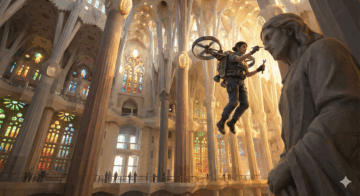 Better than a scaffolding
You are scrolling the news, half awake sipping your coffee, when you see the announcement. A startup, not quite unknown but not familiar, has a new product unveiling video. Ok, sure, another hype reel. You scroll past. But it shows up again on your socials. Everyone seems… excited? Fine. You tap the clip.
It’s a jetpack.
A person, obscured by a helmet and motorcycle leathers, straps on the sleek backpack. It doesn’t look like any jetpack you’ve ever seen and also, somehow, looks like every jetpack you’ve ever seen. The pilot grips two handles, is hovering, then flies off. The footage is real. All of it. Cool, you th…
by Kyle Munkittrick
Better than a scaffolding
You are scrolling the news, half awake sipping your coffee, when you see the announcement. A startup, not quite unknown but not familiar, has a new product unveiling video. Ok, sure, another hype reel. You scroll past. But it shows up again on your socials. Everyone seems… excited? Fine. You tap the clip.
It’s a jetpack.
A person, obscured by a helmet and motorcycle leathers, straps on the sleek backpack. It doesn’t look like any jetpack you’ve ever seen and also, somehow, looks like every jetpack you’ve ever seen. The pilot grips two handles, is hovering, then flies off. The footage is real. All of it. Cool, you think, another impressive demo for a product you can’t buy and if you could, couldn’t afford. Then you see it, just below the video, a button.
“Pre-Order Now”
Curiosity overrides your skepticism. You tap it. Deposit (refundable) is $200. Full price is twice as much as your iPhone Pro. It ships in two months.
Unbelieving, you scrutinize the website. Your vision tunnels. You rewatch the video. You read the tweets and posts and comments. You watch the commentary clips and clips of those clips. This is real. The thing works. You click all the way through, adding one to your cart.
You could buy a jetpack. You can buy a jetpack.
The world tilts. You feel vertiginous. You sit down, dizzy and unmoored. How is this thing straight from the world of not just science fiction, but a bygone and lampooned era of cartoonish Flash Gordon optimism, real? It can’t be. But it is. You live in the future. Not the cynical cyberpunk future of Blade Runner or the nihilistic ruined future of The Road, but the future we had given up for lost, the future we had decided was as impossible as Narnia or Atlantis. Tomorrow is now.
Congratulations, you just had your first bout of future vertigo.
The Mirror and the Light Cone
The NEO Home Robot from 1x caused my most recent, but not my first, bout of future vertigo—the mental dolly zoom effect that comes from the sudden realization you live inside the future you’d spent your life being told wouldn’t arrive. You can subscribe to one for the same price as a twice-a-month house cleaner. While watching the announcement from the back of a Waymo, I realized that I, me, Kyle, could subscribe to one. This wasn’t some billionaire’s toy. In a few years, most people might have one of these, just like a smartphone.
The tantalizingly faraway future was suddenly in my lap.
And here’s what makes it vertiginous: we spent decades training ourselves not to believe this was possible.
For half a century, “Where’s my jetpack?” was our generational lament. We’d accepted that the jet age would never become the space age, that the Jetsons were propaganda. So we grew up into cyberpunk—not just an aesthetic but a disposition. The future would be unevenly distributed, owned by the powerful, and probably worse than the present. This wasn’t pessimism; it was maturity.
But while we were perfecting our cynicism, the future was being built. OpenAI was founded in 2015. DARPA’s self-driving Grand Challenges were in 2005 and 2007. The first GLP-1 receptor agonist was developed in 1998. Our imaginations picked up on this—films like Her, Ex Machina, and the rediscovery of Iain M. Banks’ Culture novels were less interested in technological rupture than in the texture of living with new kinds of minds.
Now watch Her again. It doesn’t feel like a film from over a decade ago. It feels like a film set next week. The allegorical has become literal. The mirror we used to look at ourselves has become a window onto our actual street. We’d gotten very good at mourning the future. We’d accepted that the horizon was closed.
And then it blew wide open.
The Future is so Back
GLP-1 agonists are reversing obesity at scale. Solar is so cheap Africa is going solar punk. AI systems can tutor, diagnose, translate, code. These aren’t hype cycles. They’re mundane facts.
And yet we still fight it. Every breakthrough is immediately framed through risk, capture, or dystopia. We don’t have the optimism gear anymore—those muscles atrophied from decades of disuse.
The problem is neither of our inherited frameworks works. Jet-age optimism assumed technology would solve problems automatically. Cyberpunk pessimism assumed technology would inevitably be captured and corrupted. Both were fantasies. Both let us opt out of agency.
What we need instead is techno-realism: holding two truths simultaneously. The jet-age optimists weren’t wrong that great things were possible—they were wrong about the timeline and the ease. The cyberpunk pessimists weren’t wrong that technology could be used badly—they were wrong that this was inevitable.
For my entire life, and likely yours, the dominant assumption has been that the future will be worse. Climate change, institutional decay, declining fertility—you pick. The serious people talked about managing decline, not building utopia. The only moral thing we could do with the future was prevent it.
But if we can genuinely augment human capability, if we can cure diseases with an injection, then the question changes from “how do we manage decline?” to “how do we build something good?” and even “what should we build so we can do *more *good?”
And that’s terrifying in a different way. The future is a choice. Our choice. We’re responsible.
So what now?
Cathedral Time
We’re standing in the reopened frontier, handed our jetpacks, and we have no idea how to proceed. We can’t go back to jet-age optimism—we know too much about how things can go wrong. We can’t stay in cyberpunk cynicism—the future showed up anyway.
We need to think in cathedral time.
Next year, La Sagrada Família will be completed—144 years after construction began. Gaudí never expected to see his vision finished. He laid foundations for craftsmen who hadn’t been born yet. And what a gift he gave us. The architecture is still, today, among the most radical and avant-garde in existence. From within, it is one of the most beautiful structures ever created by humans. It is also where I *first *felt future vertigo.
To look up at that forest of stone, ablaze with chromatic light, and know that every detail was imagined over a century before—time telescopes. You’re inside something brand new that feels bleeding edge, imagined by someone who died before your grandparents were born. Gaudí understood his duty to the future. He knew how to think in cathedral time.
Techno-realism requires us to do the same.
Cathedral time requires patience. Whether it’s cultured meat replacing factory farms or fusion power replacing fossil fuels—these improvements we know to be good still terrify people. Society does not change overnight. Would you rather wait an extra decade for slow adoption, or face a panicked backlash, like those against GMOs or nuclear fission, that set us back half a century?
Cathedral time requires belief in progress. As technology improves, it gets cheaper, more accessible, higher quality. As society improves, it gets freer, more tolerant, creates more opportunities. This isn’t automatic—we must both believe these trends are real and recognize they require action to make it so.
Cathedral time requires trust in future generations. Whatever we start, we must trust that future generations will know best how to steer, complete, and build upon it. Making the world better is compounding, not cyclical.
Techno-realism embraces both the virtues of cathedral time and the duty to take on more duties. When we ask and answer the question “What will future generations find most morally shocking about our current era?” it’s clear that we know there are problems we ought to address, but cannot. Ought implies can. We must expand our capabilities to expand our moral frontier. Cultured meat doesn’t just solve factory farming—it creates the capacity to be the people we already know we should be. AI as an accelerator to basic science doesn’t just solve problems—it creates new moral possibilities we can’t yet imagine.
Our cathedrals will not be buildings but systems, whole techno-social architectures that move us past our present inability to live up to our moral ideals. Meat without suffering, an energy grid that runs on light—we are laying the foundations for these now, knowing we likely won’t live to see their completion.
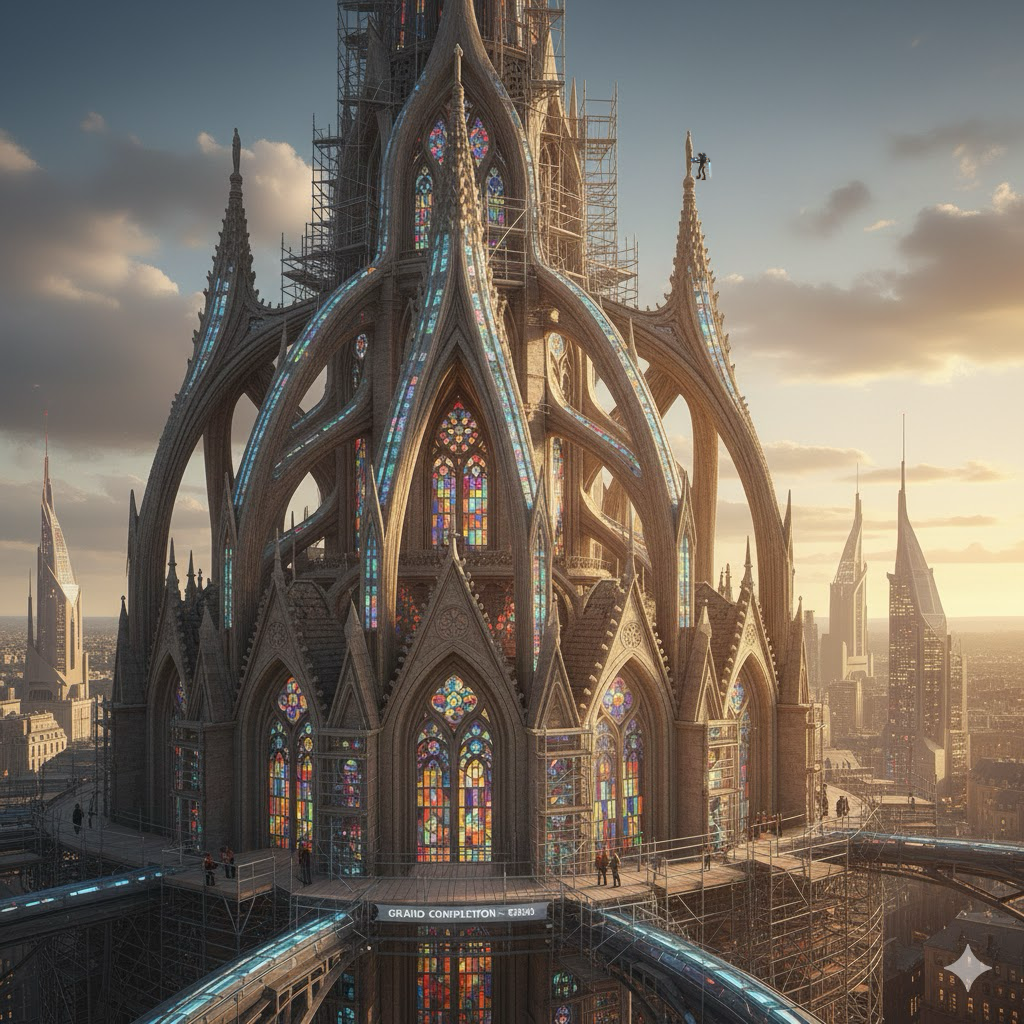 Nano Banana still doesn’t hold a candle to Gaudi
Here Is Your Jetpack
Technology is a set of tools. Tools can be used well or badly, distributed widely or hoarded, developed carefully or recklessly. The dystopian warnings remain valid. Climate change is still a crisis. AI safety is a genuine concern. The loneliness epidemic is real. But these risks aren’t inevitable. The bad future is possible. So is the good one. The choice is not made for us. We actually have to make it.
There’s a strange comfort in realizing the question was never “will the future be good or bad?” but “what are we going to build, and how long are we willing to work on it?”
Techno-realism is the recognition that we’re in a long project with mixed results, and that this is not a failure mode. It’s just what building things is actually like.
We spent fifty years mourning a future that never came. Now it’s here, messy and partial and demanding, and it needs people who are willing to work on it for longer than they’ll live.
The frontier has reopened. Our choices matter. Go build a cathedral.
***
Enjoying the content on 3QD? Help keep us going by donating now.