Falcom’s Trails series represents a truly massive epic in the making: twelve RPGs produced over the course of 20 years that tell the ongoing story of personal, political, and industrial change in a fictional world. After 20 years, the series is making the jump to its final frontier: space. Being a Trails neophyte, I struggle to gauge how longtime fans will tolerate this great leap forward—but if you’ve never picked up a Trails game before, it’s a great place to start.
© Nihon Falcom Corporation, NIS America, Inc
Make no mistake, there are two decades’ worth of lore behind this …
Falcom’s Trails series represents a truly massive epic in the making: twelve RPGs produced over the course of 20 years that tell the ongoing story of personal, political, and industrial change in a fictional world. After 20 years, the series is making the jump to its final frontier: space. Being a Trails neophyte, I struggle to gauge how longtime fans will tolerate this great leap forward—but if you’ve never picked up a Trails game before, it’s a great place to start.
© Nihon Falcom Corporation, NIS America, Inc
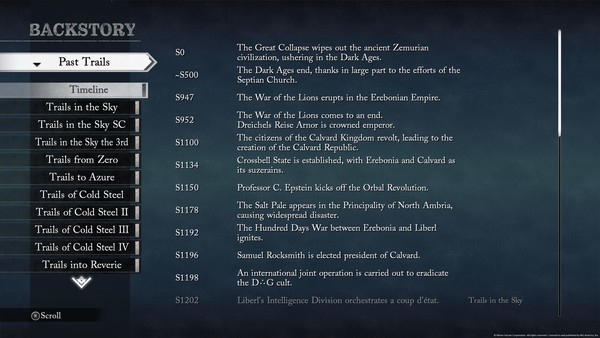
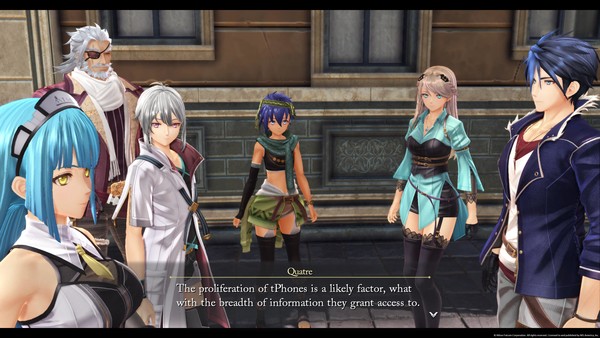
Make no mistake, there are two decades’ worth of lore behind this game, and your introductory dungeon tosses you into the deep end with not one but two parties consisting of heroes from previous games. It’s like going to a friend’s house for the holidays where everyone else has their in-jokes, and you’re just the new guy. The good news is that Falcom is aware of the possible struggles of newcomers, and affords every luxury to catch people up to speed: the main menu features a handy primer for the history of the game’s setting of the Zemurian continent and its many kingdoms and city-states (this is a world where the invention of what are basically magical-smartphones and the magic-Internet are a major focal point). There is also a primer that gives you the basic overview of all previous Trails titles, plus an in-game glossary that can be brought up at any moment to find explanations on any proper nouns being discussed in the current scene.
© Nihon Falcom Corporation, NIS America, Inc
Even if you play your games with your eyes shut, it’s pretty easy to get involved in the story of Trails Beyond the Horizon; the central conceit of an in-world Space Race capturing the attention and imagination of the continent, plus the political cloak-and-dagger that follows, is captivating in its own right. And there is plenty of scheming to unravel, from embers left over from previous in-universe wars and conflicts to plenty of organizations and secret societies vying for power. The political and ethnic landscape of Zemuria is rich and fully fleshed-out, such as with Feri and her Krugan ancestry (effectively an in-universe equivalent of Middle Eastern cultures). A major plot point early on involves terrorist organizations kidnapping immigrants, to further illustrate Falcom’s lack of hesitation in touching upon these matters. And amidst all that is the fun worldbuilding of a society that’s still getting used to magitechnology improving their daily lives. Trails Beyond the Horizon is a delight for people who appreciate worldbuilding.
© Nihon Falcom Corporation, NIS America, Inc
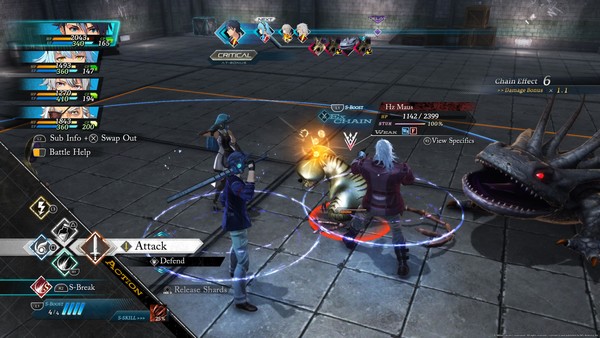
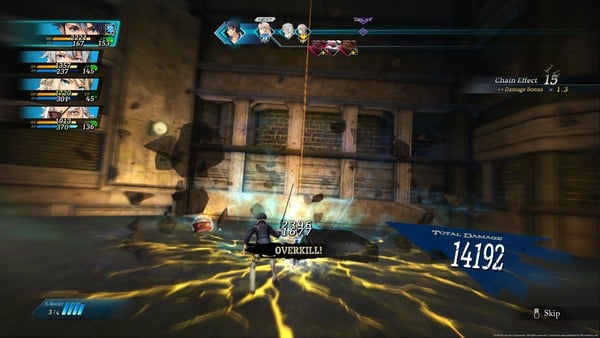
But Horizon is still an RPG, first and foremost, and it makes sure to give players plenty of mechanics to chew on. You have two battle modes to toy with: Field Battles (where players engage with enemies in real-time action-RPG combat), and Command Battles, a traditional turn-based affair where clever positioning of your units and enemies is key. Horizon has both modes play with each other, encouraging players to soften up and stun enemies through Field Battles, then deploying Command Battles once enemies are on the ropes. There are also the SBLTZ (Shard Blitz) abilities, where party members that are close enough to each other can grant each other follow-up attacks or bonuses to spells. You’ll have plenty of tools at your disposal to gain your advantages, and while all of the acronyms and proper nouns might start as confusing, they’ll quickly become fun to incorporate in all kinds of strategies. And you’ll need them because Horizons isn’t afraid to toss health sponges at you; quite early on, we discovered Corrupted enemies with inflated health meters that also regained health each turn. Neglect your character growth at your own risk.
© Nihon Falcom Corporation, NIS America, Inc
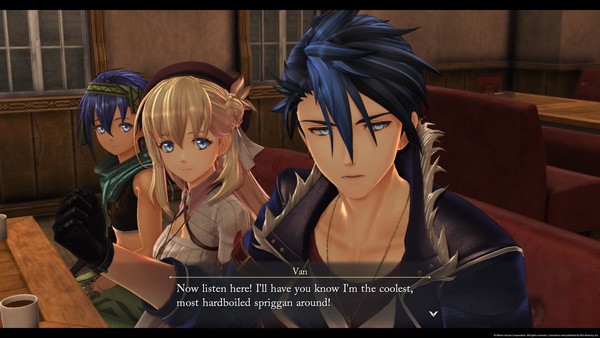
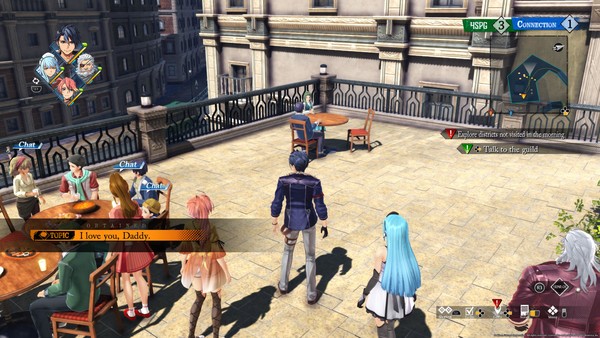
Outside of combat, you’ll have plenty of fun exploring Van’s home city, as well as carrying out his duties as a Spriggan: fulfilling requests from citizens, wandering into gang wars, or just generally keeping up with his wide social circle. There are plenty of sub-systems to enjoy, like the Gourmet system, where we can indulge Van’s sweet tooth in exchange for stat buffs. There’s even a neat Blog we can maintain to help promote local businesses. There’s a keen fishing mini-game, as needed. Players can also dip out of the main story and pursue the Grim Garten, an in-universe VR dungeon that offers tense battles and plenty of rewards. And, of course, there are your Orbments: your magic smartphones that handle your spells, sub-skills, and such, with customizable slots for extra skill boosts and even alternate faceplates that can be earned throughout the rest of the game. And if that’s not enough customization for you, there are piles of outfit components that can be found for your party members, down to alternate hair colors. If you want to dive into the deep end, you’ll find plenty to do.
© Nihon Falcom Corporation, NIS America, Inc
There are only a few matters that I could bring up to dissuade players. During my playthrough, I had the game crash on me once. I don’t know if this was the result of keeping the game open while my PS5 was resting or what; it only happened once, and I assume it’ll be rectified by Falcom’s upcoming Day 1 patch. Also, players need to be aware that an important faction in-game is called the Epstein Foundation (thankfully pronounced "Ep-stine", not "Ep-steen"). The in-game Epstein is intended to be an in-universe equivalent to Einstein, having created the widespread Orb technology while setting other plot threads in motion. My pity is extended to Falcom for the universe’s perverse sense of humor.
© Nihon Falcom Corporation, NIS America, Inc
However, one major point that makes me leery of recommending Trails Beyond the Horizon is Falcom’s recent admission of incorporating Generative AI into its workflow. How much, or how little, of it was included in Horizon is unknown; it would be a tragedy if a game that touched on so many human themes were the result of someone who couldn’t be bothered to tell their own story. Horizon is positioned as the beginning of the end for the current saga of the Trails games, and I would hope that, as such, it was made with care—not with misplaced "efficiency" above all else. I struggle to think of any longtime Trails fan who would want a machine laying the foundation for these brilliant games.
© Nihon Falcom Corporation, NIS America, Inc
Generative AI aside, Horizon is a phenomenal game, and definitely a great RPG to kick off 2026—assuming human involvement. Longtime fans can look forward to the continued stories of countless beloved characters—plus, there’s a tool in place for importing your save data from older titles, allowing for bonuses to carry over. New fans can join in and meet these characters, with little fear of missing anything too important. What a shame I didn’t pick these games up sooner.