Sidebar 3: Measurements
I measured one of the EgglestonWorks Andra 5 loudspeakers, serial number A5-88887, in Tom Fine’s listening room. Tom and I maneuvered the 159lb loudspeaker onto a small dolly, wheeled it several feet from the wall behind it, and aimed the speaker along one of his listening room’s diagonals so that it was well away from the room boundaries, apart from the floor. The speaker was driven by TF’s Benchmark AHB2 amplifier for the measurements.
I used DRA Labs’ MLSSA system with a calibrated DPA 4006 microphone to examine the EgglestonWorks speaker’s farfield behavior and dispersion at my usual 50" distance; I used an Earthworks QTC-40 mike, which h…
Sidebar 3: Measurements
I measured one of the EgglestonWorks Andra 5 loudspeakers, serial number A5-88887, in Tom Fine’s listening room. Tom and I maneuvered the 159lb loudspeaker onto a small dolly, wheeled it several feet from the wall behind it, and aimed the speaker along one of his listening room’s diagonals so that it was well away from the room boundaries, apart from the floor. The speaker was driven by TF’s Benchmark AHB2 amplifier for the measurements.
I used DRA Labs’ MLSSA system with a calibrated DPA 4006 microphone to examine the EgglestonWorks speaker’s farfield behavior and dispersion at my usual 50" distance; I used an Earthworks QTC-40 mike, which has a small ¼" diameter capsule, for the nearfield responses. I measured the Andra 5’s impedance magnitude and electrical phase angle with Dayton Audio’s DATS V2 system.
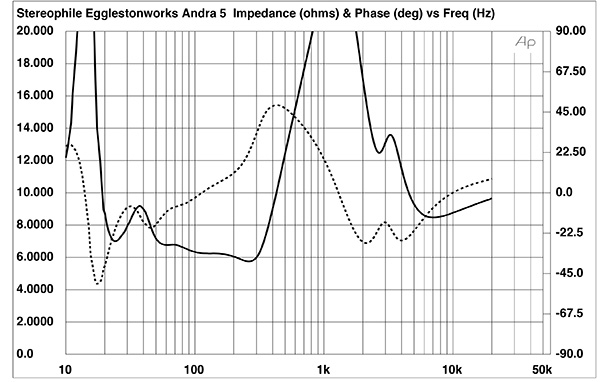
Fig.1 EgglestonWorks Andra 5, electrical impedance (solid) and phase (dashed) (2 ohms/vertical div.).
EgglestonWorks specifies the Andra 5’s anechoic sensitivity as 87.5dB; no voltage or distance is mentioned. My B-weighted estimate was within experimental error of the specified number, at 88dB(B)/2.83V/1m. Fig.1 shows the impedance magnitude (solid trace) and electrical phase angle (dashed trace). The nominal impedance is specified as 8 ohms with a minimum value of 6 ohms; the magnitude remains above 8 ohms in the midrange and treble, with a minimum value of 5.75 ohms at 265Hz. As the electrical phase angle is occasionally high, the effective resistance, or EPDR (footnote 1), drops below 4 ohms below 47Hz and between 105Hz and 512Hz. While the minimum EPDR is 2.3 ohms between 22Hz and 34Hz, the EPDR is higher than 4.6 ohms above 600Hz. The Andra 5 should be a relatively easy load for the partnering amplifier.
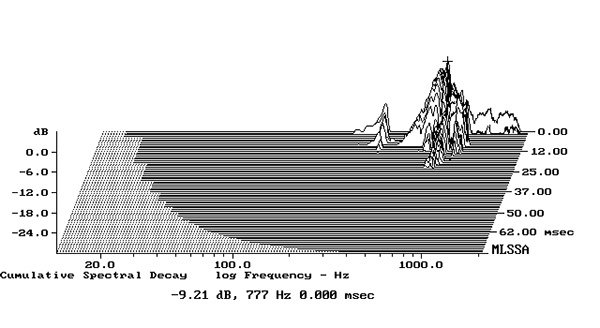
Fig.2 EgglestonWorks Andra 5, cumulative spectral-decay plot calculated from output of accelerometer fastened to center of sidewall level with lower midrange unit (measurement bandwidth, 2kHz).
The traces in fig.1 are free from the small discontinuities in the midrange that would imply the existence of cabinet resonances, and the enclosure seemed inert when I rapped its walls with my knuckles. When I investigated its vibrational behavior with a plastic-tape accelerometer, I found a cluster of resonant modes close to 777Hz, on the woofer enclosure sidewalls and the midrange enclosure sidewalls (fig.2). As these modes are high in frequency, low in level, and have a high Q (Quality Factor), it is safe to say that they won’t have audible consequences.
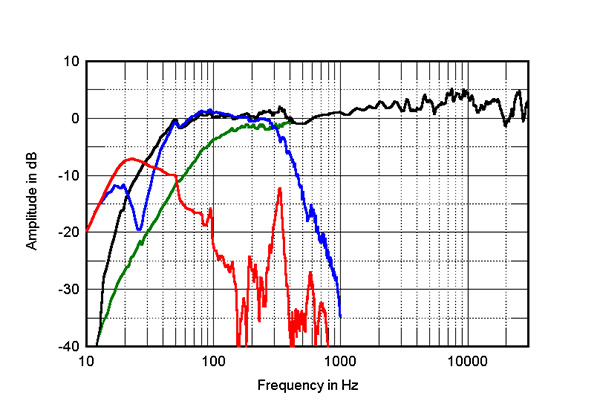
Fig.3 EgglestonWorks Andra 5, anechoic response on tweeter axis at 50", averaged across 30° horizontal window and corrected for microphone response, with the nearfield responses of the midrange units (green), woofer (blue), and port (red), and the complex sum of the nearfield responses (black), respectively plotted below 400Hz, 1kHz, 800Hz, and 400Hz.
The saddle centered at 24Hz in the magnitude trace in fig.1 indicates that the tuning frequency of the rectangular port on the rear panel that loads the woofer lies in this region. The red trace in fig.3 shows the port’s nearfield response; its output reaches its maximum at the tuning frequency, but its upper-frequency rolloff is disturbed by several resonant peaks. The highest in level is at 333Hz and is just 12dB below the level of the woofer’s nearfield response (fig.3, blue trace). The woofer’s nearfield response has the expected minimum-motion notch at the port tuning frequency and rolls off with a steep slope above 300Hz.
The woofer crosses over to the midrange units (fig.3, green trace) close to the specified 350Hz, though the midrange units’ output, measured in the nearfield, extends an octave below the crossover frequency with then a low-order high-pass rolloff. The two midrange units behaved identically. Unusually, the subenclosures that load these units are open at the rear. As expected, the output of these vents was in the opposite polarity to that of the midrange units.
The black trace below 400Hz in fig.3 shows the complex sum of the midrange, woofer, and port responses. The speaker offers extended low frequencies, but the usual boost in the bass due to the nearfield measurement (footnote 2) is absent, suggesting that the woofer’s alignment is overdamped.
The black trace above 400Hz in fig.3 shows the Andra 5’s quasi-anechoic farfield response, averaged across a 30° horizontal window centered on the tweeter axis. The EgglestonWorks speaker’s response in the midrange and treble is even, but it gently tilts up as the frequency increases and by 10kHz is 5dB higher than the midrange level. The treble response is broken up by small peaks and dips. The tweeter axis is 41" from the floor, which is a little higher than a listener’s typical ear height, which a survey Stereophile performed in the 1990s found was 36". The Andra 5’s response a few inches below the tweeter axis was identical to its response on the tweeter axis.
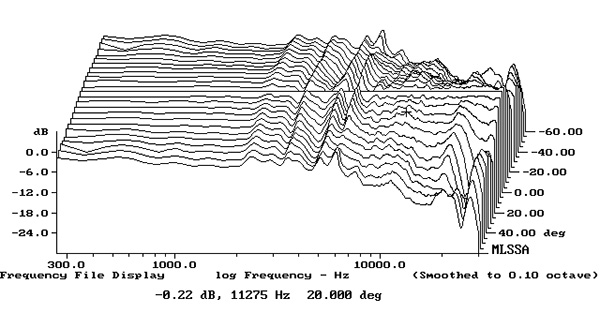
Fig.4 EgglestonWorks Andra 5, lateral response family at 50", normalized to response on tweeter axis, from back to front: differences in response 60–5° off axis, reference response, differences in response 5–60° off axis.
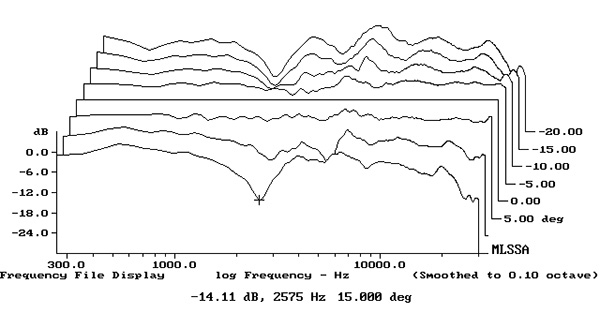
Fig.5 EgglestonWorks Andra 5, vertical response family at 50", normalized to response on tweeter axis, from back to front: differences in response 20–5° above axis, reference response, differences in response 5–15° below axis.
Fig.4 shows the Andra 5’s horizontal dispersion, normalized to the response on the tweeter axis, which thus appears as a straight line. (It wasn’t possible to measure the off-axis response more than 60° to each side of the tweeter axis in TF’s room.) The radiation pattern is generally well-controlled up to 12kHz and narrows in the top octave. However, the small peaks and dips in the on-axis response either fill in or are exaggerated to the speaker’s sides. The EgglestonWorks’s radiation pattern in the vertical plane, again normalized to the tweeter-axis response, is shown in fig.5. The loudspeaker’s response doesn’t change appreciably over a ±5° window, though a suckout in the crossover region between the outputs of the midrange units and the tweeter develops 15° below and 10° above the tweeter axis.
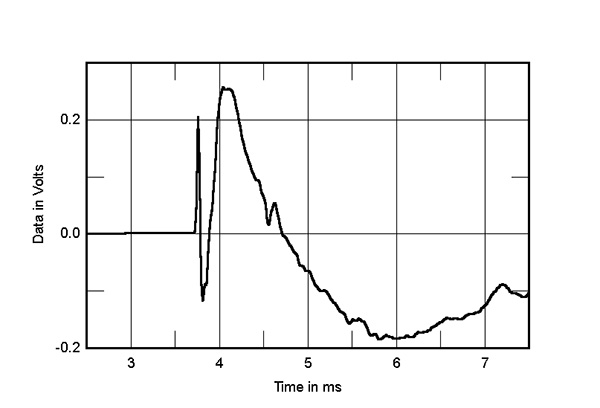
Fig.6 EgglestonWorks Andra 5, step response on tweeter axis at 50" (5ms time window, 30kHz bandwidth).
In the time domain, the Andra 5’s step response (fig.6) indicates that the tweeter and the midrange units are connected in positive acoustic polarity, the woofer in inverted polarity. The tweeter’s output arrives first at the microphone, the decay of its step blending with the start of the midrange units’ step. The decay of the midrange units’ step smoothly blends with the start of the woofers’ step, which implies an optimal crossover topology.
However, a strong inverted reflection can be seen at 4.55ms in fig.6; this is 0.85ms after the arrival of the tweeter’s output, 0.45ms after the arrival of the midrange units’ output. These time differences are equivalent to distances of 11.5" and 6.1", respectively, meaning that whatever is reflecting the sound is either 5.75" behind the tweeter or 3.05" behind the midrange units (footnote 3). (These distances are too small for this behavior to be due to the output from the midrange units’ vents on the subenclosure’s rear panel.)
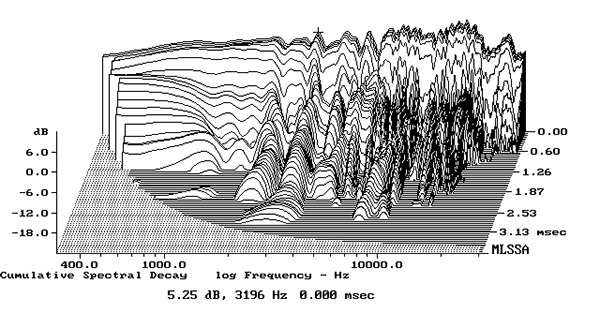
Fig.7 EgglestonWorks Andra 5, cumulative spectral-decay plot on tweeter axis at 50" (0.15ms risetime).
It is not possible to determine which drive unit was responsible for the reflection, but it results in comb filtering and decayed treble hash in the Andra 5’s cumulative spectral-decay plot (fig.7). Ridges of delayed energy are present at the frequencies of the small peaks in the low treble that are present in the on-axis response.
The EgglestonWorks Andra 5’s measured performance is enigmatic. The speaker is relatively easy to drive, offers extended low frequencies, and its overdamped woofer alignment will make it tolerant of placement near the wall behind it. However, that gently tilted-up treble response and the presence of that close reflection will make it intolerant of source components, amplifiers, and recordings that are themselves balanced on the bright side.—John Atkinson
Footnote 1: EPDR is the resistive load that gives rise to the same peak dissipation in an amplifier’s output devices as the loudspeaker. See "Audio Power Amplifiers for Loudspeaker Loads," JAES, Vol.42 No.9, September 1994, and here.
Footnote 2: A speaker that has a truly flat response in the farfield will appear to have a boosted upper-bass output with a nearfield measurement, the center frequency of that boost depending on the physical dimensions of the speaker and the woofer alignment. See here or aes2.org/publications/elibrary-page/?id=7171.
Footnote 3: In his Manufacturer’s comment, EgglestonWorks’ Jim Thompson wrote "All measurements taken during our design process were performed in an anechoic chamber, and the early reflection visible in the published data is not present in our results. While there is insufficient information to identify its source, we can state with confidence that it is neither an intentional design choice nor an oversight."

Company Info
EgglestonWorks
540 Cumberland St.
Memphis
TN 38112
answers@egglestonworks.com
(901) 525-1100