 |
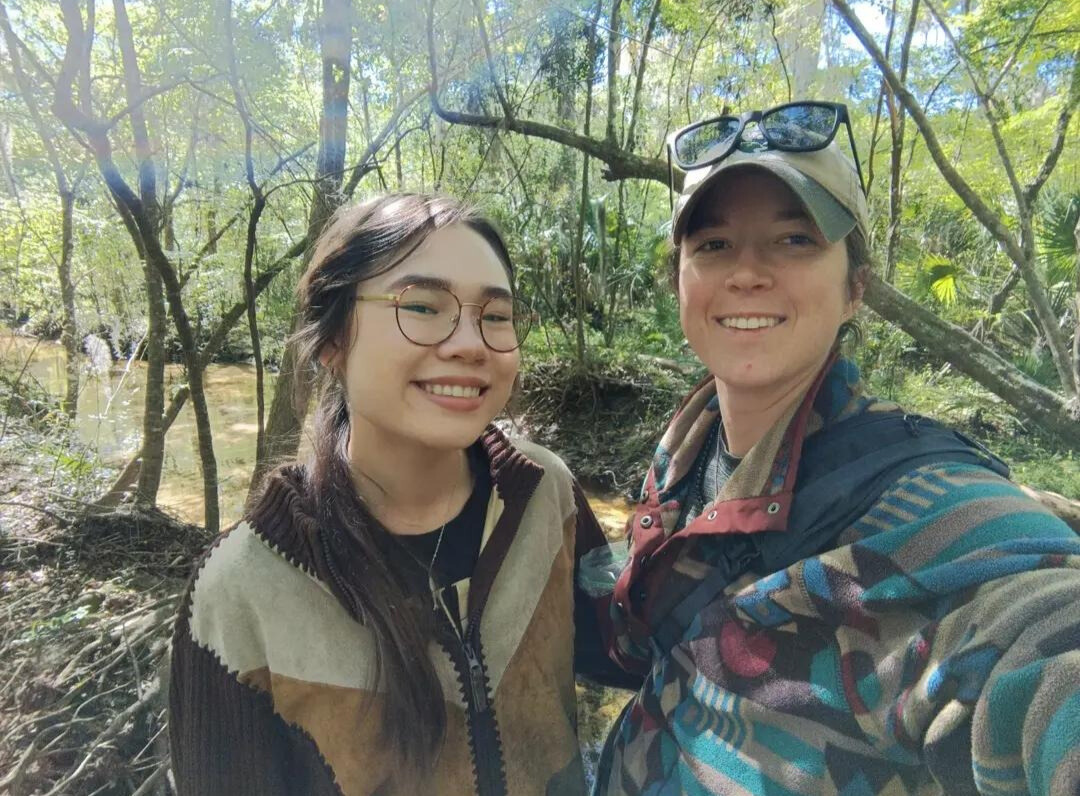
| The author with student journalist Tarryn Nichols, hiking in the woods in Gainesville, Florida, in 2025. Photo: Courtesy CD Davidson-Hiers. |
EJ Academy: Helping Students Learn the Hard Work of Journalism
By CD Davidson-Hiers
I run the Florida Student News Watch, a small nonprofit based in Florida, and our mission is to develop young writers as environmentally conscious journalists and researchers. Students can join us from anywhere in the state to cover our natural environment. We don’t need them to have a background in journalism, but we do require them to know what a fact is, to never lie and to lead with their curiosity.
Students who work with us don’t have t…
|
| The author with student journalist Tarryn Nichols, hiking in the woods in Gainesville, Florida, in 2025. Photo: Courtesy CD Davidson-Hiers. |
EJ Academy: Helping Students Learn the Hard Work of Journalism
By CD Davidson-Hiers
I run the Florida Student News Watch, a small nonprofit based in Florida, and our mission is to develop young writers as environmentally conscious journalists and researchers. Students can join us from anywhere in the state to cover our natural environment. We don’t need them to have a background in journalism, but we do require them to know what a fact is, to never lie and to lead with their curiosity.
Students who work with us don’t have to become journalists, but they will gain an appreciation, through their experiences with the News Watch, for how much effort goes into informing a community.
We pair our writers one-on-one
with professional journalists to craft
stories from pitch to publication.
As a hybrid training program and publication, we pair our writers one-on-one with professional journalists to craft stories from pitch to publication. The best part: We pay students 10 cents per word for the final published work.
We aim to train students in professional freelancing practices, which include pitching, contracting, invoicing, conducting interviews and going through (no more than three) rounds of edits with the masthead. By the end of the semester, our writers will have published at least one 800 to 1,200-word story with the News Watch.
Lessons in balancing responsibilities
Working with students requires setting reasonable expectations — for everyone. Students are creative and often fearless, and their enthusiasm is the first lesson mentors address with them, to balance their News Watch assignments with their academics and other commitments.
Students meet with their mentors at least twice per month to check in, ask questions and get help addressing any issues they’ve run up against. Our professional journalists can guide students through sourcing a story, building out interview questions and obtaining data to supplement their angle.
 |
| Program mentor and environmental reporter Max Chesnes with student Noah Bookstein in Tampa Bay, Florida. Photo: Courtesy CD Davidson-Hiers. |
By partnering students directly with our volunteer professionals, the team can determine a schedule and pace that is manageable for them and provides a valuable lesson in balancing responsibilities.
We publish enterprise stories and public records reporting, such as Annamarie Simoldoni’s look at the calls from the Florida Fish and Wildlife Conservation Commission for encounters with black bears. At the time, a bill was making its way through the legislature to renew the black bear hunt in our state.
We publish personal essays and more narrative features, such as Tarryn Nichols’ look at regenerative farming practices in central Florida. We author creative stories highlighting specific species, such as Des Lewis’ profile of a manatee.
When Florida’s legislature convenes, students keep their eyes on environmental bills and write updates on the topics they find most pressing. In March 2025, Noah Bookstein wrote a roundup of lobbying activity by environmental advocates.
After a semester with the News Watch, students can use their time in the program in applications for jobs or for graduate school. They may ask their mentors for letters of recommendation and put us down as references.
It’s one of my favorite things to brag about students to a hiring manager. I talk about their initiative, creativity, diligence and thoughtfulness. I talk to editors about the sort of person the student is and what will make them successful in the job they’ve applied for.
Partnerships help us grow, challenge our processes
We have a yearly budget of $5,000, which covers our website costs, monthly stipends for a student managing editor and student social media manager, the 10 cents-per-word rate for student stories, and various subscriptions for reporting resources (such as Canva and Otter). Last semester, we brought on eight students, who write stories ranging upwards of 800 words.
We also want to offer an in-person
convening to our students, so they
can go beyond their screens to interact
with the professionals who mentor them.
We’d love to stretch our annual budget to $10,000 so we could offer stipends to our (currently) eight mentors, increase the number of stories we can routinely publish and bring on more advisers for editorial roles. We also want to offer an in-person convening to our students, so they can go beyond their screens to interact with the professionals who mentor them.
Last year, I participated in the Center for Community News Champions program (out of the University of Vermont) to work on a fundraising strategy for the program, which we will put into practice in 2026.
We’re also forming new partnerships with publications that republish our students’ work, with credit to the News Watch. This summer, News Watch student Cameron Glymph had a story about climate change fueling a Floridian housing crisis picked up by Florida publication The Invading Sea.
Where we go from here
In 2026, the Florida Student News Watch has bold goals.
We want to offer in-person and virtual workshops to our students on journalism skills and topics in more depth, such as wading through public records requests; understanding candidate finance records; and working on practical skills, like budgeting as a freelancer.
A few years ago, we hosted a semester-long podcast, “How I Got the Story,” in which our managing editor at the time interviewed each student about their reporting process for a behind-the-scenes look at how the story came together.
If we had the funding, we could restart the podcast, which would give our participants the chance to reflect on their experiences more in depth and draw lessons from their time with the program, while adding a new medium for students interested in audio and multimedia reporting.
Our biggest goal is to host an in-person event where our writers, mentors and supporters can build new working relationships and create opportunities to publish more environmental stories in Florida. The News Watch is an excellent way for our young writers to practice their networking skills, and I hope to foster this more this year.
The News Watch has been one of my proudest accomplishments. If you are interested in our program, we would love to hear from you.
CD Davidson-Hiers is a Florida journalist. She founded the Florida Student News Watch in 2020 to give young writers professional experience in journalism. She received a fellowship in 2025 from the National Press Club to assist with her graduate studies in journalism at the University of Georgia. You can reach her at: cd.davidson.hiers@gmail.com.
SIDEBAR: Young Journalists Step Up to Climate Threat
By Jim Poyser
A former journalist, I’m now executive director at Earth Charter Indiana, where I help run various programs, such as our summer climate camps to train young people to speak to elected officials on stepping up to the climate crisis challenge.
But in late 2019, we began a new program for youth journalists. At that time, I was invited to a high school in the Indianapolis area to do a sustainability walk-through, helping students understand how they could advocate for lowering their school’s carbon footprint. A school newspaper reporter, Elizabeth, followed along the walk-through, and lo and behold, she published a story on their school newspaper platform.
I realized we could go further;
we could begin to work directly
with student journalists on solutions
journalism regarding the climate crisis.
The proverbial lightbulb ignited! The idea of republishing this story on our ECI platforms was a natural. But then I realized we could go further; we could begin to work directly with student journalists on solutions journalism regarding the climate crisis. I contacted Elizabeth, and the two of us teamed up with Angel, also an Indianapolis high school student.
The three of us created Youth Environmental Press Team. Now, we are a ten-state organization — Texas, Colorado, Nebraska, Missouri, Wisconsin, Illinois, Michigan, Indiana, Ohio and Kentucky — with high school students serving as directors, writing, editing and promoting stories about climate, but also directing the growth of the organization.
We pay those directors $1,000 per semester. Former directors have returned to intern with the press team at $18 per hour. In addition, we pay middle and high school journalists $100 for original stories, and $30 for republication rights for stories published in their school newspapers.
Suffice to say, we are growing exponentially because we are compensating young journalists at a time when it is impossible to ignore the threat to their futures. The kids are ready to meet the challenges of the climate crisis, and it’s my joyful job to support them every step of the way.
To be clear, the majority of our stories are of a more traditional, third-person nature. But the occasional first-person entreaty is welcome, especially in such an urgent time of climate disruption, climate science denial and regulation rollbacks. In this politically siloed time, we still see instances where youth voices can cut through the dichotomy to be heard.
In terms of funding, we’re fortunate at this time to have support from Earth Rising Foundation, Glick Philanthropies and the Netherleigh Fund, totaling $40K this year. More funding would mean more states, directors and most importantly, justifying more of my time spent on YEPT.
My queries to, shall we say, more traditional journalism funders have not been successful. I find plenty of funders interested in college or professional programs, but not high school. My question is, where do college and professional journalists come from? I submit it might often be high school newspapers! If you have any grant ideas or want to donate on your own, we’d be thrilled.
My goal is for YEPT to be a national program by the end of 2027. I turned 67 this year, and am still recovering from successful open heart surgery. But while my contemporaries are retiring, I’m ramping up. The opportunity to combine my two passions – journalism and climate education – is a dream come true. I submit it might be a dream come true for others. If so, I’d be glad to hear from you.
Jim Poyser, former executive director and now director of advancement for Earth Charter Indiana since 2022, is a former member of the Society of Environmental Journalists. He recalls that “as important as I found the comradeship to be, it was the annual conference that made me happiest to belong, especially the culminating dance party.”
* From the weekly news magazine SEJournal Online, Vol. 11, No. 5. Content from each new issue of SEJournal Online is available to the public via the SEJournal Online main page. Subscribe to the e-newsletter here. And see past issues of the SEJournal archived here.