Gaming is a wonderful thing. Unfortunately for many of us, work takes up our valuable time, which should be allocated to our gaming. What if there was a better way? Well, printers can print an image quickly, and receipt printers can print a lot of images. This sounds like an effective display for DOOM in a pinch. [Bringus Studios] managed to find such a printer and got the classic shooter running.
Getting the printer’s attached computer, which was only designed for printing the cost of your chicken sandwich, to run Half-Life was far from easy. [Bringus] struggled through the process of swapping operating systems from Windows 7 to Linux just to return to Windows 7 after a painful process of maintaining compatibility between 32 an…
Gaming is a wonderful thing. Unfortunately for many of us, work takes up our valuable time, which should be allocated to our gaming. What if there was a better way? Well, printers can print an image quickly, and receipt printers can print a lot of images. This sounds like an effective display for DOOM in a pinch. [Bringus Studios] managed to find such a printer and got the classic shooter running.
Getting the printer’s attached computer, which was only designed for printing the cost of your chicken sandwich, to run Half-Life was far from easy. [Bringus] struggled through the process of swapping operating systems from Windows 7 to Linux just to return to Windows 7 after a painful process of maintaining compatibility between 32 and 64 bit software. Driver issues followed through the entire process just to get anything running at all.
But we can’t play DOOM while at work on a normal screen. The printer MUST display our glorious 480p gameplay. To achieve such a workflow, [Bringus] implemented a script to print out a frame of the display, allowing for “visible gameplay”. Along with some heat issues from the nature of thermal receipts, eventually the printer displayed the glory of DOOM.
Playing games on a thermal printer might be one of the weirdest things you’ve seen today, but what if we could reverse the script a bit and create a printer from something else? Here at Hackaday, we have exactly the thing for you: a printer made from a vintage typewriter!
Continue reading “Playing DOOM On A Receipt Printer” →
Origami has become known as a miracle technique for designers. Elegant compliant mechanisms can leverage the material properties of a single geometry in ways that are sometimes stronger than those of more complicated designs. However, we don’t generally see origami used directly in 3D printed parts. [matthew lim] decided to explore this uncharted realm withvarious clever designs. You can check out the video below.
Continue reading “Origami On Another Level With 3D Printing” →
We all know that you can play DOOM on nearly anything, but what about the lesser known work being done to let other species get in on the action? For ages now, our rodent friends haven’t been able to play the 1993 masterpiece, but [Viktor Tóth] and colleagues have been working hard to fix this unfortunate oversight.
If you’ve got the feeling this isn’t the first time you’ve read about rats attempting to slay demons, it’s probably because [Victor] has been working on this mission for years now — with a previous attempt succeeding in allowing rats to navigate the DOOM landscape. Getting the rodents to actually play through the game properly has proved slightly more difficult, however.
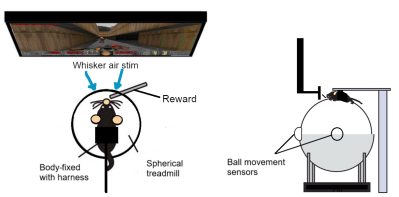
Improving on the previous attempt, V2 has the capability to allow rats to traverse through levels, be immersed in the virtual world with a panoramic screen, and take out enemies. Rewards are given to successful behaviors in the form of sugar water through a solenoid powered dispenser.
While this current system looks promising, the rats haven’t gotten too far though the game due to time constraints. But they’ve managed to travel through the levels and shoot, which is still pretty impressive for rodents.
DOOM has been an indicator of just how far we can take technology for decades. While this particular project has taken the meme into a slightly different direction, there are always surprises. You can even play DOOM in KiCad when you’re tired of using it to design PCBs.
One of the most influential inventions of the 20th century was Big Mouth Billy Bass. A celebrity bigger than the biggest politicians or richest movie stars, there’s almost nothing that could beat Billy. That is, until [Kiara] from Kiara’s Workshop built a Magikarp version of Big Mouth Billy Bass.
Sizing in at over 2 entire feet, the orange k-carp is able to dance, it is able to sing, and it is able to stun the crowd. Magikarp functions the same way as its predecessor; a small button underneath allows the show to commence. Of course, this did not come without its challenges.
Starting the project was easy, just a model found online and some Blender fun to create a basic mold. Dissecting Big Mouth Billy Bass gave direct inspiration for how to construct the new idol in terms of servos and joints. Programming wasn’t even all that much with the use of Bottango for animations. Filling the mold with the silicone filling proved to be a bit more of a challenge.
After multiple attempts with some minor variations in procedure, [Kirara] got the fish star’s skin just right. All it took was a paint job and some foam filling to get the final touches. While this wasn’t the most mechanically challenging animatronic project, we have seen our fair share of more advanced mechanics. For example, check out this animatronic that seesthrough its own eyes!
Continue reading “Magic Magikarp Makes Moves” →
Biking can be an incredibly rewarding hobby, but what do you do with all of your expensive pieces of metal and composite when you aren’t hitting the trails? They take up space that you could use for more bikes! [Chaz] figured there had to be a better way and discovered the unlikely solution of the humble garage opener.
Garage doors are made to lift high with moderate weight, exactly what one would expect from a bike lift. If you have high ceilings in your garage or wherever else you store your bikes there can’t be much easier than pushing a button to get your bike out of the way.
To assemble the unusual bike rack, [Chaz] mounted the motor to the wall with a few scraps of wood, and built a wooden platform that rides along the rail. This additional board allows you to use a traditional bike wheel rack to gently raise the bike. While initially [Chaz] had some questionable results, this was quickly resolved with removing the rotational elements of the mount and allowing a slight slant in the bike.
While not everyone may need to raise their bikes to the heavens, this type of simple hacking is always rewarding to see come together. If you want to see how some more bike specific tech works, check out the insides of this expensive bike seat!
Continue reading “Raise Bikes To The Heavens With Humble Garage Door Opener” →
Surgery is hard, there is a reason why school is so long for the profession. Making the job easier and smoother for both patients and surgeons is valuable for all parties, which is why [Mayo Clinic] is now working on including 3D printing into its more regular medicine pipeline.
Prepping for surgery often requires examining CT scans of patients to figure out, well, what they’re even going to be doing. Every body is different, and complex surgical procedures require checking to see where certain organs or features are located. This can be made much easier with a physical model of where the bones, organs, or nerves are specifically located in a patient. While this isn’t true in every case of treatment, there are even cancerous cases where custom equipment can be used to decrease side effects, such as mini-beam collimator adapters.
What if you could use the same pipeline to print what was lost from certain procedures? In a mastectomy, the breast tissue is removed, which can cause negative attention from curious gazes. So why not 3D print a custom breast? Cases like these are generally considered poor commercial investments from industry, but are relatively easy for an existing medical facility to add to treatment.
[Mayo Clinic] is far from the first to consider 3D printing in the medical setting, but seeing the technology see actual applied use rather than future seeking is exciting. Medical hacking is always exciting, and if you want to see more examples, keep sure to check out this commercially available simulator (with some free models).
In the desktop 3D printing world, we’re fortunate to have multiple online repositories of models that anyone can load up on their machine. Looking to create a similar experience but for electronic projects, [Mike Ayles] created CircuitSnips — a searchable database of ready-to-use KiCad schematics available under open source licenses.
Looking for reference designs for LiPo chargers? CircuitSnips has you covered. Want to upload your own design so others can utilize it? Even better. Currently, there are over four thousand circuits on CircuitSnips, although not all have been put there purposely. To get the project off the ground, [Mike] scraped GitHub for open source KiCad projects. While this doesn’t run afoul of the licensing, there’s a mechanism in place for anyone who wants to have their project removed from the repository.
To scrape the depths of GitHub, [Mike] had to simplify the text expression for the KiCad projects using a tool he’s since released. For anyone so inclined, he’s even put the entire site on GitHub for anyone who wants to try their hand at running it locally.
CircuitSnaps fills a very specific space to post your circuit diagrams, but if you’re looking for somewhere to host your complete designs, we can’t fail to mentionHackaday’s own repository for hardware projects and hacks!