Defining Scope, Hypotheses, and Contribution Boundaries for Clarity, Testability, and Impact in AI & ML Research

Snapshot
A thesis statement is the central claim of your dissertation or research. It articulates the core idea your entire AI/ML project is designed to test and va...
Defining Scope, Hypotheses, and Contribution Boundaries for Clarity, Testability, and Impact in AI & ML Research
Snapshot
A thesis statement is the central claim of your dissertation or research. It articulates the core idea your entire AI/ML project is designed to test and validate. It is your intellectual anchor, guiding every methodological decision and framing the contribution you aim to make to the field.
A well-crafted thesis statement does more than summarize your topic. It establishes the logic of your research. It clarifies what you believe is true, what you intend to test, and why your work matters. Many doctoral candidates struggle with this step because they either write statements that are too broad (Example — “This research explores interpretability in machine learning”) or too vague (“This project looks at improving model performance”).
The diagram below delineates the characteristics of a weak thesis compared to a strong one.
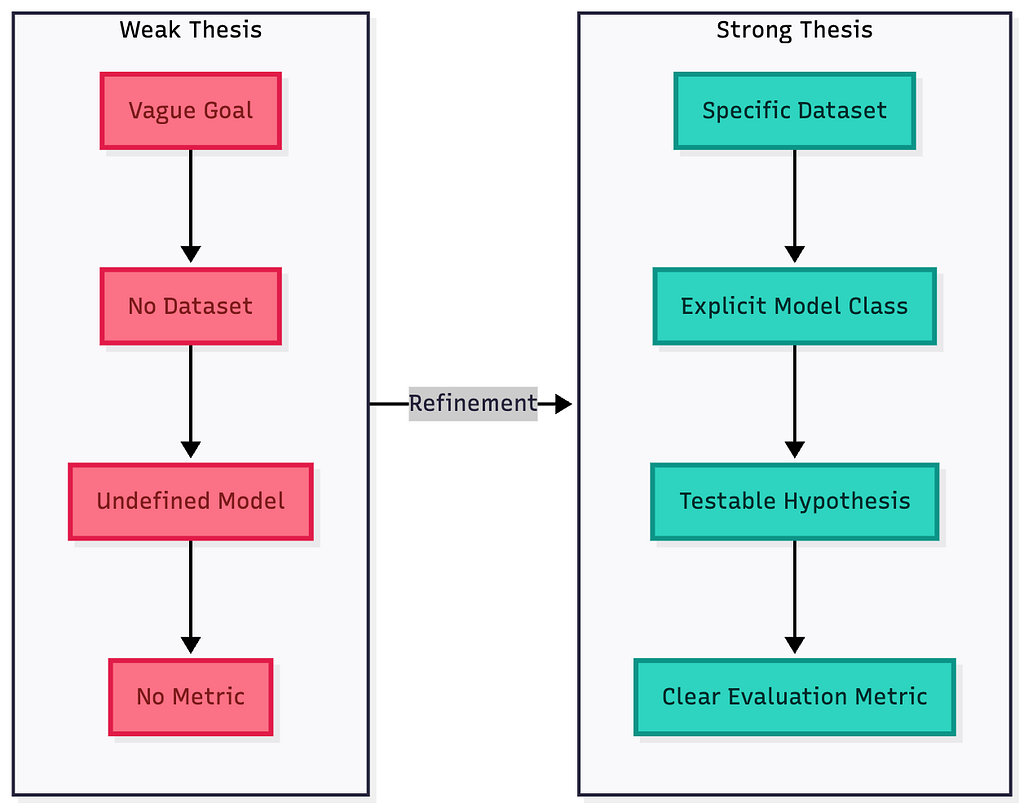
A strong thesis statement should be specific, testable, and firmly tied to a research gap in the literature. An example:
“This research investigates whether L1-regularized sparse autoencoders improve reconstruction performance on tabular clinical datasets compared to standard autoencoders.”
Before defining scope or contribution, a thesis must articulate testable claims — which is why hypothesis formulation is the logical first step. Also your claim must be falsifiable. If not then it is not a thesis. To make your thesis actionable and defensible, it is helpful to understand how it interacts with other key research elements:
- Hypotheses : These are testable statements derived from your thesis. The alternative hypothesis (H1) expresses the expected effect, while the null hypothesis (H0) asserts no effect. Hypotheses define the experiments or analyses that can support or refute your claim.
- Scope: Scope defines where and how your thesis applies — the models, datasets, domains, and metrics included. It ensures your research remains feasible, rigorous, and focused.
- Delimitations: These are intentional exclusions — aspects you decide not to study due to practical or methodological constraints. Delimitations help reviewers understand the boundaries of your research and prevent misinterpretation.
- Contribution Boundaries: Your thesis implicitly or explicitly defines what your work adds to the field. Contributions can be algorithmic, empirical, theoretical, methodological, or applied. Clear boundaries prevent over claiming and clarify the intellectual value of your work.
Your thesis claim should be falsifiable. If not, it isn’t a thesis.
In this article, we explore how to craft hypotheses, define scope and delimitations, and clarify contribution boundaries, showing how all of these elements integrate to form a credible thesis statement. Understanding how your thesis interacts with these research components, allows for designing research that is meaningful and manageable, giving your work the needed clarity and impact from the jump.
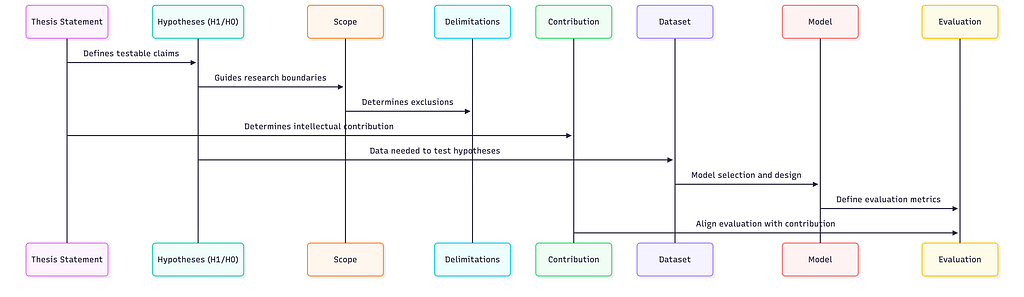
The Thesis Statement is the claim being made
Hypotheses are how you test the claim
Scope is where or how the claim is valid
Your contribution is why the claim matters to the field
Hypothesis Formulation: Building H1 and H0
A strong thesis statement in AI/ML almost always includes a hypothesis: which is a provisional claim you intend to support or reject with evidence. The hypothesis is the backbone of your methodology because it defines the relationship you aim to test. Most research uses two complementary components: the alternative hypothesis (H1) and the null hypothesis (H0). You could have multiple of this pair for your research (H1, H2, H3 . . . ) depending on scope.
The alternative hypothesis (H1) is the statement you believe will be supported. It represents the expected effect or relationship in your study. For example, in an AI-generated text detection research project, H1 might be: “A curvature-based detection method (inspired by DetectGPT) will outperform traditional perplexity-based detectors under paraphrasing attacks by . . .” This assumes an expected direction of improvement.
The hypothesis is the backbone of your methodology because it defines the relationship you aim to test
The null hypothesis (H0) is the opposite: it states there is no effect, no improvement, or no detectable relationship. A well-formulated null hypothesis would be: “A curvature-based detection method performs no better than existing perplexity-based detectors under paraphrasing transformations.” The key is that H0 must be testable. You must be able to reject or fail to reject it based on experimental evidence.
In AI/ML, hypotheses typically fall into three categories:
- Performance hypotheses — claiming improvements in accuracy, robustness, or generalization.
- Behavioral hypotheses — asserting differences in how models act under stressors, perturbations, or distribution shifts.
- Structural hypotheses — claiming that a new architecture, representation, or training strategy provides qualitative benefits (e.g., interpretability or efficiency).
Clear hypotheses push you toward concrete evaluation metrics, well-chosen baselines, and reproducible experiments. A thesis without hypotheses often becomes descriptive rather than analytical.
Defining Scope: What Your Research Will Cover
Scope refers to the boundaries of your research in terms of concepts, models, datasets, and methods. Defining scope is important because it prevents your thesis from becoming unmanageably broad — a common risk in fast-moving fields like AI/ML. Scope is not about limiting ambition; it is about designing a project that is achievable, rigorous, and defensible.
For example, suppose you are studying interpretability methods for large language models. Your scope might specify that you will focus only on transformer-based architectures between 7B and 13B parameters, using English-language corpora and analyzing token-level attribution methods. This scope is clear and reasonable. It signals to the reader what is included in your inquiry and prepares them for the methodological choices you will make later.
Defining scope is essential because it prevents your thesis from becoming unmanageably broad — a common risk in fast-moving fields like AI/ML.
Strong scope statements often include:
- The specific models or techniques being studied (e.g., sparse autoencoders, RNNs, diffusion models)
- The domain or application area (e.g., medical NLP, autonomous driving, cybersecurity)
- The datasets or types of data (e.g., tabular clinical data, synthetic benchmarks, conversational text)
- The metrics or evaluation frameworks (e.g., MAUVE, F1, calibration error, computational efficiency)
Defining scope early fosters clarity, accountability, and academic focus.
Delimitations: What Your Research Will Not Cover
Unlike scope, delimitations are intentional limits set by the researcher. These are areas you choose not to explore because they fall outside your research goals, resources, time constraints, or methodological focus— even if they are relevant. Delimitations demonstrate maturity: they show reviewers and committees that you understand the complexity of your topic and have made thoughtful decisions about what is feasible.
For example, imagine a student working on adversarial robustness of graph neural networks. They might delimit the study by excluding non-graph models, multimodal datasets, cross-architecture transfer attacks, or physical-world adversarial scenarios. These are all meaningful directions, but excluding them keeps the research manageable and properly focused.
Common delimitations in AI/ML include:
- Excluding larger model scales due to compute constraints.
- Focusing only on certain types of attacks, metrics, or benchmarks.
- Studying performance in simulation environments rather than real deployment.
- Limiting data domains due to privacy, licensing, or availability.
- Avoiding certain theoretical analyses because the study is primarily empirical.
When expressed clearly, delimitations protect the researcher from reviewer criticism and help situate the contribution without overstating its generality.
Contribution Boundaries: Clarifying What Your Thesis Adds
A thesis statement not only introduces your claim — it also implies the type of contribution you are making. Contribution boundaries define the intellectual territory your work occupies and prevent claims that are too broad or unrealistic.
In AI/ML, contributions typically fall into five categories:
- Algorithmic contribution: proposing a novel model or training method.
- Empirical contribution: providing new evidence, experiments, or evaluations.
- Theoretical contribution: deriving proofs, bounds, or formal analyses.
- Methodological contribution: designing new benchmarks, datasets, or evaluation frameworks.
- Applied contribution: developing solutions for a specific real-world context.

A strong thesis statement implicitly or explicitly identifies which of these contributions your work targets. It also sets boundaries by declaring what you are not trying to contribute.
For instance, if your thesis focuses on improving scalability of sparse autoencoders for interpretability, you may explicitly state that the contribution is algorithmic and empirical, not theoretical. You might also clarify that you are not introducing new generalization bounds or competing directly with full mechanistic interpretability pipelines. These boundaries protect your thesis from being misinterpreted as over reaching.
Ultimately, contribution boundaries articulate the value of your work while maintaining intellectual humility — a crucial trait in doctoral research.
Final Thoughts
A strong thesis statement is not simply a description of your topic — it is a precise claim, supported by a clear hypothesis, bounded by realistic scope and delimitations, and grounded in a contribution that advances the field. You might also wonder when should you craft a thesis in the research process? The diagram below walks through an ideal sequence.
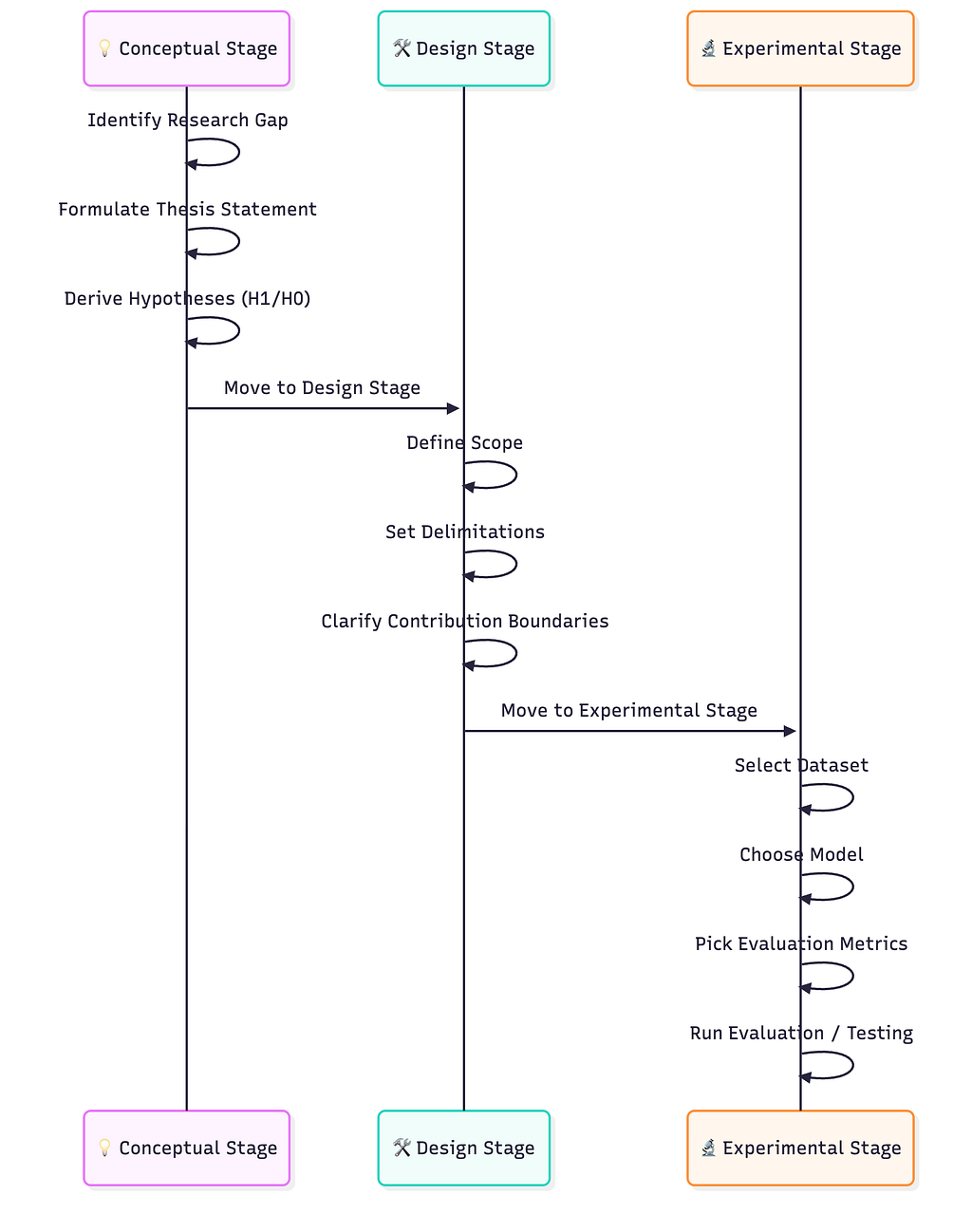
The process of crafting such a statement forces you to think critically about what you are testing, how you will evaluate it, and where your work fits within the broader AI/ML ecosystem. Mastering hypothesis formulation and thoughtfully defining the limits of your study, helps create a thesis that is credible, manageable, and aligned with top research and doctoral level expectations.
A strong thesis statement is not just a component of your dissertation — it is the foundation upon which rigorous, meaningful AI research is built.
How to Craft a Strong AI/ML Thesis Statement was originally published in Towards AI on Medium, where people are continuing the conversation by highlighting and responding to this story.