At CES 2026, NVIDIA finally revealed its long-awaited lineup of first-generation G-SYNC Pulsar monitors—and one of them is the MSI MPG 272QRF X36. Like the other new monitors revealed at NVIDIA’s conference, the MSI MPG 272QRF X36 is a 27-inch Rapid IPS monitor in 2560×1440 resolution, with full G-SYNC support up to 360 Hz. Where things get truly mind-boggling is the "Pulsar" part, though—something that NVIDIA claims can provide motion clarity akin to 1000 Hz on a 360 Hz display.
While the exact quantification is complex and requires specialized testing, early hands-on impressions of the technology have been profoundly positive, and the science b…
At CES 2026, NVIDIA finally revealed its long-awaited lineup of first-generation G-SYNC Pulsar monitors—and one of them is the MSI MPG 272QRF X36. Like the other new monitors revealed at NVIDIA’s conference, the MSI MPG 272QRF X36 is a 27-inch Rapid IPS monitor in 2560×1440 resolution, with full G-SYNC support up to 360 Hz. Where things get truly mind-boggling is the "Pulsar" part, though—something that NVIDIA claims can provide motion clarity akin to 1000 Hz on a 360 Hz display.
While the exact quantification is complex and requires specialized testing, early hands-on impressions of the technology have been profoundly positive, and the science behind it actually makes a lot of sense—especially to those familiar with CRTs and modern techniques like BFI (Black Frame Insertion) or ULMB (Ultra Low Motion Blur).
For those who may not know, a long-established key weakness of modern flat display panels is that they are "sample-and-hold" displays. Unlike a CRT, which displayed each frame for a fraction of a second before the phosphors decayed, LCDs and OLEDs display an image continuously until the monitor refreshes to a new image. This fools our brain into seeing it as a continuous image instead of a series of images. While that might sound like a good thing, the end result is that it becomes blurred, as if you were moving your head during the capture.
For gamers, this was actually the biggest loss with the pivot to HDTVs & flat screen monitors from CRTs. While CRTs were interlaced, bulky behemoths, they also had perfect motion clarity, pixel response time, and zero input lag, not to mention their ability to display many resolutions "natively." That’s why even signals in sub-SD resolutions (like the Super NES’ 256x224) could still look remarkably good on a CRT TV, but would be obviously blown-up and blurry on a flatscreen—at least, without the use of integer scaling, which is a relatively novel feature.
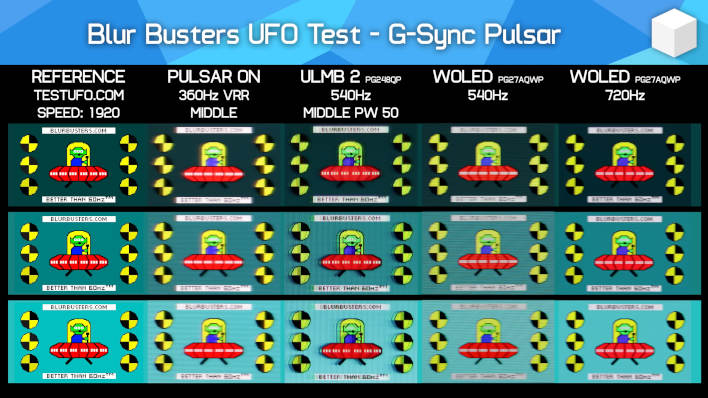 Image Credit: Monitors Unboxed on YouTube
The introduction of G-SYNC Pulsar does not address pixel scaling, but provides what is being reported as the clearest motion clarity since CRT displays. Previously, this crown was held by OLEDs, but early testing indicates that at least when compared to OLEDs at the same refresh rate, G-SYNC Pulsar is genuinely much clearer. As Hardware Unboxed notes, in their testing, they consider OLED to offer a motion clarity boost of approximately 1.5x compared to standard LCD, but G-SYNC Pulsar achieves approximately 4x the motion clarity at a given refresh rate. Of course, an OLED with BFI would be even better, but you will miss out on the variable refresh rate smoothness provided by NVIDIA’s G-SYNC, and that’s the beauty of G-SYNC Pulsar—no compromises, best of both worlds.
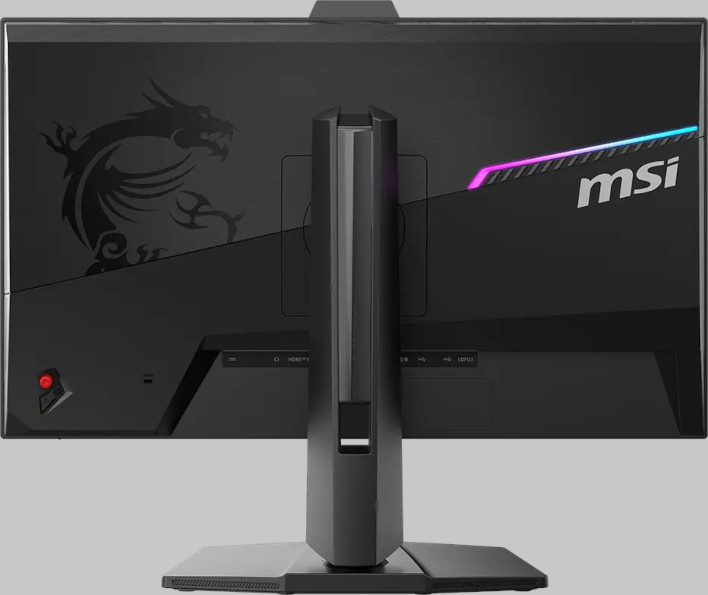
With that information in mind, the MSI MPG 272QRF for just $649.99 (from MSI) actually does begin sounding like a good deal. If gaming is your #1 concern, particularly as an eSports player, G-Sync Pulsar is the new state of the art. Added features like G-Sync Ambient Adaptive Technology (using a light sensor to adjust brightness according to your surroundings—YMMV), HDR10 up to 500 nits and 91% Adobe RGB colorspace coverage also sweeten the pot. There’s also a "25 mode" that shrinks the visual screen size for scaling-free reproduction of resolutions like 2368 x 1332 or 1920 x 1080 at 16:9 or even 1280 x 960 at 4:3, which should prove useful for retro gaming or squeezing yet more performance out of high-demand games.

Christopher Harper is a tech writer with over a decade of experience writing how-tos and news. Off work, he stays sharp with gym time & stylish action games.