still low drag
Starting at $47,250, Mercedes’ new electric sedan is quite compelling.
The 2026 Mercedes-Benz CLA 250+ is the brand’s latest—and cheapest—electric vehicle. Credit: Jonathan Gitlin
The 2026 Mercedes-Benz CLA 250+ is the brand’s latest—and cheapest—electric vehicle. Credit: Jonathan Gitlin
SAN FRANCISCO—Automakers are starting to follow somewhat familiar paths as they continue their journeys to electrification. Electric vehicles are, at first, strange new tech, and usually look like it. Mercedes-Benz’s EQS and EQE are good examples—with bodies that loo…
still low drag
Starting at $47,250, Mercedes’ new electric sedan is quite compelling.
The 2026 Mercedes-Benz CLA 250+ is the brand’s latest—and cheapest—electric vehicle. Credit: Jonathan Gitlin
The 2026 Mercedes-Benz CLA 250+ is the brand’s latest—and cheapest—electric vehicle. Credit: Jonathan Gitlin
SAN FRANCISCO—Automakers are starting to follow somewhat familiar paths as they continue their journeys to electrification. Electric vehicles are, at first, strange new tech, and usually look like it. Mercedes-Benz’s EQS and EQE are good examples—with bodies that look like bars of soap worn down in the shower, they stood out. For early adopters and trailblazers that might be fine, but you need to sell cars to normal people if you want to survive, and that means making EVs more normal. Which is what Mercedes did with its newest one, the all-electric CLA.
The normal looks belie the amount of new technology that Mercedes has packed into the CLA, though. The car sticks to the four-door coupe look that the company pioneered a couple of decades ago, but there’s a thoroughly modern electric powertrain connected to the wheels, run by four powerful networked computers. And yes, there’s AI. (For the pedants, “coupe” means cut down, not two-door, so the name is accurate.)
The CLA is the first of a new series of Mercedes that will use the same modular architecture, and interestingly, it’s powertrain agnostic—a hybrid CLA is coming in time, too. But first the battery EV, which makes good use of some technology Mercedes developed for the EQXX concept car.
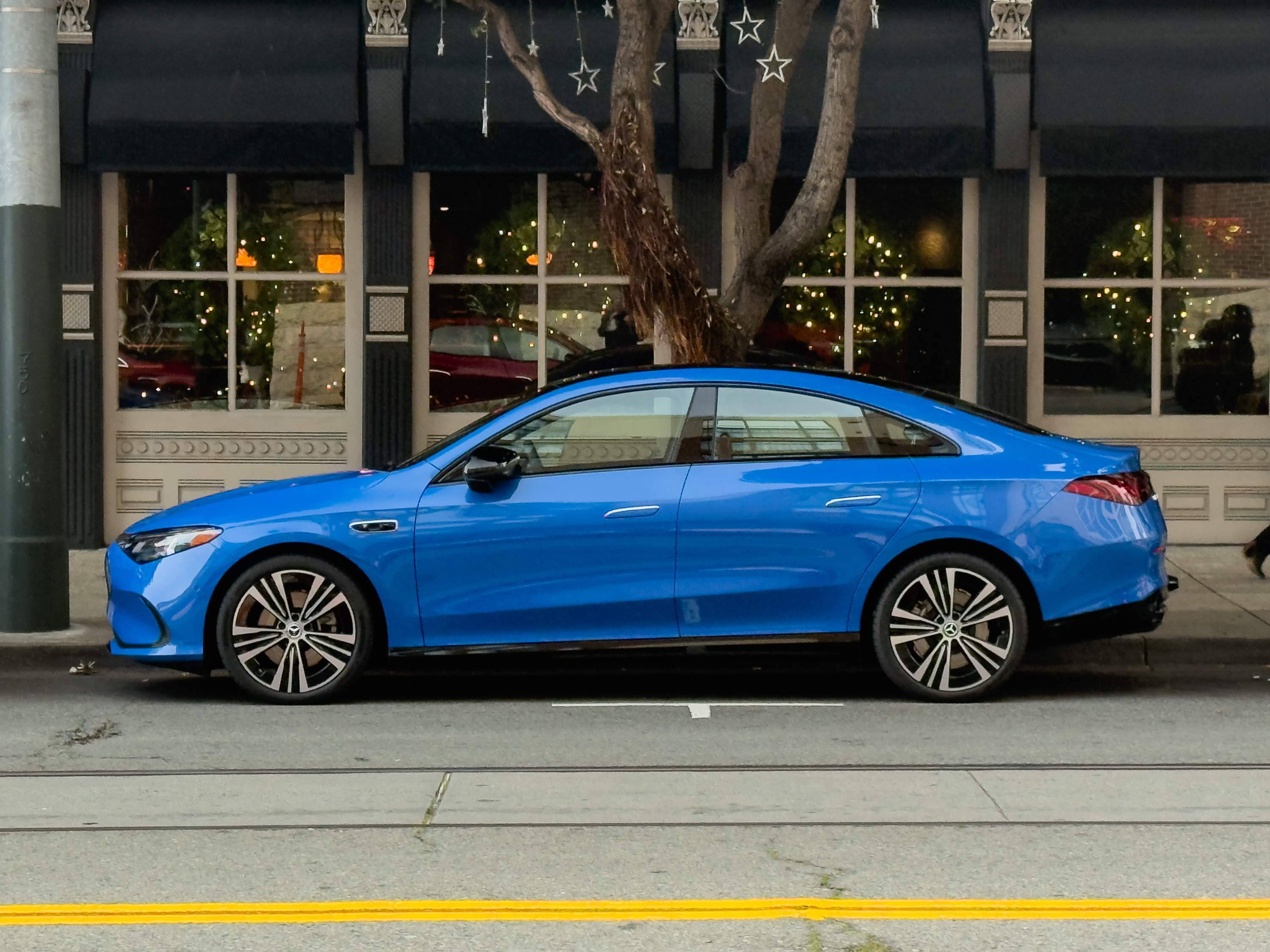
At 185.9 inches (4,722 mm) long, 73 inches (1,854 mm) wide, and 57.8 inches (1,468 mm) tall, it’s not a particularly big car. In addition to the trunk, there’s a small frunk up front. Credit: Jonathan Gitlin
That creation was capable of about 750 miles (1,207 km) on a single charge, but it was handbuilt and lacked working rear doors or an actual back seat. The CLA manages as much as 374 miles on a full charge of its 85 kWh (useable) battery pack, although as ever this decreases a little as you fit larger wheels.
But Mercedes has been restrained in this regard, eschewing that terrible trend for larger and larger wheels. Designers use that trick to hide the size of their SUVs, but the relatively diminutive size of the CLA needs no such visual trickery, and the rims range from 17–19 inches and no larger. Smaller wheels make less drag, and even though the CLA doesn’t look like it has been rubbed smooth, its drag coefficient of 0.21 says otherwise.
On the road
The version we tested, the CLA 250+, is not a particularly fast car. It uses a single motor driving the rear wheels, which generates 268 hp (200 kW) and 247 lb-ft (335 Nm), but which also has to get the car’s 4,553-lb (2,065 kg) curb weight moving. From a standstill in sport mode, it takes 6.6 seconds to reach 60 mph. Acceleration is perfectly adequate for day-to-day driving, but you won’t find that traditional EV “punch in the back” feeling when you floor it. Top speed is 130 mph (210 km/h), aided by a two-speed transmission for the rear drive unit.
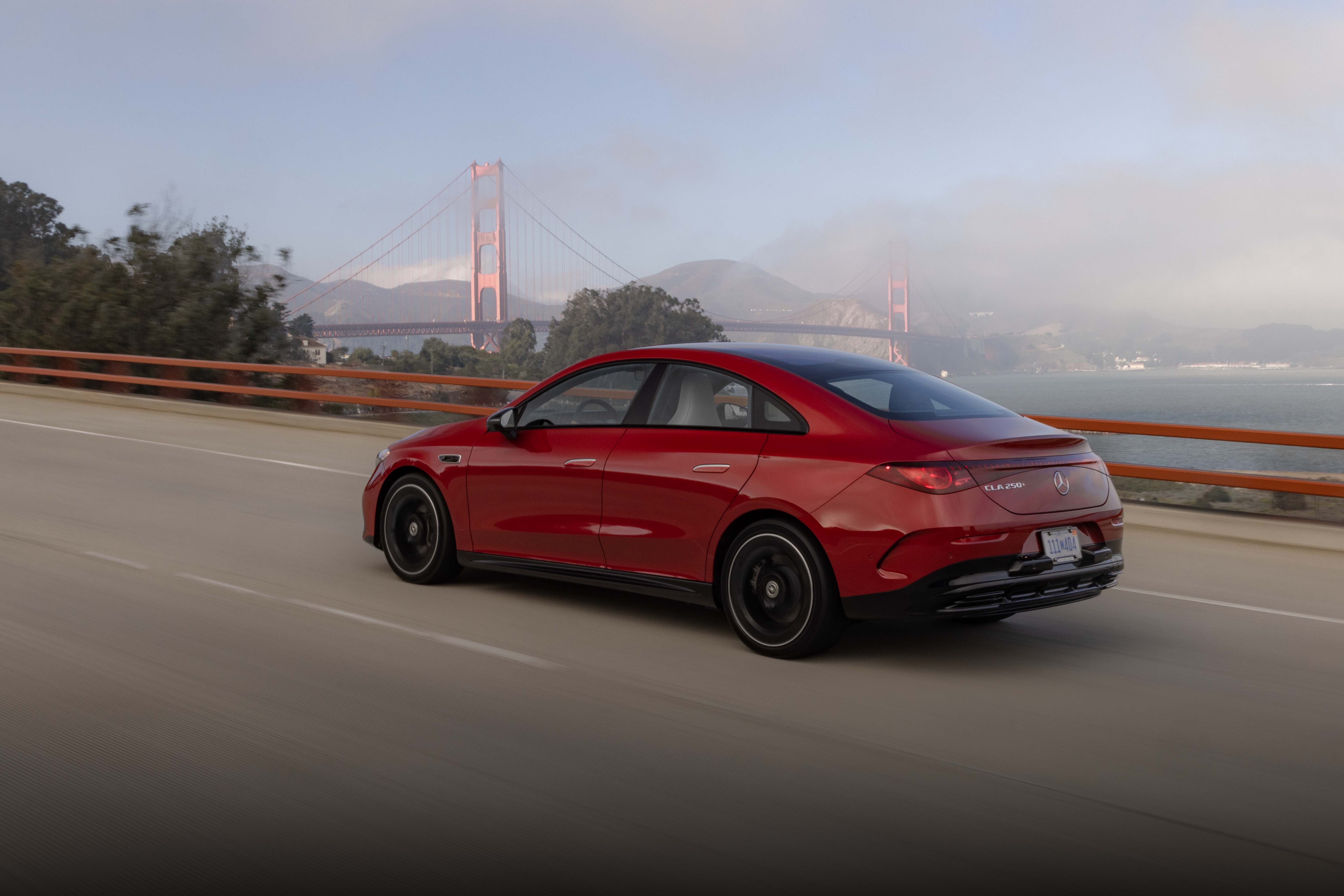
The CLA should be future proof for a while, with regular OS updates. Credit: Mercedes-Benz
The firmness of the suspension makes sense in light of that curb weight. It is relatively stiffly sprung, transmitting shocks from potholes and the like into the cabin. The steering is precise and well-weighted, and the pedal mapping was intuitive in the various drive modes and with different levels of lift-off regenerative braking. In the CLA you toggle those levels with the same stalk that you use to select drive or reverse (forward and back instead of up and down), which feels like a bit of an improvement on other control paradigms.
And I am thrilled to report that when you are in the high and intelligent regen settings, the brake pedal no longer moves by itself as the car decelerates. (Now it’s just you, Nissan.) With lift-off regen turned off, the CLA coasts extremely well, as we’ve come to expect from German EVs.
Speaking of Nissan, the CLA and the new Nissan Leaf do share something in common: they both have a J1772 port for AC charging, and a NACS port for DC fast charging. In the CLA’s case, that can peak at 320 kW and charge the battery pack from 10–80 percent in 22 minutes.
In addition to the trunk at the back (14.3 cubic feet/405 L) there’s also a 2.5 cubic foot (71 L) frunk at the front. Jonathan Gitlin
Software-defined
The CLA is one of a new breed of software-defined vehicles and debuts Mercedes’ latest MB.OS operating system. One of the four domain controller computers is tasked with the driver assists, and another handles infotainment, which is now the newest version of MBUX. This now contains AI from both Google and Microsoft built into the onboard personal assistant and responds well to natural language inputs, something that is becoming unfortunately less and less true of cars from rival OEMs. While its AI was occasionally stumped when questioned, if you get in an CLA, ask it the meaning of life. Adaptive cruise control and lane keeping is standard, and competent, with a camera-based driver monitoring system making sure you keep your eyes on the road if your hands aren’t on the wheel.
The infotainment and powertrain computers talk to each other, the former providing route information—traffic, topography, weather, and so on—to the latter, which can use it in the intelligent regen setting to maximize efficiency. Google provides map data points of interest, but Mercedes adds its own layers of data, including realtime parking and charger status, topography, and car integration. That requires connectivity, though, which isn’t always guaranteed; on our test route around the Bay Area, the car lost its data signal for around 10 minutes, which confused the navigation until a connection was restored.
The CLA interior manages to feel less lightweight than the more expensive EQS and EQE, although there’s extensive use of recycled plastics and other secondary materials that Mercedes says have helped it reduce the car’s carbon impact by 40 percent. I’m still not much of a fan of the “Superscreen,” which sets the driver display and a central infotainment touchscreen and a third passenger touchscreen under a single sheet of glass, but it’s also confined to the most expensive trim. The displays are bright and responsive, with a variety of UIs for the driver display and a “zero-layer” UI for the infotainment that is easier to use than the somewhat busy graphics might suggest. Apple CarPlay and Android Auto are also onboard, and there are wireless charging pads and four 100 W USB-C ports for personal devices.
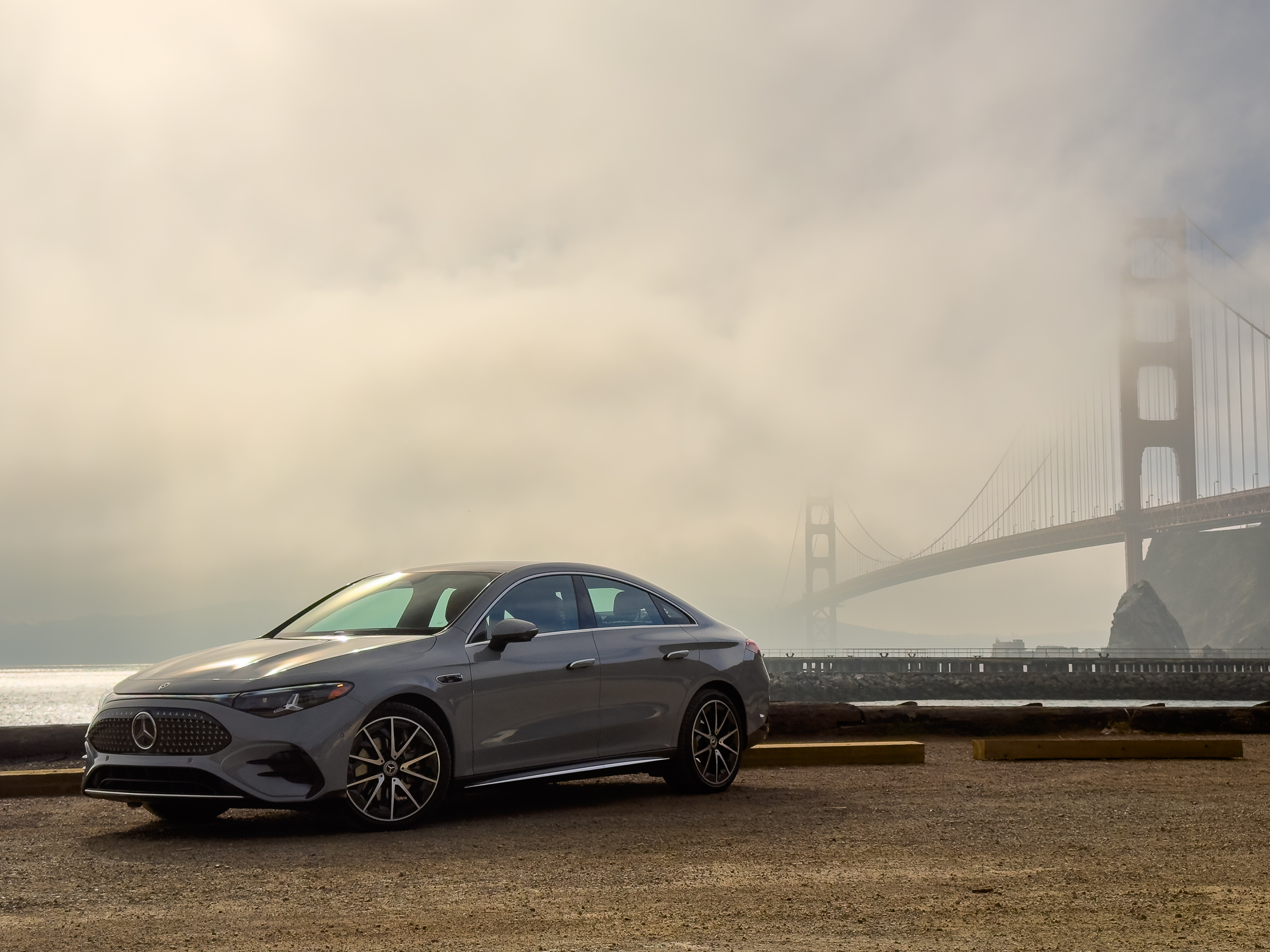
Now I’m very interested to try the hybrid version of this car in a year or two. Credit: Jonathan Gitlin
In addition to making the CLA feel like a normal car, Mercedes appears to have priced it like one, too. The CLA 250+ starts at just $47,250, which sounds like a lot until you remember it’s 2025 and the average new car price topped $50,000 a while ago. At that price, this is a rather competitive electric sedan.
Jonathan is the Automotive Editor at Ars Technica. He has a BSc and PhD in Pharmacology. In 2014 he decided to indulge his lifelong passion for the car by leaving the National Human Genome Research Institute and launching Ars Technica’s automotive coverage. He lives in Washington, DC.