U G L Y it ain’t got an alibi
It drives fine, but the first hybrid Forester is not without its flaws.
A flat four engine joins up with two electric motors and a 1.1 kWh battery to create a hybrid Subaru Forester. Credit: Jonathan Gitlin
A flat four engine joins up with two electric motors and a 1.1 kWh battery to create a hybrid Subaru Forester. Credit: Jonathan Gitlin
Although many of us associate it with rally-derived machinery from the late 1990s and early 2000s, these days, Subaru has mostly abandoned its performance cars to concentrate on its true calling—rugged, all-wheel-drive vehicles that are high on practicality, powered by horizontally opposed “boxer” engines. One area where the brand has never particularly excelled has been fuel efficiency, which is where today’s test…
U G L Y it ain’t got an alibi
It drives fine, but the first hybrid Forester is not without its flaws.
A flat four engine joins up with two electric motors and a 1.1 kWh battery to create a hybrid Subaru Forester. Credit: Jonathan Gitlin
A flat four engine joins up with two electric motors and a 1.1 kWh battery to create a hybrid Subaru Forester. Credit: Jonathan Gitlin
Although many of us associate it with rally-derived machinery from the late 1990s and early 2000s, these days, Subaru has mostly abandoned its performance cars to concentrate on its true calling—rugged, all-wheel-drive vehicles that are high on practicality, powered by horizontally opposed “boxer” engines. One area where the brand has never particularly excelled has been fuel efficiency, which is where today’s test car, the Subaru Forester Hybrid, comes in.
The last time Ars reviewed a Subaru Forester, it left us impressed. How about one with 40 percent better economy, in that case? Now, the 2.5 L flat-four engine operates on the Atkinson/Miller cycle, which generates 162 hp (121 kW) and 154 lb-ft (208 Nm). There’s an electric motor-generator starter and an electric traction motor with 118 hp (88 kW) and 199 lb-ft (270 Nm) that work together to send a combined 194 hp (145 kW) to all four wheels via a symmetrical all-wheel drive system and a planetary continuously variable transmission.
The Forester Hybrid is 183.3 inches (4,656 mm) long, 70.2 inches (1,783 mm) wide, and 68.1 inches (1,729 mm) tall, with a 105.1-inch (2,670 mm) wheelbase. Jonathan Gitlin
If that sounds vaguely familiar, that’s because it’s the same powertrain that Subaru has also fitted to the smaller Crosstrek Hybrid that we drove in September.
The 14 hp (10 kW) bump over the non-hybrid Forester is little enough that it probably won’t be noticed, but a combined EPA fuel efficiency of 35 mpg (6.7 L/100 km) is a meaningful increase over the unelectrified Forester’s 29 mpg (8.1 L/100 km). In practice, I struggled to exceed 31 mpg (7.6 L/100 km) during my week with the Forester, although as you’ll note from the temperatures displayed on the dash, winter temperatures have arrived, and we all know the cold makes all vehicles less efficient, not just EVs.
Driving a CVT hybrid can often feel disconcerting. Sometimes you press the accelerator and the car decides that electric propulsion will suffice; other times, the engine will rev with a non-linear relationship to the power being delivered at the wheels, as internal combustion tops up lithium-ion and then sends electrons to a motor to make the car go. Like all Atkinson cycle engines, it doesn’t sound very mellifluous when worked hard.
The rest of the driving experience was quite pleasant. The Forester Hybrid rides well on tires that have plenty of sidewall, and the 8.7-inches (221 mm) of ground clearance gives plenty of room for suspension travel. While it doesn’t handle like a WRX (or my dear departed Saab 9-2x), driving the Forester is no real chore. Other than the engine and some wind noise, it’s mostly refined on the move.
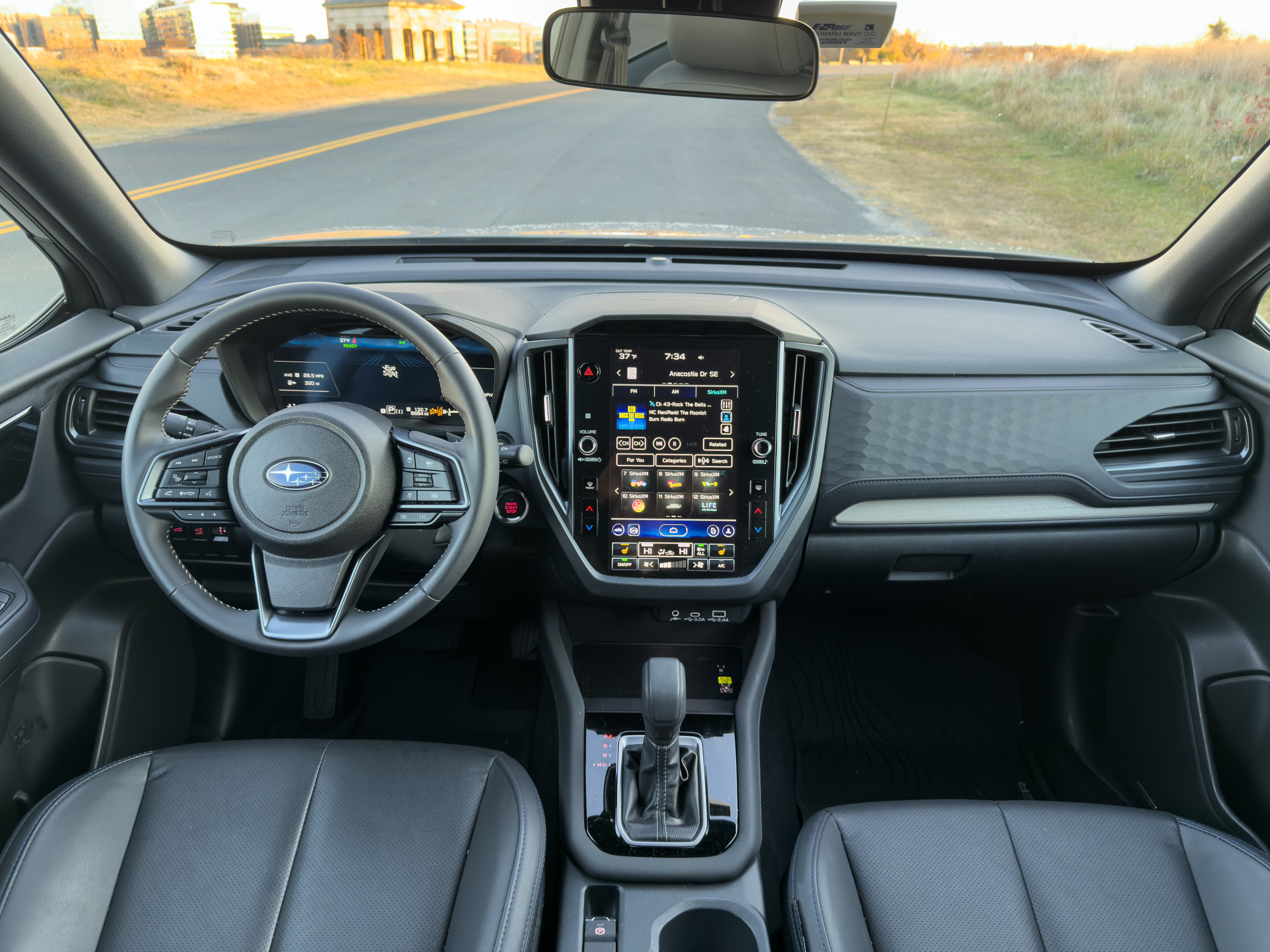
The plastics, including that textured panel in front of the passenger, are all rather hard and don’t feel particularly expensive. Credit: Jonathan Gitlin
It also majors in practicality. There’s a surfeit of cup holders and cubbies to store things, and Subaru gets bonus points for putting a bunch of hooks in the cargo area so you can secure grocery bags from sliding from one side of the car to the other under cornering.
Who signed off on this?
And then there’s the Forester’s infotainment system. This might be one of the least impressive digital user experiences we’ve experienced in a vehicle in some time. The touchscreen is unresponsive, as are the capacitive buttons on either side that turn the seat heaters on and off. The user interface looks like a refuge from 2008 and even manages to make Apple CarPlay look bad, washing out the colors on Apple Maps in a way I’ve never encountered before in what must be hundreds of test cars over the years.
Mediocrity affects some of the Forester Hybrid’s other digital systems, too. The advanced driver assistance system relies on a vision-only approach as opposed to fusing cameras with radar, as almost every other automaker does. Consequently, direct bright sunlight is enough to disable the system, which has been under scrutiny in the past due to a high rate of phantom braking events. We didn’t experience any phantom braking, but the EyeSight camera system disabled itself a few times, sometimes blaming the sun, sometimes not.
There’s 27.5 cubic feet (779 L) of space with the rear seats in use, or 69.1 cubic feet (1,957 L) with the seats flat. The 1.1 kWh lithium ion traction battery lives under the cargo area floor. Jonathan Gitlin
I also have some harsh words for the backup camera, which seems to have been borrowed from a Motorola RAZR.
In absentia, and for existing fans of the Subaru Forester, the Hybrid’s improved fuel efficiency over the not-hybrid version may well be enough to merit consideration when it’s time for a new car (the Hybrid starts at $34,995 before delivery charge). At least existing owners will have made their peace with the limitations of the infotainment and camera systems. But compared to hybrid SUVs from rivals—like the new Toyota RAV4 hybrid, the Honda CR-V Hybrid, or even the Mazda CX-50 hybrid—the Forester falls short in terms of fuel efficiency, particularly in city driving.
Jonathan is the Automotive Editor at Ars Technica. He has a BSc and PhD in Pharmacology. In 2014 he decided to indulge his lifelong passion for the car by leaving the National Human Genome Research Institute and launching Ars Technica’s automotive coverage. He lives in Washington, DC.