Down, but not out
Sports and YouTube TV played big roles, MoffettNathanson report says.
In a surprising, and likely temporary, turn of events, the number of people paying to watch cable channels has grown.
On Monday, research analyst MoffettNathanson released its “Cord-Cutting Monitor Q3 2025: Signs of Life?” report. It found that the pay TV operators, including cable companies, satellite companies, and virtual multichannel video programming distributors (vMVPDs) like YouTube TV and Fubo, added 303,000 net subscribers in Q3 2025.
According to the report, “There are more linear video subscribers now than there were thr…
Down, but not out
Sports and YouTube TV played big roles, MoffettNathanson report says.
In a surprising, and likely temporary, turn of events, the number of people paying to watch cable channels has grown.
On Monday, research analyst MoffettNathanson released its “Cord-Cutting Monitor Q3 2025: Signs of Life?” report. It found that the pay TV operators, including cable companies, satellite companies, and virtual multichannel video programming distributors (vMVPDs) like YouTube TV and Fubo, added 303,000 net subscribers in Q3 2025.
According to the report, “There are more linear video subscribers now than there were three months ago. That’s the first time we’ve been able to say that since 2017.”
In Q3 2017, MoffettNathanson reported that pay TV gained 318,000 net new subscribers. But since then, the industry’s subscriber count has been declining, with 1,045,000 customers in Q2 2025, as depicted in the graph below.
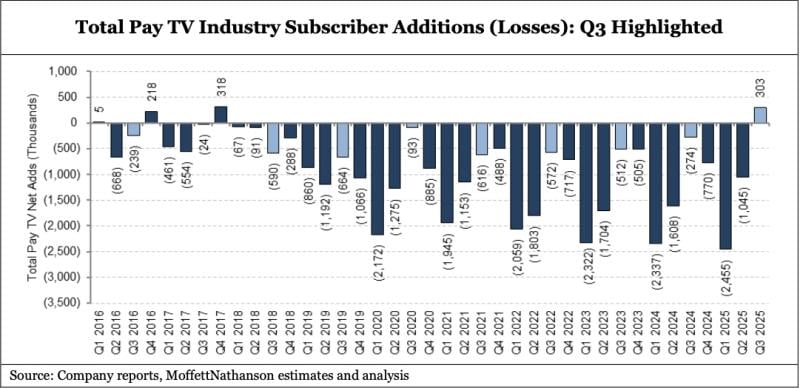
The world’s largest vMVPD by subscriber count, YouTube TV, claimed 8 million subscribers in February 2024; some analysts estimate that number is nowat 9.4 million. In its report, MoffettNathanson estimated that YouTube TV added 750,000 subscribers in Q3 2025, compared to 1 million in Q3 2024.
Traditional pay TV companies also contributed to the industry’s unexpected growth by bundling its services with streaming subscriptions. Charter Communications offers bundles with nine streaming services, including Disney+, Hulu, and HBO Max. In Q3 2024, it saw net attrition of 294,000 customers, compared to about 70,000 in Q3 2025. Other cable companies have made similar moves. Comcast, for example, launched a streaming bundle with Netflix, Peacock, and Apple TV in May 2024. For Q3 2025, Comcast reported its best pay TV subscriber count in almost five years, which was a net loss of 257,000 customers.
“It was the improvement at Charter that made it possible for the growth at vMVPDs to put the whole industry into positive territory,” MoffettNathanson’s report reads.
The number of people who subscribe to cable and satellite, however, still declined in Q3 by 10.2 percent compared to the same quarter last year. However from Q3 2023 to Q3 2024, the decline was steeper, at 12.4 percent.
Overall, the pay TV industry is still declining. For Q3 2024, pay TV’s subscriber count was down 6.7 percent, but the decline decreased to 5.8 percent in Q3 2025.
“Traditional pay TV — i.e. cable and satellite — still declined quarter over quarter in Q3, but again, by less. The [year-over-year] rate of attrition dropped from -12.4 percent to -10.2 percent over 12 months,” StreamTV Insider, which reviewed MoffettNathanson’s report, noted.
Cable and broadcast viewing hours also remain overshadowed by streaming. Nielsen reported that in October, 45.7 percent of TV viewing occurred via streaming services, compared to 22.9 percent via broadcast channels, and 22.2 percent via cable channels.
“Yes, Q3 saw a positive net add number for [pay TV for] the first time in eight years, but that positive result came in the year’s seasonally strongest quarter. We’re not yet close to seeing the category actually *grow *again… But might we eventually?” MoffettNathanson asked.
Scharon is a Senior Technology Reporter at Ars Technica writing news, reviews, and analysis on consumer gadgets and services. She’s been reporting on technology for over 10 years, with bylines at Tom’s Hardware, Channelnomics, and CRN UK.