LOS
If NASA is serious about exploring Mars, it’s past time to send new missions.
MAVEN’s Imaging Ultraviolet Spectrograph obtained this image of Mars on July 13, 2016, when the planet appeared nearly full when viewed from the highest altitudes in MAVEN’s elliptical orbit. Credit: NASA/Goddard Space Flight Center
NASA has lost contact with one its three spacecraft orbiting Mars, the agency announced Tuesday. Meanwhile, a second Mars orbiter is perilously close to running out of fuel, and the third mission is running well past its warranty.
Ground teams last heard from the Mars Atmosphere and Volatile Evolution, or MAVEN, spacecraft on Saturday, December 6. “Telemetry from MAVEN had showed all subsystems working normally before it orbited behind the red planet,” [NASA said in a sho…
LOS
If NASA is serious about exploring Mars, it’s past time to send new missions.
MAVEN’s Imaging Ultraviolet Spectrograph obtained this image of Mars on July 13, 2016, when the planet appeared nearly full when viewed from the highest altitudes in MAVEN’s elliptical orbit. Credit: NASA/Goddard Space Flight Center
NASA has lost contact with one its three spacecraft orbiting Mars, the agency announced Tuesday. Meanwhile, a second Mars orbiter is perilously close to running out of fuel, and the third mission is running well past its warranty.
Ground teams last heard from the Mars Atmosphere and Volatile Evolution, or MAVEN, spacecraft on Saturday, December 6. “Telemetry from MAVEN had showed all subsystems working normally before it orbited behind the red planet,” NASA said in a short statement. “After the spacecraft emerged from behind Mars, NASA’s Deep Space Network did not observe a signal.”
NASA said mission controllers are “investigating the anomaly to address the situation. More information will be shared once it becomes available.”
A long life at Mars
MAVEN is the newest of NASA’s three operational Mars orbiters. The robotic mission arrived at the red planet in September 2014 after a 10-month cruise from Earth, then settled into an elliptical orbit to begin studying interactions between the Sun and the Martian atmosphere.
Earlier in its mission, MAVEN discovered how the solar wind erodes the Martian atmosphere. Over billions of years, the erosion transformed Mars from a warm, wet, habitable world into the cold, inhospitable planet seen today. MAVEN’s science instruments measured the densities of light and heavy isotopes of argon to show how a process known as “sputtering” removed the majority of the air and water from the atmosphere. The spacecraft also made detailed in-situ plasma observations to help scientists understand Mars’ auroras.
Built by Lockheed Martin, MAVEN has far outlived its original design life. More recently, MAVEN became an important node in NASA’s Mars relay network, passing signals between rovers on the Martian surface and controllers on Earth. If NASA is unable to revive the MAVEN spacecraft, the agency has two other orbiters that can pick up the slack.
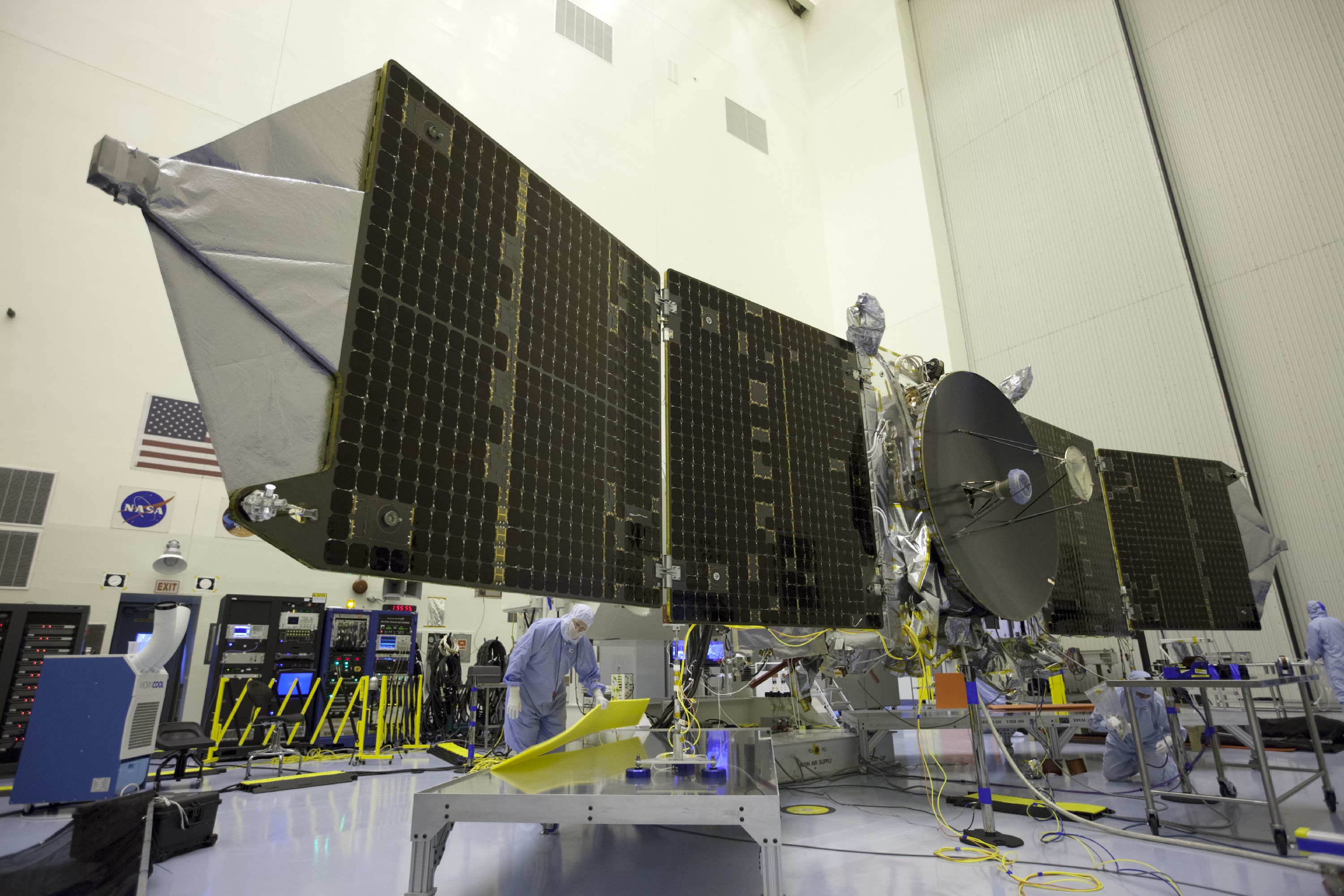
Technicians work on the MAVEN spacecraft at NASA’s Kennedy Space Center in Florida ahead of its launch in 2013. Credit: NASA/Kim Shiflett
But NASA’s two other Mars orbiters have been in space for more than 20 years. The older of the two, named Mars Odyssey, has been at Mars since 2001 and will soon run out of fuel, probably some time in the next couple of years. NASA’s Mars Reconnaissance Orbiter, which launched in 2005, is healthy for its age, with enough fuel to last into the 2030s. MRO is also important to NASA because it has the best camera at Mars, with the ability to map landing sites for future missions.
Two European spacecraft, Mars Express and the ExoMars Trace Gas Orbiter, have radios to relay data between mission controllers and NASA’s landers on the Martian surface. Mars Express, now 22 years old, suffers from the same aging concerns as Mars Odyssey and MRO. The ExoMars Trace Gas Orbiter is newer, having arrived at Mars in 2016, but is also operating beyond its original lifetime.
China and the United Arab Emirates also have orbiters circling Mars, but neither spacecraft is equipped to serve as a communications relay.
NASA’s Curiosity and Perseverance rovers have the capability for direct-to-Earth communications, but the orbiting relay network can support vastly higher data throughput. Without overhead satellites, much of the science data and many of the spectacular images collected by NASA’s rovers might never make it off the planet.
MAVEN’s unique orbit, stretching as far as 2,800 miles (4,500 kilometers) above Mars, has some advantages for data relay. In that orbit, MAVEN could relay science data from rovers on the surface for up to 30 minutes at a time, longer than the relay periods available through NASA’s lower-altitude orbiters. Because of this, MAVEN could support the largest data volumes of any of the other relay options.
Before the loss of communications last weekend, NASA said MAVEN had sufficient fuel reserves to operate until at least the late 2030s.
MAVEN was one of 19 operating missions targeted for cancellation in President Donald Trump’s proposed NASA budget for fiscal year 2026. Congress largely rejected the Trump’s administration’s proposed budget cuts at NASA.
Mars is clearly a second priority at NASA amid a race between the United States and China to land astronauts on the Moon. But the recent trouble with MAVEN will likely rekindle long-running concerns about NASA’s aging spacecraft at Mars, especially the risk of losing capacity for communications relay and high-resolution mapping to support NASA’s active rovers, along with future robotic or human expeditions.
The space agency has investigated using commercial relay services to replace the government-owned network currently in place at Mars. NASA awarded study contracts to Blue Origin, Lockheed Martin, and SpaceX in 2024 to examine possible data relay architectures.
NASA was in the early stages of planning for a dedicated Mars Telecommunications Orbiter more than 20 years ago, with plans to put it into an orbit similar to the one occupied by MAVEN. The agency canceled the project in 2005. Since then, NASA has tacked on relay radios to science orbiters sent to Mars, giving them the ability to provide communications support as a secondary mission.
The Mars Telecommunications Orbiter name appeared again in the “One Big Beautiful Bill” passed by Congress earlier this year. Lawmakers included $700 million for a “high-performance” telecom relay station in Mars orbit to be developed through a fixed-price contract. Blue Origin and Rocket Lab are among the companies that have publicized their concepts for a Mars telecom orbiter in recent months. NASA officials have not said when they will release a request for bids for such a mission.
Stephen Clark is a space reporter at Ars Technica, covering private space companies and the world’s space agencies. Stephen writes about the nexus of technology, science, policy, and business on and off the planet.