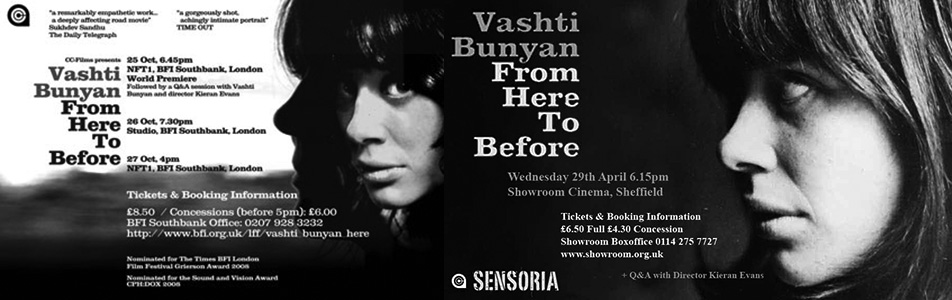
Vashti Bunyan: From Here to Before is a 2008 documentary directed by Kieran Evans about Bunyan’s fabled horse drawn trip across the country at the end of the 1960s and turn of the decade and the album she made at the time.*
If you should not know about Vashti Bunyan and the subject matter of the documentary, below is a brief précis of the background to it:
Born in 1945, in the mid 1960s Vashti Bunyan worked with Rolling Stones manager Andrew Loog Oldham, released two singles which did not sell in great numbers and recorded further songs for Oldham’s Immediate records which remained unreleased for many years. After this she de…
Vashti Bunyan: From Here to Before is a 2008 documentary directed by Kieran Evans about Bunyan’s fabled horse drawn trip across the country at the end of the 1960s and turn of the decade and the album she made at the time.*
If you should not know about Vashti Bunyan and the subject matter of the documentary, below is a brief précis of the background to it:
Born in 1945, in the mid 1960s Vashti Bunyan worked with Rolling Stones manager Andrew Loog Oldham, released two singles which did not sell in great numbers and recorded further songs for Oldham’s Immediate records which remained unreleased for many years. After this she decided to travel with her boyfriend Robert Lewis by horse and cart to the Hebridean Islands to join a commune planned by a friend, fellow singer/songwriter Donovan. During the trip, she began writing the songs that eventually became her first album, Just Another Diamond Day which was released in 1970.
The album sold very few copies and Vashti Bunyan, discouraged, abandoned her musical career. Its first reissue was in 1998 and by the turn of the millennium it had acquired a cult following and it and Bunyan’s story became inspirational to a new generation of musicians, some of whom including Devendra Banhart and Joanna Newsom, who have been loosely connected under the label “freak folk”.
After this re-release and a gap of more than 30 years Vashti Bunyan began recording again, collaborated with contemporary musicians and appeared live. She released the album Lookaftering in 2005 and in 2014 what she said was to be her final album Heartleap (both on Fatcat).
Vashti Bunyan: From Here to Before accompanies her as she retraces the horse drawn journey she made with Robert Lewis and sets it against the backdrop of her first high-profile London concert and the associated rehearsals. The film serves as an entrancing exploration of a youthful journey of exploration and searching and also an associated selfcreated almost parallel sense of reality.
Vashti and her partner appeared to want to step aside from mainstream society and the modern world’s ways of doing things and to seek out some kind of rural, previous era way of life and watching the documentary it was as though they were searching for a pure, unobtainable dream, an escape, refuge and respite from the wider world.
To quote author Rob Young from his 2011 book Electric Eden they seemed to be undertaking a form of “imaginative time travel”, a wish to get back to the land and simpler ways of life, which seems to have been fairly widespread at the time within certain often folk leaning areas of culture and music.
In turn Just Another Diamond Day has become a totem and reflection of such yearnings. This is due in part to the album’s gentle farside of folk delivery and vocals, alongside the almost dreamlike bucolic subject matter of its songs and the evocative nature of her horse and cart journey when she began work on what would become the songs on the album.
Adding to this are the equally almost dreamlike, fantasy rural atmosphere conjured by the cover image of Vashti Bunyan in period rural clothing and headscarf, where she is pictured outside her cottage accompanied by painted animals. However, as she says in the documentary:
“The songs represented the dream. They didn’t represent reality… I wasn’t living in the… beautiful hills, I was living in my head.”
Alongside recording Vashti Bunyan’s thoughts and memories of her journey, life and work as she revisits places from her journey or prepares for a live appearance, contemporary interviews make up part of the film. These include amongst others Andrew Loog Oldham, her 1960s producer Joe Boyd, Adem Ihan who is one of the musicians rehearsing with her for a live performance and artist John James who was a companion for parts of the journey.
The film also includes archival footage and photographs of Vashti and her partner in their folkloric, late 1960s, gypsy like garb that they wore at the time. This is clothing that at times is almost medieval and which accompanied by images of them travelling in their horse and cart shows the degree to which they lived out their dreams and attempted to remake their lives in the image of those dreams.
They were dedicated to the creation of those dreams in a very singular manner and in the documentary John James comments on how the “leaders” of the journey (by which I assume he means Vashti Bunyan and Robert Lewis) took the dedication, singlemindedness and purity of their quest very seriously with it gaining an almost religious aspect or puritanical zeal.
Vashti Bunyan comments on and illustrates this by saying how she would look disfavourably on people who for example went off to get a shop-bought chocolate bar and how she wanted everything to be as natural or what she thought of as natural, handmade or created by themselves as possible.
From Here to Before also effectively becomes a document of the landscape as it records her return to locations of her journey and a line could be drawn from its more rural views and capturing of their beauty and Kieran Evans later film The Outer Edges’ exploration of edgeland landscapes.
The realities of Vashti Bunyan and her fellow travellers’ lives during their journey and after that are shown and discussed in the film were far from an idyll as much of it was physically and materially hard, reflecting the practicalities of long-distance horse and cart travel in the twentieth century, particularly when undertaken with little financial cushioning, as was so in their case.
The refuge at the end of their horse and cart journey was a cottage in the Outer Hebrides which they eventually settled in for a while and which had a mud floor and a leaky thatched roof (although in From Here to Before Vashti Bunyan remembers being very appreciative after their horse and cart journey of the fact that it had a roof, whatever its condition).
The dream did not last, with her saying in the film that they felt that they were not wanted there and in contrast to her interests in the old ways of doing things the local people, particularly the young, were embracing modern ways and the coming of electricity, with the timing of her journey meaning that they arrived just as the old way of life was noticeably changing.
Although not made overly implicit in the film, it seemed that in part such things caused her to return with her partner to London. This decision was also due to practical considerations about childbirth when she became pregnant and realised that no matter how beautiful the place and landscape, she actually wanted to be around friends and family (although she talks in the film about an ongoing journey and searching; they later moved variously to the psychedelic folk group The Incredible String Band’s Glen Row cottages, then Ireland and also back to Scotland but did not return to the cottage).
From Here to Before was made over four years around the mid to later 2000s, when interest in Bunyan’s was flowering and she began to express herself again creatively in public via music and live performance and the film is a respectful observation of this period in her life and her earlier stories.
Vashti Bunyan’s music of the time and her journey have created an iconic story, set of images and songs; a modern-day fable or almost fairytale. The film is a reflection and exploration of this fable-like nature but it also captures the realities and hardships of their journey and subsequent home but without shattering the allure or spell of that dream.
* The documentary has had a notably piecemeal release; it had a limited initial cinematic release and has been shown occasionally at cinema’s since then but it has never had a physical media home release. Alongside which its availability digitally has also been very limited; for a period it was unofficially distributed online however the only time it was officially released to view via streaming was in 2020 at the Welsh culture website AM (amam.cymru), although at the time of writing it can no longer be viewed there.
This website uses cookies to help it run more smoothly. We’ll assume you’re ok with this, but you can opt-out if you wish. Cookie settingsACCEPT