
Building Foundations for Tomorrow:
Assessing Housing-Enabling Infrastructure Across Canada
National Infrastructure Assessment
Report 1, 2025

Table of Contents
Letter to the Minister of Housing and Infrastructure
[Lookin…
Building Foundations for Tomorrow:
Assessing Housing-Enabling Infrastructure Across Canada
National Infrastructure Assessment
Report 1, 2025
Table of Contents
Letter to the Minister of Housing and Infrastructure
About the Canadian Infrastructure Council
Chapter 1: Enabling Housing Through Infrastructure
The current state of our housing-enabling infrastructure
Public transit and active transportation
Infrastructure disparities in Indigenous communities and in the North
The infrastructure impact of daily choices
Existing infrastructure systems alone cannot support future growth
25-year infrastructure outlook
Chapter 2: Tailoring Infrastructure to Regional Realities
Illustrating future regional infrastructure needs
Atlantic communities confronting demographic shifts and climate threats
Central Canada population bracing for significant rising temperatures and rainfall
Meeting population growth and climate challenges in the Prairies
Building resiliency in the West
Navigating change in northern realities
More informed planning starts with improved data accessibility
Chapter 3: Navigating Pressures in Infrastructure Planning and Delivery
Supply chain disruptions delay materials
Workforce gaps in construction delay new projects
Navigating financial pressures
From green bonds to blended finance
Navigating local concerns on infrastructure development
Regulatory processes contribute to project delays and cost escalation
Chapter 4: Planning for Resilient and Liveable Communities
Prioritizing building through density over suburban sprawl
Natural infrastructure and nature-based solutions provide cost-effective, multi-benefit results
Green public spaces boost health and resiliency
Climate-resilient infrastructure pays off
Strengthening infrastructure through smarter asset management
Chapter 5: Building For What Lies Ahead
Recommendation #2: Strengthen coordination across all partners
Recommendation #3: Build for the future with resilience and data at the forefront
ANNEX A: Canadian Infrastructure Council
ANNEX B: National Infrastructure Assessment Report 1 Engagement
ANNEX C: Methodology, Data Sources and Tables
Letter to the Minister of Housing and Infrastructure
Dear Minister Robertson:
The Canadian Infrastructure Council was tasked by the Minister of Housing and Infrastructure to produce Canada’s first National Infrastructure Assessment (NIA), an undertaking that has received broad support across industry, academia, and government. The first mandate has focused on the public infrastructure needed to build more houses, specifically water and wastewater, waste management, and public transit and active transportation systems, the challenges facing these systems due to population growth and climate change.
The Government of Canada has established an ambitious housing agenda that will require significant investment in infrastructure systems. We have an urgent problem to solve and the global economic landscape has changed since we began this work. To meet this moment, we have worked quickly to engage cross-sectoral experts and assemble data and evidence to develop Report 1 of the National Infrastructure Assessment. This report is just the beginning of the Canadian Infrastructure Council’s work.
This first report aims to establish common ground among all interest holders, from policy-makers to infrastructure operators, to effectively address the challenges ahead. Its purpose is not to critique past decisions or existing policies and programs, but to contribute to more effective infrastructure planning and delivery, rooted in data and evidence.
Meeting Canada’s housing and infrastructure demands over the next 25 years and beyond will require a transformative shift in how infrastructure is planned, financed, delivered and managed. The journey to gather the critical data and evidence needed to support sound infrastructure decisions is just beginning.
Much of the country’s infrastructure was built for a different time and is now aging, outdated, or poorly suited to current conditions and long-term needs. And while good data exists in some areas, access to data and evidence to inform decision making is not consistently available or accessible across Canada. A common understanding and coordinated action that is rooted in regionally tailored data and evidence is needed to ensure that infrastructure systems can support new housing and a high quality of life for Canadians.
In this first report, these findings lead us to the following three recommendations:
- Make the most of existing built and natural infrastructure before building new.
- Strengthen coordination across all partners.
- Build for the future with resilience and data at the forefront.
Canada must build, but building alone is not enough. Infrastructure is more than discreet construction projects; it depends on built and natural systems that support and sustain it over time. This includes sound asset management, sustainable investment to maintain it, efficient operations, the ability to scale services to meet future growth, and the responsibility to influence where we want to see that growth.
The Canadian Infrastructure Council has a vital role in advising how to coordinate these efforts and maximize the impact of investments over time. We look forward to continuing this important work.
Sincerely,
 | Jennifer AngelChair of the Canadian Infrastructure Council |
 | Peter WeltmanVice-Chair of the Canadian Infrastructure Council |
Land acknowledgement
This report was developed by the members of the Canadian Infrastructure Council, who reside and work on ancestral and traditional lands across the country.
The Council members honour the peoples and land of all First Nations, Inuit and Métis peoples. The Council respects the histories, languages and cultures of all other Indigenous Peoples, including First Nations, Inuit and Métis, who enrich these communities to this day.
**Executive **summary
As the country works to address a deepening housing crisis, it must also confront the reality that public infrastructure systems essential to supporting more housing, including water and wastewater, waste management and public transit and active transportation systems, are ill-equipped to support our future needs.
The Canadian Infrastructure Council has produced Report 1 of the National Infrastructure Assessment (NIA) that is focused primarily on these public infrastructure systems, along with the governance, procurement, and financing systems that influence their development and delivery. The report provides initial actions needed to support Canada’s growing population and changing climate. The findings and recommended actions are a first step, creating common ground for solutions that support economic impact, climate resilience and the well-being of all Canadians, both now and in the future.
The Council conducted extensive engagement with more than 150 experts and interest holders between January to April 2025, building on the Government of Canada’s 2021 consultation with more than 300 organizations and experts. Through its engagement, the Council heard that there are very diverse infrastructure needs, alongside uneven capacity, data availability and resources to address these needs in a way that positions Canada to thrive in the future.
By bringing together, for the first time, population projections, asset conditions and climate considerations, this report offers an important starting point. It aims to lay the foundation for a shared reference that supports a coherent and strategic approach to strengthening infrastructure systems, highlighting gaps and pressures and recognizing regional differences.
For some interest holders, this initial report may not go far enough, particularly where compelling data and evidence exist that suggests bold changes are needed to how Canada plans infrastructure. For others, it may go too far by recommending new forms of collaboration and outcome-focused planning that imply fundamental changes in how infrastructure is delivered that may exceed current regional capacity or desire for change. Despite these differences, the Council heard consistent and strong support across sectors and interest holders for a common national framework.
Although the primary focus of this report is housing-enabling infrastructure, the findings have broader relevance across Canada’s infrastructure landscape.
Key findings
- Infrastructure must be tailored to regional realities: Regions across Canada face unique infrastructure needs shaped by varying climate and population pressures – needs that can be met only with planning, data and investment that is tailored to regional and community realities.
- Building new infrastructure faces significant constraints: Building new infrastructure faces barriers including workforce shortages, supply chain disruptions, uncertain investment and regulatory burdens that often delay and/or increase the cost of needed development.
- Significant opportunities exist to meet future needs with existing assets: Improved planning, asset management and operational funding, combined with technological advances and the use of natural assets and nature-based solutions, are cost-effective solutions to many infrastructure challenges.
Recommendations
- **Make the most of existing ****built and natural **infrastructure before building new: Before investing in new infrastructure, communities should recognize and optimize the services already provided by existing infrastructure to ensure that every dollar spent delivers maximum value. Key actions include maximizing services from existing built and natural infrastructure, managing service demand to avoid costly expansion, and investing in innovative projects that deliver multiple benefits.
- Strengthen coordination across all partners: Addressing Canada’s infrastructure and housing challenges requires coordinated action among all orders of government, Indigenous nations and the private sector to share knowledge and resources, leverage expertise, reduce barriers and align investment for maximizing impacts. Streamlining regulations, seeding innovation and establishing a pan-Canadian project pipeline can improve efficiency and predictability, attract investment and support vital infrastructure projects to get built.
- Build for the future with resilience and data at the forefront: To ensure infrastructure stands the test of time, governments and industry leaders must make forward-looking, evidence-based decisions that account for evolving climate conditions, population trends and regional differences in risk and capacity. This includes adopting standardized data and tools, transparent risk assessments and climate-resilient designs to avoid costly future retrofits or repairs.
Looking ahead
Canada stands at a pivotal juncture. The infrastructure decisions made today will shape the country’s prosperity and resilience for generations. This report lays the groundwork for a more integrated, data-driven and collaborative approach to building the infrastructure Canadians need to live and thrive, while ensuring future generations can do the same.** **
A deeper examination is required, nonetheless these findings and recommendations can offer a foundation and shared reference for infrastructure development in Canada.
About the Canadian Infrastructure Council** **
The Canadian Infrastructure Council (the Council), established under the authority of the Minister of Housing and Infrastructure (the Minister), supports long-term infrastructure planning and decision-making in Canada. Launched in December 2024, the Council is an arm’s length, expert advisory body composed of eleven independent experts from across Canada with diverse experience and expertise in infrastructure-related fields. See Annex A for member biographies.
Mandate
The Council’s mandate is to provide all orders of government with impartial, evidence-based research and analysis, developed openly and transparently, to help improve infrastructure planning and decision-making in Canada. Reporting to the Minister, the Council:
- Develops National Infrastructure Assessment(s) to provide an evidence-based picture of Canada’s infrastructure needs and priorities in the built environment;
- Develops evidence-based research and analysis on key infrastructure issues; and,
- Provides analysis and/or advice on any other matter referred to the Council by the Minister.
To inform its work, the Council draws on a broad range of expertise and diverse perspectives, engaging with experts, partners and interest holders from various sectors and regions across Canada.
The Council assumes an advisory role and does not review or assess the policies or programs of any order of government. Other orders of government retain their decision-making authority in all cases.
Guiding principles
The Council set the following principles to guide its work:
- the importance of evidence-based decision-making;
- the need to improve the efficient use of existing resources;
- the role of infrastructure in supporting sustainable, resilient and inclusive communities; and,
- the need to design projects that achieve multiple outcomes (i.e., multi-solve) while staying manageable and feasible.
Introduction
National Infrastructure Assessments (NIAs) can enable a more integrated, consistent and forward-looking approach to infrastructure planning and decision-making across all orders of government, the private sector and communities. NIAs offer a portrait of existing assets, future needs, regional priorities and delivery challenges and opportunities, as population growth and accelerating climate change place increasing pressure on infrastructure systems.
Scope
The Council was directed to focus the first NIA on the following three public infrastructure sectors that are fundamental to enabling more housing:
- water and wastewater;
- solid waste management;and,
- public transit and active transportation (i.e., community mobility).
Unless stated otherwise, facts and figures defined as “housing-enabling infrastructure” in this report include these sectors only. The Council was tasked with examining the challenges these systems face due to population growth and climate change, and with providing an evidence-based overview of Canada’s infrastructure needs. That said, the evidence, findings and recommendations are relevant across infrastructure systems more broadly.
What we heard
The Council held 13 bilateral meetings, 8 cross-sectoral roundtables and 5 focused discussions with more than 150 experts and interest holders across the country to inform this report. An additional 46 written submissions were received in response to a public Call for Input survey that was held from March 11 to April 14, 2025. See **Annex **B for the organizations that participated.
Perspectives from engineers, developers, investors, provinces and territories, local governments, Indigenous organizations and leaders, climate experts, community organizations and the broader public were sought on the following questions:
- What are some of the challenges related to infrastructure that would benefit from more thoughtful infrastructure planning, coordination and delivery in Canada?
- What do you believe are the underlying causes of those challenges, and are there any corresponding opportunities or best practices that we can follow to address them?
- Do any of these solutions readily exist or are they being implemented in certain communities in Canada or abroad?
Several cross-cutting themes emerged from the Council’s engagement:
- **Complex programs and lack of cohesion in funding landscape: **Infrastructure planning and delivery are hindered by fragmented governance that sometimes works at cross purposes, as well as short-term and restrictive funding programs that do not match local timelines or capacities for implementation.
- Climate-resilient design considering the full infrastructure lifecycle: Current infrastructure systems are not built to withstand increasing climate risks. To address this, there is a need for better access to, and routine use of, climate data and tools, updated standards, early integration of climate-resilient designs, and investment models that support shared and long-term benefits. Additionally, progressive procurement models are necessary to promote innovation and risk-sharing leading toward increased use of nature-based solutions and low-carbon materials.
- **Planning and data gaps: **Better data and planning are essential for strategic infrastructure decisions, including stronger asset management plans, access to and integration of climate and population projections, and support for smaller communities to plan for the long-term.
- Unique circumstances in northern, Indigenous, rural and remote communities: These communities face distinct challenges in planning and delivering infrastructure, underscoring the need for more equitable, tailored and locally led approaches that reflect higher costs, seasonal constraints and geographic isolation, aging systems and distinct local capacities.
- Barriers to more innovative infrastructure approaches: Risk aversion in procurement approaches, slow adoption of emerging technologies and nature-based solutions, labour and skill shortages and regulatory barriers often hinder innovation. Progressive procurement, pilot projects, flexible delivery models and workforce development can optimize resources and accelerate sustainable infrastructure solutions.
We thank all participants for sharing their time, knowledge, experience and insights to inform this report. For more detailed insights and information on the engagement process, please see our What We Heard: Planning for Canada’s first National Infrastructure Assessment.
**Chapter 1: ****Enabling **Housing Through Infrastructure
| CHAPTER SUMMARY |
|---|
| Canada faces a growing housing crisis driven by rapid population growth and a need for housing delivery that is unable to keep pace. Many systems, like water, transit and waste, are aging, lack capacity to accommodate recent and projected growth, and are often vulnerable to a changing climate. Fixing this is urgent. More than $126 billion of housing-enabling infrastructure is in poor or very poor condition and at risk of failure in the near-term.[i] Climate change, rising demand, and persistent gaps in Indigenous and remote communities are compounding pressures. Better use of existing built and natural assets, through conservation, changes in consumption and use, density, and better planning can help, but it will not be enough. New, resilient infrastructure that meets new and changing conditions must be built alongside housing. Without it, Canada risks compounding a housing crisis with an infrastructure crisis. |
Canada is in a housing crisis, driven by rapid population growth. Our population grew by 3.0% in just one year (reaching 41.3 million people in July 2024), which was the fastest growth since 1972.[ii] We face a shortfall of millions of homes, with affordability slipping out of reach for many Canadians, particularly young people, newcomers and marginalized communities.
Housing demand in Canada is expected to continue to increase in the short-term as the population may grow up to 46 million in 2035.[iii] The Parliamentary Budget Office estimates that 290,000 housing units need to be built annually to close the housing gap,[iv] 65,000 more per year than are expected.[1] By 2074, Statistics Canada estimates that Canada’s population could be as high as 81 million people under a high-growth scenario, suggesting that housing pressures could persist and potentially intensify over time.[v]
Housing and infrastructure are two sides of the same coin. Solving the housing crisis means ensuring that infrastructure systems, like transit, water and wastewater and waste management, can support the added population. Relying solely on aging, and in some cases overstretched, infrastructure to accommodate a growing population risks exacerbating existing challenges.
Figure 1.1: Connecting housing with the infrastructure that supports everyday life.
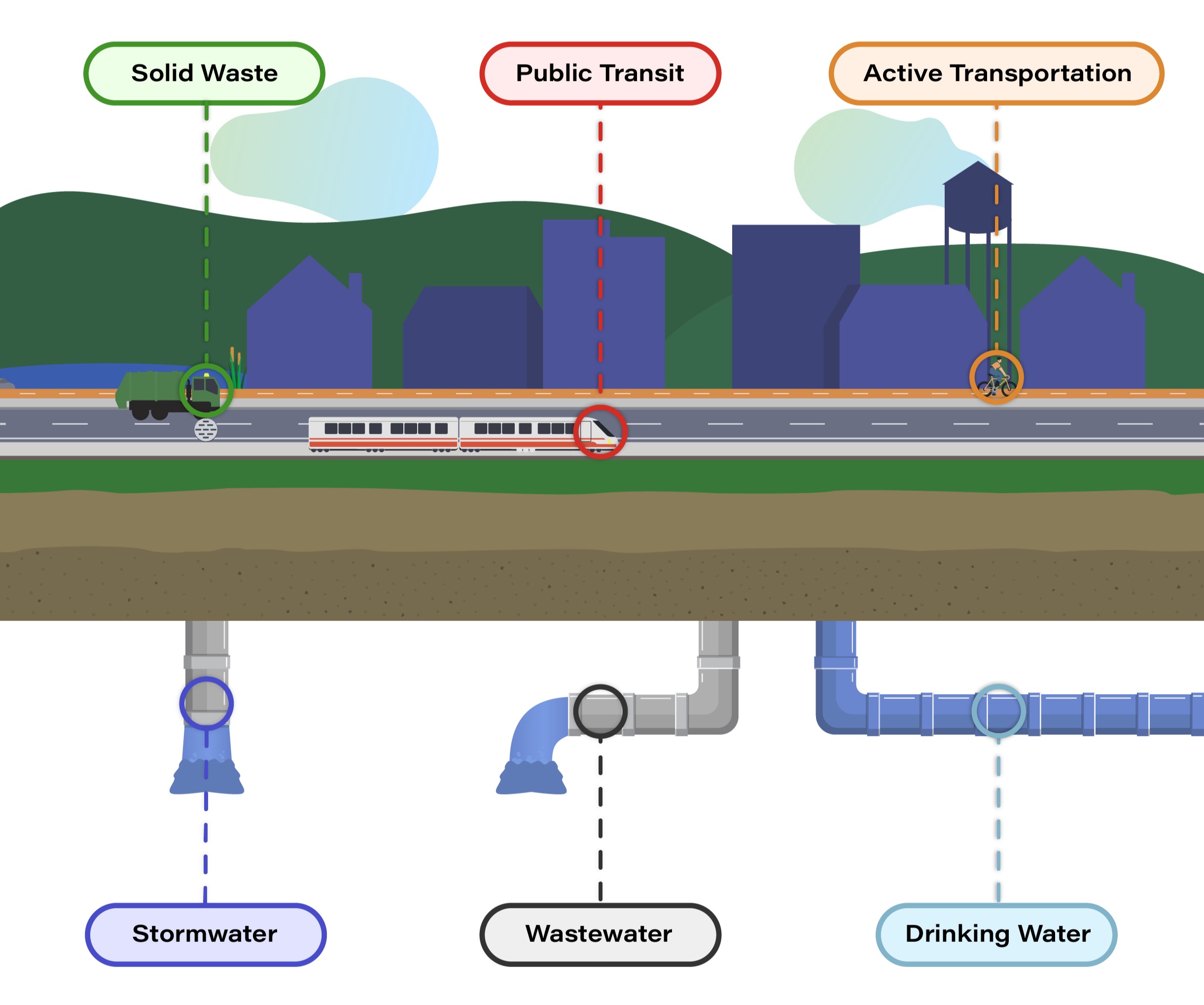
As we work to support more housing and expand infrastructure capacity, it is essential to leverage the infrastructure we already have. This requires a shared understanding of where infrastructure exists, its condition and capacity, and how these systems are interconnected. This insight is critical for guiding growth strategies, optimizing existing infrastructure assets, targeting investments in high-growth areas, and retrofitting or repurposing infrastructure in communities.
The current state of our housing-enabling infrastructure
Canada’s infrastructure is aging, and in many cases requires repairs in the near-term just to maintain existing service levels. In 2022, 11% of housing-enabling infrastructure was classified as being in poor or very poor condition, with an estimated replacement value of $126 billion.[vi] The following sections take a closer look at the current conditions of Canada’s housing-enabling infrastructure assets, gaps and disparities before outlining potential opportunities.
Water and wastewater[vii]
In 2022, more than 11% of water and wastewater-related assets in Canada were in poor or very poor condition, with an estimated replacement value of $107 billion.[viii] Additionally, significant disparities in access to quality services persist between Indigenous and non-Indigenous communities. Looking ahead, climate change and population growth will intensify pressure on water and wastewater systems and require proactive planning and investment to ensure resilient and equitable access to water and sanitation for all.
Water losses in Canada have increased from 13% in 2011 (673 million litres (L)) to 17% in 2021 (806 million L) of total drinking water use, roughly equivalent to the total drinking water consumed in British Columbia in the same year (807 million L).[ix] Historically, Canada has had significantly worse leakage rates than peer countries, largely due to insufficient water loss control practices (e.g., leak detection and repair).[2] In addition to using more energy and other resources, water systems are vulnerable to water main breaks and other disruptions as a result of insufficient water loss control practices.
Solid waste management
While solid waste infrastructure is generally in good physical condition across the country,[x] concerns remain about future capacity, especially as solid waste volumes are driven by population, economic growth and consumption habits.[3] Though the percentage of solid waste diverted from landfills and incineration (waste diversion rate) rose from 21.6% in 2002 to 27.1% in 2022, [xi] landfill shortages could occur within the next decade in some regions, like Ontario and parts of Quebec.[4],[5] Many remote and northern communities lack access to even basic waste management infrastructure, like engineered landfills and recycling depots, and face high costs and logistical barriers.[6] Proper management of solid waste is important, as landfills emit methane, a potent greenhouse gas, and shifting weather patterns, specifically increased rainfall and flooding, may increase leakage (i.e., leachate) that can contaminate nearby soil and pollute water.
Public transit and active transportation
In 2022, more than 13% of public transit related assets in Canada were in poor or very poor condition, with an estimated replacement value of nearly $15 billion.[xii] While only 7% of active transportation infrastructure was in poor or very poor condition, the condition of over 40% was unknown in 2022.[xiii] Public transit and active transportation provide affordable access to jobs and amenities, while offering environmental, health and social benefits, particularly in densely populated areas where shorter travel distances and better infrastructure make them more viable.[7] Larger communities benefit further from these systems due to reduced congestion. In contrast, smaller communities often lack alternatives to private vehicles.[8] Many neighbourhoods also lack adequate cycling infrastructure.[9] To support growing communities effectively, mobility systems must be integrated with land use and housing development planning and take into consideration population growth.
| Climate impacts |
|---|
| Canada’s infrastructure has faced major service disruptions in recent years due to natural hazards including intensifying storms, heat waves and wildfires, underscoring the urgent need to adapt existing infrastructure to future conditions and plan proactively for recovery following weather-related events. Infrastructure and housing have also been developed in high-risk areas, like river and coastal floodplains, and degradation of natural infrastructure has reduced its regulating influence on hazards like flooding, erosion and extreme heat. Thawing permafrost presents specific infrastructure challenges in Northern Canada.In November 2021, British Columbia experienced catastrophic flooding triggered by record-breaking rainfall, which washed out highways, submerged communities, and forced thousands from their homes. The disaster caused damage to infrastructure, housing and agriculture, with insured losses estimated to be $675 million and total costs in the billions.[10] In May 2023, wildfires threatened the suburban communities of Hammonds Plains and Tantallon in the Halifax Regional Municipality.[11] The fires destroyed approximately 150 homes, saw more than 16,000 people evacuated, and resulted in more than $165 million in insured losses. In July 2024, Toronto experienced a month’s worth of rain in two hours, overwhelming stormwater infrastructure systems causing significant flooding.[12] The cost of the flood damage was close to $1 billion.[13]The cost associated with these events is increasing. In 2024 alone, insured losses from severe weather events reached a record $8.5 billon, in addition to uninsured losses; with these costs borne by households and businesses.[14] Canada’s home, auto and business insurers reported the most challenging summer on record from weather events and natural hazards in 2024, with a 406% increase in claims compared to the previous 20 years on average.[15] |
Infrastructure disparities in Indigenous communities and in the North
Indigenous peoples, particularly those in small and remote communities, face some of the most persistent infrastructure challenges in Canada. For generations, First Nations, Inuit, and Métis communities have had limited access to safe housing, reliable water and waste systems, education, healthcare, telecommunications and other essential services gaps that contribute to deep-rooted socio-economic inequalities.[16] Notably, drinking water advisories in Canada have been disproportionately concentrated on First Nation reserves, with advisories often being sustained for significantly longer periods of time. As of August 29, 2025, 39 long-term drinking water advisories (i.e., lasting longer than one year) were in place on public systems on 37 First Nation reserves.[17]
The Assembly of First Nations and Indigenous Services Canada estimate that $350 billion is needed to close the existing infrastructure gap for First Nations on reserve.[18] Inuit Tapiriit Kanatami estimates that $75.1 billion is needed to close existing priority infrastructure gaps in Inuit Nunangat.[19] There is no comprehensive assessment of current infrastructure needs for Métis. Across Canada, Indigenous communities face unique infrastructure challenges when compared to other remote communities,[20] as a result of long-standing socio-economic marginalization and rapidly growing populations.[21],[22]
Infrastructure deficits are especially pronounced in Canada’s North. Historical underinvestment, harsh climate and remote geography all lead to construction challenges, such as insufficient transportation infrastructure including roads and ports, short seasonal construction windows, permafrost adaptation requirements, and the lack of integrated systems that combine housing, energy, water, transportation and broadband needs.[23],[24],[25] These factors contribute to the northern and Arctic infrastructure deficit, which includes poor quality and overcrowded housing,[26] inadequate public infrastructure,[27] fragile supply chains and logistic networks, and insufficient energy generation and transmission infrastructure.[28] The rapid pace of warming in the North as a result of climate change is increasing the incidence of disasters, severe weather events, and slow-onset events (e.g., permafrost thaw, coastal erosion) which accelerate infrastructure failure.[29]
The infrastructure impact of daily choices
Managing or reducing user demand can ease pressure on assets and improve efficiency. These measures can reduce future infrastructure needs, giving communities valuable time to better plan for future growth and scale up strategically when resources allow.
Water usage
Without demand management practices, such as water metering, Canada’s growing population and relatively high per person water use will place significant demand on water systems. There is untapped opportunity to use water more wisely and avoid the need to build as much new infrastructure in the future.
In 2021, total drinking water use in Canada reached 4.9 billion cubic metres (m³).[xiv] More than half of drinking water use (55%) is by households, followed by industry (28%), and losses from distribution systems (17%).[xv] Despite a downward trend in drinking water use, Canada’s per capita use is still high by global standards. In 2021, average daily drinking water use for all end users (including water losses) was 401 litres (L) per person.[xvi] While this declined from 485 L per person in 2011, it is still significantly higher than most peer countries. Reducing Canada’s per capita average daily drinking water use would reduce the need to expand or build new drinking water treatment plants.
Residential usage makes up the largest proportion of drinking water use and is significantly higher than peer countries. Average daily residential use per capita was 223 L per person in 2021, down from 251 L in 2011,[xvii] whereas the average daily residential drinking water use among 29 European countries was 124 L per person in 2021.[30] This is at least partially driven by higher prices for water usage in these countries. Average water pricing in Europe was nearly €4/m3 (or $6.50/m3) in 2021, compared to an average price in five large cities in Canada of about €1.3/m3 (or $2.00/m3). [31]
Drinking water usage also varies significantly across Canada, ranging from 283 L per person per day in Manitoba to 709 L per person per day in Newfoundland and Labrador.[xviii] Differences in consumption across provinces can be attributed to a number of factors, including higher water losses and differing levels of water metering and conservation practices.
Solid waste production
Most of Canada’s solid waste ends up in landfills. In 2022, only 27% of waste was diverted from landfills or incineration, placing us 17th out of 38 Organisation for Economic Co-operation and Development (OECD) countries, and well behind leaders like South Korea (54%) and Germany (45%).[xix] Even countries with relatively similar economies and geography, like New Zealand (35%) and the US (30%), are doing better. This trend is also seen in our relatively low circularity rate (i.e., a measure of how much waste is reused in an economy) of just 6.1% compared to 11.5% in the European Union.[32] Canada’s low waste diversion rate reflects not only our high consumption level, but also the relatively low cost of landfilling that is made possible by our vast land area and abundant natural resources.
Canada’s overreliance on landfills and low circularity rate signal a missed opportunity to recover valuable materials and reduce environmental impacts. While we are not alone in facing these challenges, other countries are proving that better systems are achievable. Canada has the opportunity to improve how waste is collected, sorted and processed and make it easier and more cost-effective to divert materials from landfills.
Commuting choices
From 2016 to 2024, the proportion of Canadians commuting to work by private vehicle ranged from 79% to 85% and contributed to congestion in many major cities.[xx] Roughly 90% of Canadian households own at least one private vehicle.[xxi] In comparison, public transit was the main travel mode for around 11% in 2024, while around 6% relied mainly on active transportation, with significant variability across the country and between urban and rural communities.[xxii] Access to public transit is low in rural areas, where only 10% of the population lives within 500 metres of a transit stop, compared to 81% of those living in urban areas in 2024.[xxiii] OECD research indicates that Canadians living in urban areas generally have closer access to public transit stops than those in peer US cities, but less than peers in Australia and the European Union.[xxiv]
To a large extent, the high use of private vehicles in Canada is shaped by existing land use patterns, such as where and how closely residential, commercial and social buildings/activities are located. Land use dictates how far people need to travel from one activity to another or to access mobility infrastructure and services (e.g., if residential areas are low-density, people may have farther to go to get to transit). Increased use of public transit and active transportation can support increased housing density. [33] This relationship is also true in reverse as more density would decrease the distance people need to travel to commute to work or access amenities.[34]
Heavy reliance on private vehicles leads to traffic congestion, which wastes time and reduces economic productivity. Sprawl (e.g., expansion of urban areas into surrounding rural land) limits access to jobs, services and opportunities without the use of a vehicle, and increases road congestion as more people drive. Recent estimates indicate the economic impact of congestion in Ontario from 2014 to 2024 at $12.8 billion annually, which increases to $56.4 billion when quality of life impacts are considered.[35] This includes the cost of delayed movement of goods and services, and reduced efficiency from workers, as well as the cascading impacts on investment and employment growth. Reliance on private vehicles often creates social inequalities, as those without access to vehicles face reduced mobility.[36] Overall, too many vehicles on the road strain resources and drive us away from more sustainable cities.
Existing infrastructure systems alone cannot support future growth
While making better use of existing infrastructure and managing demand is critical, more housing and infrastructure will be needed to support growing communities in the context of a changing climate. Enabling more housing, and advancing the underlying infrastructure systems that support it, is a complex, multi-year process that needs to involve multiple entities, interest holders and expertise. Coordinated planning over the next 25 years and beyond is crucial to guide the development of housing and infrastructure, not only now but in the future. This involves building housing where existing infrastructure can be leveraged and adding infrastructure where new housing will be built.
**25-year infrastructure outlook **
Decision-makers cannot plan effectively if they do not know where population growth could occur. Strategic and long-term infrastructure and housing planning depend on understanding future population growth; without that information, investment risks missing the mark.
Planning for 25 years and beyond (i.e., 50 to 100 year horizons that align with the infrastructure lifecycle) requires data, and population growth projections can guide local decisions on where new housing and related infrastructure services will see future demand.
Tailored, open and transparent projections at a regional and community level would better inform where housing and related infrastructure services are needed, supporting future planning. By leveraging this information, communities can make intentional and informed decisions about where and how infrastructure and housing are built as they evolve.
In the absence of robust projections and simulations, illustrations of the potential scale of future infrastructure needs could be made as a starting point. These illustrative estimates have to rely on the assumption that infrastructure service demand changes proportionally with population growth and decline.
While population growth is a key driver, infrastructure demand is also shaped by urbanization, economic development, technological change, evolving consumption, demographic changes (e.g., aging population, increase in the share of the population with disabilities) and mobility patterns. All of these factors will also be affected by current and future government policies, including those related to housing and infrastructure. For example, current efforts by all orders of government to encourage transit-oriented development are expected to increase transit ridership beyond the estimates below.
In 25 years, if current behaviours remain unchanged, Canada may need:[xxv]
- Clean water: 5.5 to 7.0 billion cubic metres of clean water (4.9 billion in 2021);
- Wastewater: 6.3 to 8.0 billion cubic metres of wastewater (5.9 billion in 2023);
- **Waste disposal: **30 to 38 million tonnes of solid waste sent to landfills or incinerators (26 million in 2022);
- Waste diversion: 11 to 14 million tonnes of solid waste diverted from landfills or incinerators (10 million in 2022);
- Vehicles: 28 to 36 million vehicles on the road (26 million in 2023);
- Public transit: 1.8 to 2.2 billion trips taken on public transit (1.8 billion in 2023); and,
- Active transportation: 1 to 1.2 million people primarily walking, running or cycling to work (961,000 in 2023).
These estimates are not predictions, but illustrations of the potential scale of future infrastructure service demand based on low- and high-growth population projection scenarios and unchanged behaviours. See Annex C for more information on how these estimates have been calculated.
**Chapter 2: ****Tailoring Infrastructure to Regional **Realities
| CHAPTER SUMMARY |
|---|
| Canada’s infrastructure needs vary widely by region and community type, with larger communities facing housing shortages, congestion and aging systems, while smaller communities often lack basics like clean water, reliable roads, solid waste management and wastewater treatment. This is most concerning in Indigenous communities, although these gaps vary by geography and between First Nations, Métis and Inuit communities. Historic urban development has altered how natural systems function and has placed infrastructure and housing in some areas at risk from natural hazards, like flooding and wildfires. The prevalence of climate hazards can vary by region, with coastal regions facing rising sea levels and stronger storms, the North experiencing rapid permafrost thaw, the Prairies confronting drought and wildfires, and Central and Eastern Canada dealing with more frequent flooding and extreme heat. Population growth will surge in some regions and decline in others. Smaller municipalities often lack the financial and technical capacity to plan for future risks. Larger municipalities are more likely to consider climate change in decision-making,[xxvi] but a one-size-fits-all approach to infrastructure planning would deepen inequalities. Canada needs regionally tailored, data-driven solutions that reflect the geographic, demographic and climate realities of each community to build resilient, inclusive and future-ready infrastructure systems. |
To keep pace with population growth over the next 25 years, regionally tailored approaches are essential to align housing development with infrastructure capacity. Challenges vary across the country: major cities face density pressures and congested roads, while smaller communities struggle with limited resources to maintain or replace aging infrastructure. In remote communities, the gaps are often more severe, ranging from inadequate access to clean water and wastewater systems to the absence of reliable all-season roads, reflecting both geographic barriers and long-standing underinvestment. Infrastructure gaps are more pronounced in remote Indigenous communities than in remote non-Indigenous ones, with a 2019 study identifying Nunavut’s remote Indigenous communities as having the most significant disparities.[37]
Beyond infrastructure issues, population growth and impacts from climate change are also regionally driven in Canada. Small and very small communities cover 98.5% of our overall landmass,[xxvii] and these communities and their infrastructure will be exposed to a variety of climate hazards that will vary across regions given our broad and vast geography. For example, climate change in the North is happening faster and with a greater impact than the rest of Canada. Climate change impacts in the North have already resulted in erosion and/or melting of winter roads, with projections estimating that more than half of current winter roads will become unviable by 2050.[38] Consequently, the impacts from climate change, and measures to improve climate resilience, will also have to vary across regions.
Decision-makers need to understand and incorporate specific regional and community realities into their long-term planning and solutions. The challenges faced by communities are so different in Canada that an approach to infrastructure planning that reflects local realities is required for infrastructure solutions to be responsive, resilient and reflective of the diverse needs of the people they are meant to serve.
Figure 2.1: While Canada possesses an abundance of land, 73% of Canadians live on less than 2% of the land.
| Size | **Number of Census Subdivisions (CSDs) ** | **Population ** | Land |
| Very small communities (less than 5,000) | 4,394 (85.1%) | 4,164,480 (10.1%) | 7,584,300 (86.3%) |
| Small communities (5,000–30,000) | 600 (11.6%) | 7,033,027 (17.0%) | 1,071,629 (12.2%) |
| Medium communities (30,000–100,000) | 100 (1.9%) | 5,402,750 (13.1%) | 103,435 (1.2%) |
| Large communities (100,000–500,000) | 54 (1.0%) | 9,956,032 (24.1%) | 12,714 (0.1%) |
| Very large communities (more than 500,000) | 13 (0.3%) | 14,732,000 (35.7%) | 16,623 (0.2%) |
| Total | 5,161 (100%) | **41,288,599 (100%) ** | 8,788,703 (100%) |
Source: Statistics Canada. Census Profile, 2021 Census of Population. Statistics Canada. Table 17-10-0155-01 Population estimates, July 1, by census subdivision, 2021 boundaries. Classifications by HICC.
Illustrating future regional infrastructure needs
In the absence of robust, regional projections, illustrative estimates can serve as a starting point for understanding the potential scale of future infrastructure needs across Canada’s regions. See Annex C for more information on how these estimates have been calculated.
Atlantic communities confronting demographic shifts and climate threats
As of 2024, the population of Atlantic Canada (New Brunswick, Nova Scotia, Prince Edward Island and Newfoundland and Labrador) was about 2.7 million people.[xxviii] Covering a total land area of around 488,000 square kilometres, the region has a relatively low population density of about 5.5 people per square kilometre. Based on the 2021 Census, there are 135,600 Indigenous peoples (First Nations (59%), Métis (29%), Inuit (7%) and others[xxix] (5%)) living in Atlantic Canada.
Atlantic Canada’s population is projected to realize moderate growth into 2049, with an aging population that will make up an increasing share in much of the region over the next 25 years. As of 2024, almost all municipalities in Atlantic Canada were very small (744) or small (79), representing almost 60% of the population on more than 98% of the land.[xxx] While the few medium, large and very large communities in Atlantic Canada are expected to grow, the very small and small communities are expected to decline under a low-growth scenario by 15% and 8%, respectively.[xxxi]
Figure 2.2: Atlantic Canada is shaped by smaller and coastal communities

Source: Statistics Canada. [Table 17-10-01