Silver ratio
Rationalityirrational algebraic
Symbolσ
Representations
Decimal2.41421356237309504880...
Algebraic form

In mathematics, the silver ratio is a geometrical proportion with exact value 1 + √2, the positive solution of the equation x2 = 2x + 1.
The name silver ratio is by analogy with the [golden …
Silver ratio
Rationalityirrational algebraic
Symbolσ
Representations
Decimal2.41421356237309504880...
Algebraic form
In mathematics, the silver ratio is a geometrical proportion with exact value 1 + √2, the positive solution of the equation x2 = 2x + 1.
The name silver ratio is by analogy with the golden ratio, the positive solution of the equation x2 = x + 1.
Although its name is recent, the silver ratio (or silver mean) has been studied since ancient times because of its connections to the square root of 2, almost-isosceles Pythagorean triples, square triangular numbers, Pell numbers, the octagon, and six polyhedra with octahedral symmetry.
Silver rectangle in a regular octagon.
If the ratio of two quantities a > b > 0 is proportionate to the sum of two and their reciprocal ratio, they are in the silver ratio: 


Substituting 


Using the tangent function [4] 


![{\displaystyle x\gets {\tfrac {1}{2}}(x^{2}+1)/(x-1),{\text{ with }}x_{0}\in [2,3]}](https://wikimedia.org/api/rest_v1/media/math/render/svg/5b7df4bb8dd95037c90a66b2a4749cdadca32aba)
The iteration 

Rectangles with aspect ratios related to σ tile the square.
The defining equation can be written

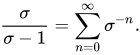
The silver ratio can be expressed in terms of itself as fractions

Similarly as the infinite geometric series
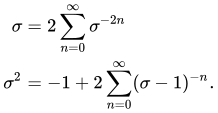
For every integer 

Continued fraction pattern of a few low powers
![{\displaystyle {\begin{aligned}\sigma ^{-1}&=[0;2,2,2,2,…]\approx 0.4142;(17/41)\\sigma ^{0}&=[1]\\sigma ^{1}&=[2;2,2,2,2,…]\approx 2.4142;(70/29)\\sigma ^{2}&=[5;1,4,1,4,…]\approx 5.8284;(5+29/35)\\sigma ^{3}&=[14;14,14,14,…]\approx 14.0711;(14+1/14)\\sigma ^{4}&=[33;1,32,1,32,…]\approx 33.9706;(33+33/34)\\sigma ^{5}&=[82;82,82,82,…]\approx 82.0122;(82+1/82)\end{aligned}}}](https://wikimedia.org/api/rest_v1/media/math/render/svg/1ef51893b5b67acf1794c998ee51934820b82942)

The silver ratio is a Pisot number, the next quadratic Pisot number after the golden ratio.[5] By definition of these numbers, the absolute value 

Quadratic field  (√2)
(√2)
[edit]
The mapping ι (ξ) = (ξ, ξ) embeds both conjugates of integer ξ = a + bσ into a point-lattice Λ spanned by unit vectors ι (1) and ι (σ). The fundamental parallelogram with area δ(Λ) = √8 in silver; the Minkowski diamond has area 4δ(Λ).


![{\displaystyle \mathbb {Z} [\sigma ]{\text{ of }}K}](https://wikimedia.org/api/rest_v1/media/math/render/svg/11cfa3ef47f56f1250d7d3576052fff7688bc97d)


![{\displaystyle O_{k}=\mathbb {Z} [\sigma ]}](https://wikimedia.org/api/rest_v1/media/math/render/svg/be9a987fb464325c5aa75c341396bb7bc28283fa)


and any one of these numbers multiplied by a unit.[12]
The silver ratio can be used as base of a numeral system, here called the sigmary scale.[b] Every real number x in [0,1] can be represented as a convergent series 
![{\displaystyle a_{n}\in [0,1,2].}](https://wikimedia.org/api/rest_v1/media/math/render/svg/bf3d33e66b64fe0b2c89613621e2cb781aa9b955)
The steps in the sigmary scale resemble the intervals of the mixolydian mode in log scale. Progression to the next octave is paralleled by the carry in 21 and 22.
Sigmary expansions are not unique. Due to the identities 


Properties of canonical sigmary expansions, with coefficients

Remarkably, the same holds mutatis mutandis for all quadratic Pisot numbers that satisfy the general equation 


The silver ratio is related to the central Delannoy numbers 


For an application of the sigmary scale, consider the problem of writing a possible third-order coefficient c in terms of the silver ratio. The decimal value of c is approximately 0.006865233, which can be found with the method of dominant balance using the recurrence relation for the central Delannoy numbers, 


![{\displaystyle {\sqrt {2}},\mathbb {Z} [\sigma ].}](https://wikimedia.org/api/rest_v1/media/math/render/svg/92d92af959a86ead68792b3b99753b98431c6f60)


Silver harmonics: the rectangle and its coloured subzones have areas in ratios 7σ + 3 : σ3 : σ2 : σ : 1.
These numbers are related to the silver ratio as the Fibonacci numbers and Lucas numbers are to the golden ratio.
The fundamental sequence is defined by the recurrence relation 

The first few terms are 0, 1, 2, 5, 12, 29, 70, 169,... OEIS: A000129. The limit ratio of consecutive terms is the silver mean.
Fractions of Pell numbers provide rational approximations of

The sequence is extended to negative indices using

Powers of 
The generating function of the sequence is given by [22]

Newton’s method for p(z) = (z2 − 2z − 1)(z2 − 2z + σ) / σ: the silver ratio (right) and its conjugate with perturbing complex roots 1 ± i√σ − 1 at the nuclei of their basins of attraction. Julia set of the Newton map in orange, with unit circle and real curve for reference.
The characteristic equation of the recurrence is 


Since 


The Binet formula 

The first few terms are 2, 2, 6, 14, 34, 82, 198,... OEIS: A002203.
This Pell-Lucas sequence has the Fermat property: if p is prime, 

Pell numbers are obtained as integral powers n > 2 of a matrix with positive eigenvalue


The trace of 

Silver rectangle and regular octagon
[edit]
Origami construction of a silver rectangle, with creases in green.
A rectangle with edges in ratio √2 : 1 can be created from a square piece of paper with an origami folding sequence. Considered a proportion of great harmony in Japanese aesthetics — Yamato-hi (大和比) — the ratio is retained if the √2 rectangle is folded in half, parallel to the short edges. Rabatment produces a rectangle with edges in the silver ratio (according to 1/σ = √2 − 1). [d]
- Fold a square sheet of paper in half, creating a falling diagonal crease (bisect 90° angle), then unfold.
- Fold the right hand edge onto the diagonal crease (bisect 45° angle).
- Fold the top edge in half, to the back side (reduce width by 1/σ + 1), and open out the triangle. The result is a √2 rectangle.
- Fold the bottom edge onto the left hand edge (reduce height by 1/σ − 1). The horizontal part on top is a silver rectangle.
If the folding paper is opened out, the creases coincide with diagonal sections of a regular octagon. The first two creases divide the square into a silver gnomon with angles in the ratios 5 : 2 : 1, between two right triangles with angles in ratios 4 : 2 : 2 (left) and 4 : 3 : 1 (right). The unit angle is equal to 22+1/2 degrees.
If the octagon has edge length 


A whirl of silver rectangles.
Divide a rectangle with sides in ratio 1 : 2 into four congruent right triangles with legs of equal length and arrange these in the shape of a silver rectangle, enclosing a similar rectangle that is scaled by factor 

The logarithmic spiral through the vertices of adjacent triangles has polar slope 
If the triangles have legs of length 


Arranging the tiles with the four hypotenuses facing inward results in the diamond-in-a-square shape. Roman architect Vitruvius recommended the implied ad quadratura ratio as one of three for proportioning a town house atrium. The scaling factor is 

Dimensions of the rhombicuboctahedron are linked to σ.
The silver mean has connections to the following Archimedean solids with octahedral symmetry; all values are based on edge length = 2.
The coordinates of the vertices are given by 24 distinct permutations of 

Coordinates: 24 permutations of 

Coordinates: 48 permutations of 


See also the dual Catalan solids
- Tetragonal trisoctahedron
- Trisoctahedron
- Hexakis octahedron Silver triangle and whirling gnomons.
The acute isosceles triangle formed by connecting two adjacent vertices of a regular octagon to its centre point, is here called the silver triangle. It is uniquely identified by its angles in ratios 


By trisecting one of its base angles, the silver triangle is partitioned into a similar triangle and an obtuse silver gnomon. The trisector is collinear with a medium diagonal of the octagon. Sharing the apex of the parent triangle, the gnomon has angles of 


The similar silver triangle is likewise obtained by scaling the parent triangle in base to leg ratio 

The centre of rotation has barycentric coordinates 

The logarithmic spiral through the vertices of all nested triangles has polar slope 


| circumcenter |  |
| centroid |  |
| nine-point center |  |
| incenter, α = 3π/8 | ![{\displaystyle \left([1+\cos(\alpha )]{-1}:[1+\sec(\alpha )]{-1}\right)\sim (\sec(\alpha ):1)}](https://wikimedia.org/api/rest_v1/media/math/render/svg/3994698a0b30e6349a2b840ee0967e95cbc5d4df) |
| symmedian point |  |
| orthocenter |  |
The long, medium and short diagonals of the regular octagon concur respectively at the apex, the circumcenter and the orthocenter of a silver triangle.
Silver rectangle and silver triangle
[edit]
Powers of σ within a silver rectangle.
Assume a silver rectangle has been constructed as indicated above, with height 1, length 


If an horizontal line is drawn through the intersection point of the diagonal and the internal edge of a rabatment square, the parent silver rectangle and the two scaled copies along the diagonal have areas in the ratios 

Relative to vertex A, the coordinates of feet of altitudes U and V are

If the diagram is further subdivided by perpendicular lines through U and V, the lengths of the diagonal and its subsections can be expressed as trigonometric functions of argument 
Diagonal segments of the s