Your analytics are only as good as your data is fresh. Waiting hours or days for production data to land in your warehouse ruffles all the wrong feathers—without the latest, you’re flying with stale information.
Artie is joining the Modern Duck Stack, integrating with MotherDuck to offer a fully managed CDC streaming platform that replicates data from your source databases to MotherDuck in real-time.
Artie automates the entire data ingestion lifecycle, from capturing changes to merges, backfills, and observability, and scales to billions of change events per day. It uses change data capture (CDC) to stream only the rows that have changed in a source database like MySQL or PostgreSQL, delivering low-latency data pipelines to your data warehouse. With Mother…
Your analytics are only as good as your data is fresh. Waiting hours or days for production data to land in your warehouse ruffles all the wrong feathers—without the latest, you’re flying with stale information.
Artie is joining the Modern Duck Stack, integrating with MotherDuck to offer a fully managed CDC streaming platform that replicates data from your source databases to MotherDuck in real-time.
Artie automates the entire data ingestion lifecycle, from capturing changes to merges, backfills, and observability, and scales to billions of change events per day. It uses change data capture (CDC) to stream only the rows that have changed in a source database like MySQL or PostgreSQL, delivering low-latency data pipelines to your data warehouse. With MotherDuck as a supported destination, you get a powerful setup: real-time data flowing into a ducking-fast data warehouse, with zero infrastructure to manage.
This pairing is ideal for teams who need fresh data for operational dashboards or customer-facing analytics—without the complexity of stitching together their own pipelines.
How CDC works
Moving data from a transactional database to an analytics warehouse is a necessary step in any analytics journey—operations is where most of the data you need to drive business-critical insights lives.
Your application database (PostgreSQL, MySQL, MongoDB) is an OLTP system optimized for transactional processing: low-latency, high-concurrency read/write operations. Running analytical queries directly on production works at first, but as your data grows, you start to overload a system that wasn’t designed for complex aggregations and scans.
That’s where OLAP systems like MotherDuck come in—purpose-built for analytical workloads. But getting data from OLTP to OLAP introduces its own challenges: schema mapping, schema evolution, handling deletes, and doing all of this without impacting production performance.
CDC pipelines solve this by replicating data changes in real-time. For PostgreSQL, Artie uses log-based CDC, reading from the write-ahead log (WAL) that already records every INSERT, UPDATE, and DELETE. This approach is non-intrusive—there’s no additional load on your source database, and changes flow continuously without polling or batch jobs. Artie handles the complexity of schema evolution, type mapping, and merge operations so you don’t have to stitch together Debezium, Kafka, and custom transformation logic yourself.
Replication for data warehousing and customer-facing analytics
For data teams
Data teams often struggle with the gap between what’s happening in production and what’s visible in dashboards. With Artie streaming changes to MotherDuck, your internal reporting stays current throughout the day.
This setup quacks right for operational use cases where timing matters: monitoring order volumes during a flash sale, tracking signup conversion in the hours after a product launch, or catching anomalies in payment processing before they escalate. Your finance, ops, and product teams get the numbers they need when they need them—not tomorrow morning.
Artie’s history tables also make it easy to maintain audit trails by automatically creating slowly changing dimension (SCD) tables. When enabled, Artie creates a separate table named {TABLE}__HISTORY that records every change made to the original table. This gives your compliance and analytics teams a complete record of how data evolved over time and enables users to run point-in-time analysis on underlying data.
For developers
Real-time data isn’t just for internal teams. If you’re building a product that surfaces analytics to your users—usage dashboards, reporting portals, embedded metrics—using Artie with MotherDuck gives you low-latency replication pipelines without infrastructure headaches. No batch jobs running overnight, no "data updated daily" disclaimers.
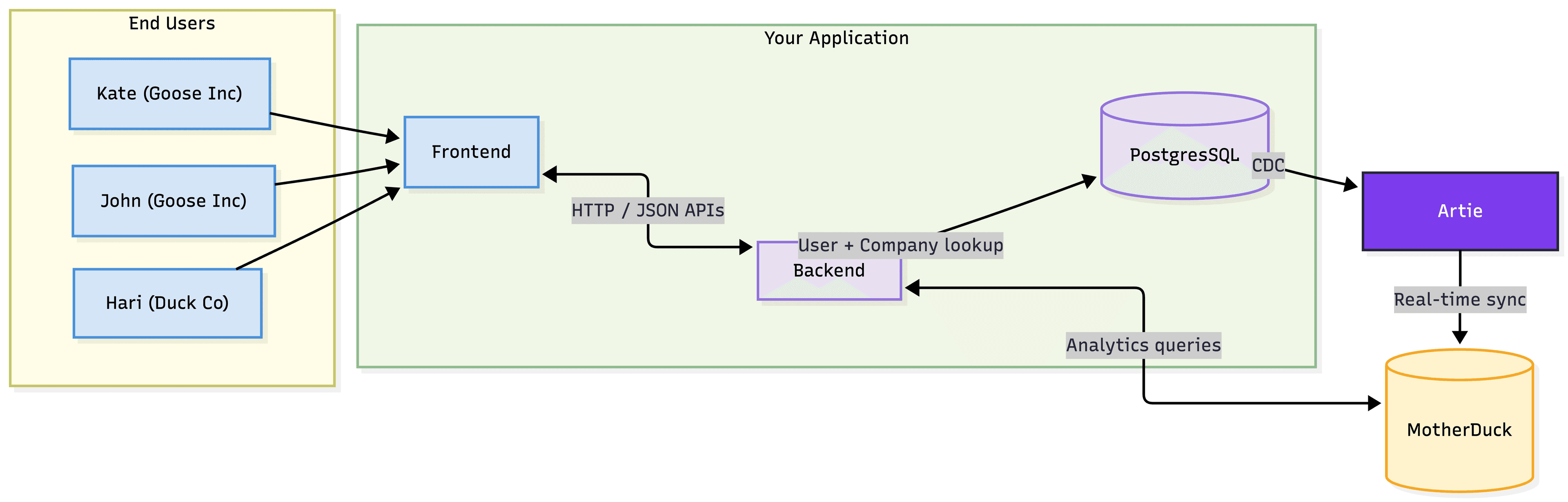
As an example, think about a high-level architecture for a typical web application. Postgres handles transactional load, while MotherDuck serves as the warehouse for sub-second analytical queries. This requires replicating data from Postgres to MotherDuck. Artie uses logical replication to read changes from the source database, streaming them to MotherDuck where your backend can query fresh data via MotherDuck.
Getting started
Setup takes minutes—connect your source, add your MotherDuck service token, select tables, and deploy. To get started replicating data to MotherDuck using Artie, see their destination documentation and join us in MotherDuck Community Slack for tips, tricks, and troubleshooting together!