Credit: Canva | The Daily Galaxy –Great Discoveries Channel
A breakthrough in space weather prediction has arrived, thanks to an innovative **AI system **developed by researchers at NYU Abu Dhabi. The system, which can predict solar wind conditions up to four days in advance, promises to revolutionize how we protect vital infrastructure, from satellites to power grids. This advance, detailed in The Astrophysical Journal Supplement Series, paves the way for more accurate space weather forecasting, a crucial development in the face of growing space technology reliance.
AI Enhances Solar Wind Prediction Accuracy
Predicting[solar wind conditions](https://dailygala…
Credit: Canva | The Daily Galaxy –Great Discoveries Channel
A breakthrough in space weather prediction has arrived, thanks to an innovative **AI system **developed by researchers at NYU Abu Dhabi. The system, which can predict solar wind conditions up to four days in advance, promises to revolutionize how we protect vital infrastructure, from satellites to power grids. This advance, detailed in The Astrophysical Journal Supplement Series, paves the way for more accurate space weather forecasting, a crucial development in the face of growing space technology reliance.
AI Enhances Solar Wind Prediction Accuracy
Predictingsolar wind conditions, particularly when they’re intensified, is a significant challenge for space scientists. The flow of charged particles from the Sun can have devastating effects on Earth’s technology, disrupting satellites, communication systems, and even power grids. The new AI system developed by NYU Abu Dhabi researchers promises to offer a solution, capable of predicting solar wind speeds up to four days before they reach Earth. This system’s forecasting accuracy outperforms existing models by 45%, a remarkable achievement that will have wide-reaching implications for space and Earth-bound technologies.
The AI is trained using high-resolution ultraviolet images fromNASA’s Solar Dynamics Observatory, which allows it to identify patterns that can signal changes in solar wind conditions. The ability to forecast these changes well in advance enables engineers and scientists to prepare and protect satellites, power systems, and astronauts from potentially catastrophic space weather events. By giving earlier warnings, this innovation can prevent incidents like the one that occurred in 2022 when SpaceX lost 40 Starlink satellites due to a solar wind surge.
This advancement offers tangible benefits to space agencies, satellite operators, and anyone dependent on space-based technologies. As Dhuri, lead author of the study, explains,
“This is a major step forward in protecting the satellites, navigation systems, and power infrastructure that modern life depends on.”
AI and Solar Wind Forecasting: A Game Changer for Space Weather Predictions
**Solar wind **forecasting is an ongoing challenge for space science, but artificial intelligence is now making it more accurate and reliable than ever before. Traditionally, solar wind predictions have been imprecise, often with limited time frames and unclear accuracy. The new AI model developed at NYU Abu Dhabi uses a combination of sophisticated machine learning techniques and detailed solar imagery, providing a level of prediction that surpasses any current methods. This breakthrough offers a 45% improvement in accuracy compared to existing models, making it a revolutionary step forward in space weather forecasting.
The AI’s ability to predict solar wind speeds up to four days ahead of time will allow scientists and engineers to better understand and anticipate potentially disruptive solar events. This provides a crucial advantage in managing the risks that solar wind poses to Earth’s technological infrastructure. The ability to predict and act in advance can minimize the damage to communication systems, satellites, and other vital infrastructure, ultimately safeguarding modern technology.
The results of this study, published in The Astrophysical Journal Supplement Series, signal the dawn of a new era in space weather forecasting.
Protecting Satellites, Astronauts, and Power Grids
One of the primary concerns with solar wind is its potential to disrupt satellites and other space-based technologies. When the solar wind intensifies, it can push satellites off their planned orbits, damage their electronics, and even make them completely inoperable. The damage caused by these space weather events can be both costly and dangerous, as evidenced by the loss of 40 Starlink satellites during a powerful solar wind surge in 2022.
The new AI system helps prevent such disasters by providing advance notice of solar wind conditions, allowing satellite operators and space agencies to take protective measures. As Dhuri points out,
“By combining advanced AI with solar observations, we can give early warnings that help safeguard critical technology on Earth and in space.”
This foresight allows critical technology to be shielded from solar flares and high-speed solar wind streams, helping to reduce the risk of malfunctions or total system failure.
Furthermore, the implications extend beyond satellites.Space weather can also affect power grids, navigation systems, and communication networks on Earth, all of which are essential to modern life. By enabling earlier and more reliable predictions, this AI system has the potential to protect a wide range of infrastructure from space weather’s unpredictable impacts.
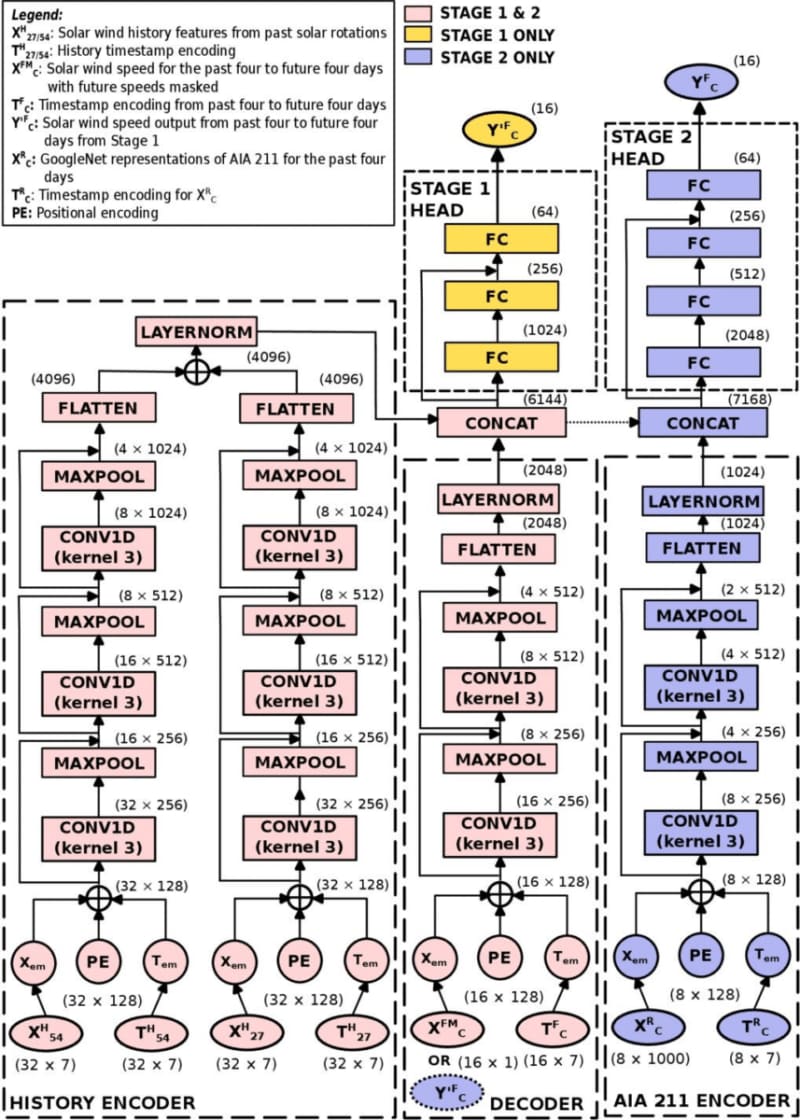
The multimodal encoder–decoder architecture used for predicting solar wind speed for 4 days into the future using solar wind history observed in the prior two solar rotations, the solar coronal EUV images from SDO/AIA 211 Å over the 4 days prior to current time, and the solar wind speed variation over 4 days prior to current time. Credit:The Astrophysical Journal Supplement Series
Understanding the Solar Wind’s Impact
The solar wind is an ongoing stream of charged particles released from the Sun’s atmosphere. This continuous flow of particles extends throughout the solar system, and while it is usually harmless, it can occasionally intensify, leading to solar storms. When these storms reach Earth, they can interact with the planet’s magnetic field, disrupting satellite operations, GPS systems, and even power grids.
Solar wind events have caused significant damage in the past. For example, the 1989 geomagnetic storm caused widespread power outages in Canada, and the more recent 2022 event caused SpaceX’s loss of dozens of satellites. With the new AI-based system, scientists can better predict these solar events and understand the behavior of the solar wind. This improved understanding of space weather behavior is crucial for reducing risks to Earth-based infrastructure and for ensuring the continued operation of satellites and other space technologies.
Enjoyed this article? Subscribe to our free newsletter for engaging stories, exclusive content, and the latest news.