Credit: Canva | The Daily Galaxy –Great Discoveries Channel
A fascinating study, published in The Astrophysical Journal, has shed light on a mysterious chapter in our Solar System’s history. Around 4 to 5 million years ago, the Sun had a close encounter with two massive stars, leaving behind an imprint on the gas clouds surrounding our neighborhood in space. This cosmic event, which affected the ionization levels of local interstellar clouds, offers us new insights into the forces that shaped our region of the galaxy.
The Role of Two Hot Stars in Shaping Interstellar Clouds
Over 4 million years ago,[the Sun ](https://dailygalaxy.com/2025/11/one-of-the-most-exp…
Credit: Canva | The Daily Galaxy –Great Discoveries Channel
A fascinating study, published in The Astrophysical Journal, has shed light on a mysterious chapter in our Solar System’s history. Around 4 to 5 million years ago, the Sun had a close encounter with two massive stars, leaving behind an imprint on the gas clouds surrounding our neighborhood in space. This cosmic event, which affected the ionization levels of local interstellar clouds, offers us new insights into the forces that shaped our region of the galaxy.
The Role of Two Hot Stars in Shaping Interstellar Clouds
Over 4 million years ago,the Sun crossed paths with two giants in the cosmos:** Epsilon and Beta Canis Majoris**, the second and fourth brightest stars in the constellation Canis Major. These massive stars, much hotter and more luminous than our Sun, would have been a spectacular sight.
“If you think back 4.4 million years, these two stars would have been anywhere from four to six times brighter than Sirius is today, far and away the brightest stars in the sky,” said Professor Michael Shull, one of the study’s authors.
This close encounter wasn’t just a remarkable event for the ancient skywatchers of Earth; it also left a long-lasting effect on the local interstellar medium, which is the diffuse gas and dust scattered between stars. According to the study, published in The Astrophysical Journal, the radiation from these stars caused a significant ionization of gas in the surrounding clouds.
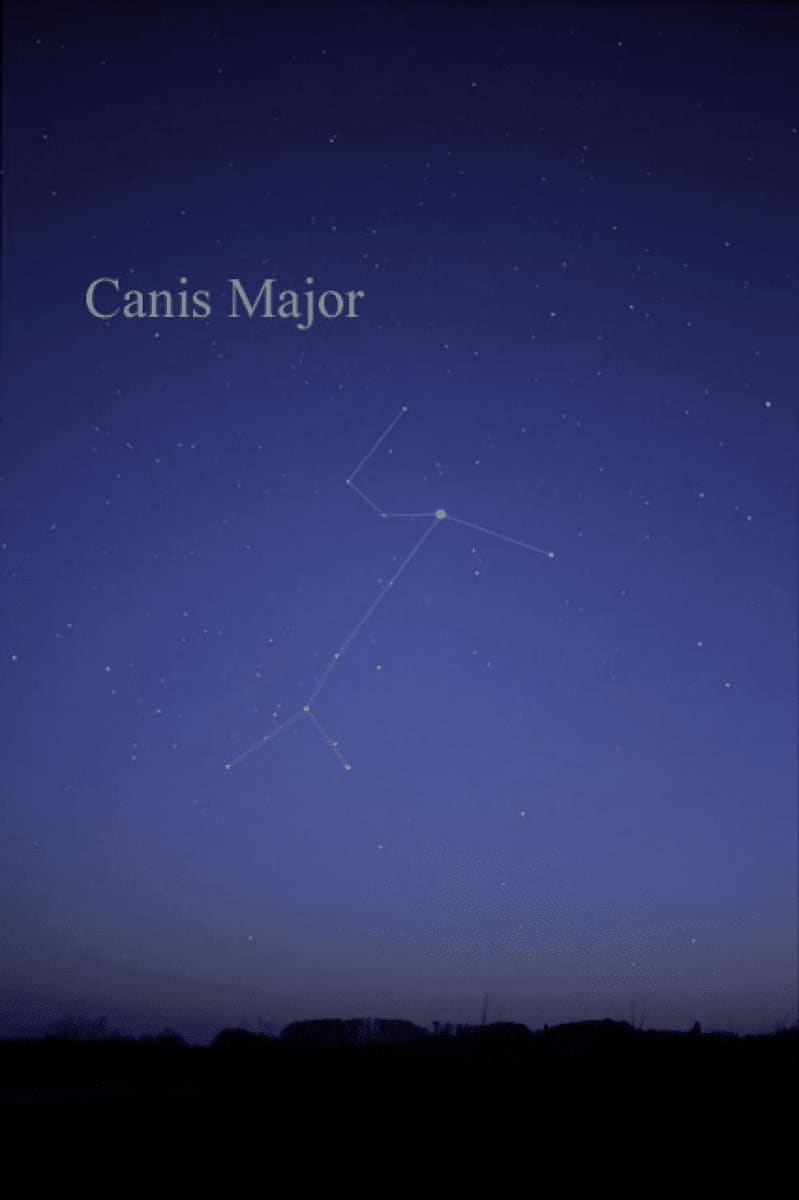
Sirius dominates Canis Major, but the end of the front leg is marked by Beta and Epsilon Canis Majoris, stars that are much larger, and were once close enough to be much brighter. Image credit: Till Credner via Wikimedia Commons (CC BY-SA 3.0)
These clouds, which are approximately 30 light-years wide, are still impacted by this ionization today. The discovery helps explain the unexpected electric charge observed in these clouds and opens up new avenues for understanding our Solar System’s galactic history.
The Impact of Stellar Radiation
The key factor behind this ionization is the radiation emitted by Epsilon and Beta Canis Majoris. These stars are B-type, meaning they are much hotter than the Sun—approximately four times as hot—and emit radiation at much higher frequencies, including X-rays and ultraviolet light. The intense radiation from these stars stripped electrons from hydrogen and helium in the surrounding gas clouds, causing a significant ionization effect. The result is that the interstellar gas in the local region remains more electrically charged than would typically be expected from other nearby cosmic phenomena.
This stellar activity is significant not just for understanding the clouds’ current state but also for revealing a critical piece of galactic history.
“A supernova blowing up that close will light up the sky,” Shull said, hinting at the possible future fate of these stars. “It’ll be very, very bright but far enough away that it won’t be lethal.”
The stars, currently around 400 and 500 light-years away, will eventually end their lives in supernova explosions. While these explosions will be spectacular, they will be too far to pose a direct threat to Earth, thanks to the vast distances involved.
The Connection to Local Interstellar Clouds
The local interstellar clouds have been a subject of mystery for decades, particularly concerning their unusual ionization levels. These clouds, which float in the space between stars, are not empty but are composed of sparse gas and dust. They play a critical role in the galactic ecosystem by contributing to the formation of new stars and planetary systems. However, the ionization of the gas in these clouds had puzzled astronomers for years, as it appeared higher than usual.
The new study reveals that the passing of Epsilon and Beta Canis Majoris provided enough radiation to ionize 20% of the hydrogen and 40% of the helium in the local clouds. This is far above typical ionization levels in space. While the ionization process is temporary, due to the slow rate at which the gas recaptures its lost electrons, the effects of this stellar encounter have remained in place for millions of years, influencing the cosmic environment surrounding our Solar System.
The Legacy of Supernova Explosions
While the encounter with these stars is an ancient event, it’s far from irrelevant. The stars’ eventual supernovae could provide insights into the future of the Solar System’s neighborhood. These supernova explosions, which will occur several million years from now, will send shockwaves through the interstellar medium, dramatically altering the gas clouds and potentially even affecting nearby stars and planetary systems. The ionization legacy from their earlier passage means the local clouds will absorb more cosmic radiation than would otherwise be expected, offering some protection to Earth.
Although this future event might seem distant, it serves as a reminder of the dynamic and ever-changing nature of our galaxy. The passage of these stars has influenced not only the interstellar gas but also the environment in which our Solar System exists, providing a kind of cosmic shield against radiation that could otherwise affect the planets in our system.
Enjoyed this article? Subscribe to our free newsletter for engaging stories, exclusive content, and the latest news.