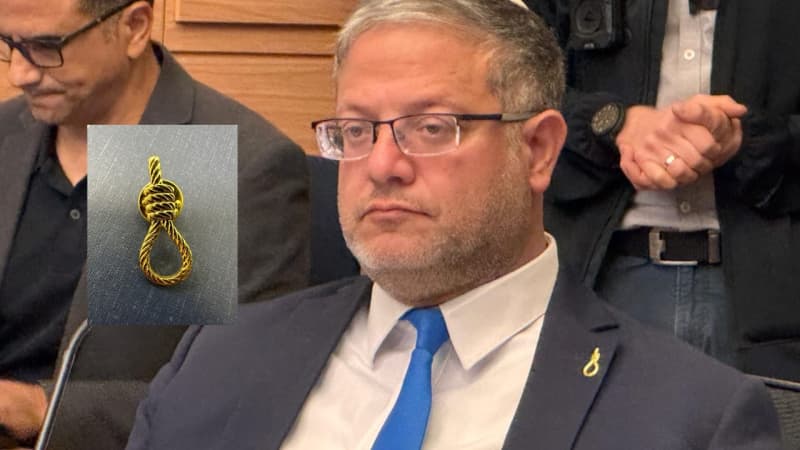
National Security Minister Itamar Ben-Gvir wore a gold pin of a noose, December 8, 2025. (photo credit: ITAMAR BEN-GVIR
“Of course, there is the option of hanging, the electric chair, and there is also the option of lethal injection,” Ben-Gvir explained.
National Security Minister Itamar Ben-Gvir donned a new golden pin in the shape of a noose during the panel to advance the death penalty for terrorists bill, initiated by his Oztma Yehudit Party, at the Knesset’s National Security Committee on Monday.
Other members of the Oztma Y…
National Security Minister Itamar Ben-Gvir wore a gold pin of a noose, December 8, 2025. (photo credit: ITAMAR BEN-GVIR
“Of course, there is the option of hanging, the electric chair, and there is also the option of lethal injection,” Ben-Gvir explained.
National Security Minister Itamar Ben-Gvir donned a new golden pin in the shape of a noose during the panel to advance the death penalty for terrorists bill, initiated by his Oztma Yehudit Party, at the Knesset’s National Security Committee on Monday.
Other members of the Oztma Yehudit Party on the panel also wore noose pins.
The pins received criticism for resembling and replacing the yellow ribbon pin, which has become a symbol associated with the nation’s battle to return the hostages held captive by Hamas.
Ben-Gvir proudly showed off the pin, stating that he and his party members “all came with a pin, and it is one of the options through which we will implement the death penalty for terrorists.”
The method of implementing the death penalty for terrorists is one of the aspects being debated in the bill’s legislation.
The minister said that the pin was worn because execution through hanging was one of the methods being considered to execute terrorists as part of the law.
“Of course, there is the option of hanging, the electric chair, and there is also the option of lethal injection,” Ben-Gvir explained.
Ben-Gvir’s death penalty bill moves forward despite outcry
The previously shown outline of the bill presented to the panel stated that the death penalty would be carried out by lethal injection, which would be required to conduct it within 90 days of the verdict.
In the previous discussion on the bill last month, Dr. Alberto Olszewski spoke as a representative from the Israel Medical Association, raising the issue of doctors being able to ethically participate in administering the lethal shot. He said that no doctor would be willing to cooperate with administering the death penalty to terrorists.
Ben-Gvir readdressed such claims, telling the panel, “Since it was reported that doctors will not want to assist with this law, I have received 100 messages from doctors saying, ‘Itamar, just tell us when.’"
The national security minister added that he would not apologize for the pin and spoke on the strict and harsh conditions that have been implemented in Israel’s prisons.
“We ended the summer camp that existed for decades,” he said regarding the changes he made.
MK Gilad Kariv (The Democrats) slammed the noose pins, calling them a “ cynical and disgraceful campaign on the backs of bereaved families.”
He said they were "a revolting paraphrase of the hostage pins."
"The Kahanists place themselves in line with the greatest haters of the Jewish people who adorned their clothing with symbols of death," he added.
Kariv called the law “immoral and unconstitutional,” noting that it will not pass the Supreme Court, and that the Shin Bet (Israel Security Agency) does not fully support it.
Kariv also sent a letter to the chairperson of the National Security Committee, Zvika Fogel (Otzma Yehudit), requesting that he summon the head of the Shin Bet to present the organization’s position regarding the death penalty bill.
Fogel told the panel that the bill “ is one of the most significant proposals that will be discussed, or has been discussed, in the 25th Knesset.”
He added that the law will allow “to achieve deterrence against those who carry out terror attacks.”
“This will put an end to the motivation to carry out attacks and kidnappings in order to negotiate prisoner exchanges for our hostages,” Fogel said.
The issue most debated in discussions has been the bill’s outline’s ethical and legal aspects.