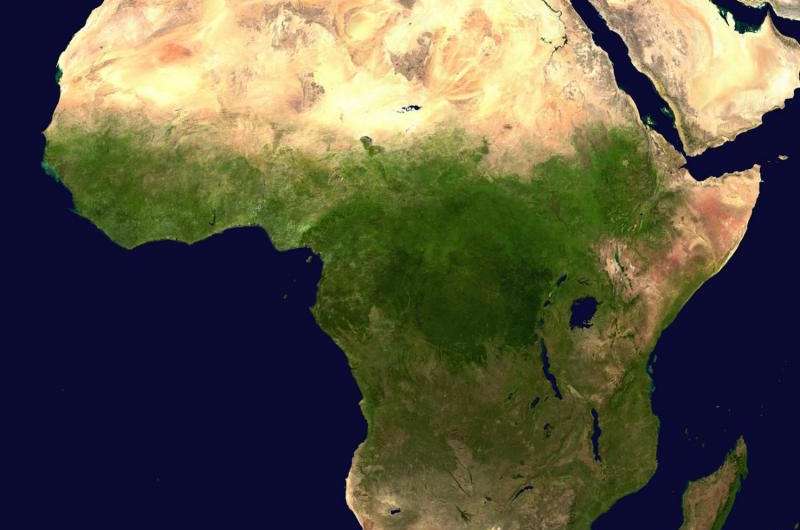
 Satellite imagery of Africa. Credit: Public Domain
Sustainable entrepreneurship in Nigeria is being stymied by a lack of engagement among business owners because of structural economic and institutional barriers, according to research in the World Review of Entrepreneurship, Management and Sustainable Development that has studied one of Africa’s largest entrepreneurial ecosystems.
The research used quantitative data from 310 entrepreneurs across manufacturing, sales, and food services. An analysis of this data showed that unstable macroeconomic conditions, limited access to finance, weak technological infrastructure, a…
Satellite imagery of Africa. Credit: Public Domain
Sustainable entrepreneurship in Nigeria is being stymied by a lack of engagement among business owners because of structural economic and institutional barriers, according to research in the World Review of Entrepreneurship, Management and Sustainable Development that has studied one of Africa’s largest entrepreneurial ecosystems.
The research used quantitative data from 310 entrepreneurs across manufacturing, sales, and food services. An analysis of this data showed that unstable macroeconomic conditions, limited access to finance, weak technological infrastructure, and inconsistent government support are the main barriers faced by entrepreneurs hoping to adopt environmentally responsible business practices.
Moreover, they found that many entrepreneurs operate under conditions in which immediate cash-flow pressures outweigh long-term environmental considerations. The result is that sustainability initiatives are difficult to get underway and even harder to maintain.
Entrepreneurs in Nigeria, the study found, are somewhat aware of sustainability principles, but currency volatility, high inflation, and unreliable public services restrain action. The researchers add that access to affordable credit remains limited, particularly for micro, small and medium-sized enterprises (MSMEs). Such companies with fewer than 250 employees form the backbone of the Nigerian economy.
Without financial buffers or capital, investments in cleaner technologies or resource-efficient processes are often postponed indefinitely. There is thus an urgent need to improve conditions for entrepreneurs to encourage those that are less than willing to engage that there are long-term benefits, and to nudge the more engaged further towards sustainability. Regulatory incentives and green technologies that have remained largely inaccessible to smaller companies need to be opened up to Nigeria’s MSMEs.
There are obvious implications for other emerging economies facing similar constraints, which also risk missing out on the economic, environmental, and social benefits associated with sustainable enterprise. There is a need to align financial systems, policy instruments, and educational initiatives with sustainability objectives across the whole of the developing world, the research would suggest.
More information: Gbemisola Ogbolu et al, Examining the inhibiting factors of sustainable entrepreneurship: evidence from emerging economies, World Review of Entrepreneurship, Management and Sustainable Development (2025). DOI: 10.1504/wremsd.2025.150508
Citation: Structural barriers hinder sustainable entrepreneurship in Nigeria’s business ecosystem, study finds (2026, January 8) retrieved 8 January 2026 from https://phys.org/news/2026-01-barriers-hinder-sustainable-entrepreneurship-nigeria.html
This document is subject to copyright. Apart from any fair dealing for the purpose of private study or research, no part may be reproduced without the written permission. The content is provided for information purposes only.