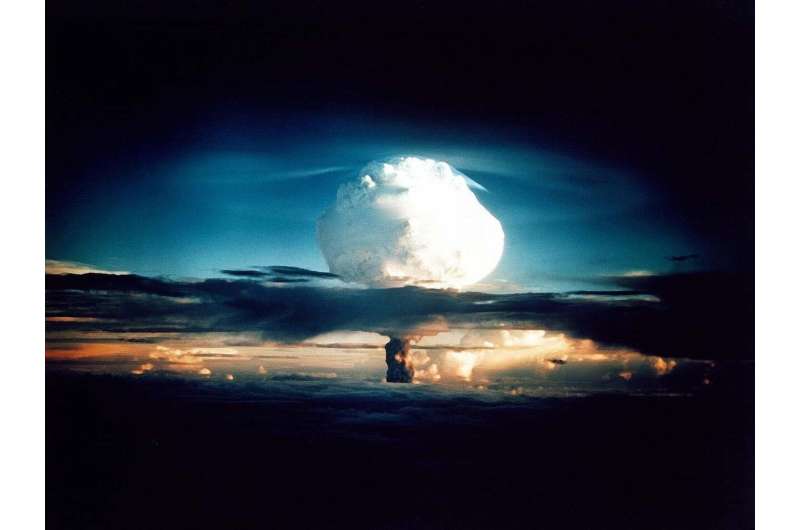
 Credit: Pixabay/CC0 Public Domain
On February 4, the New START Treaty, the last remaining nuclear arms control agreement between the United States and Russia, is set to expire. Signed in 2010, the agreement caps deployed strategic nuclear forces at 1,550 warheads and 700 delivery systems. It also establishes one of the most extensive verification systems ever negotiated, including on-site inspections, continuous data exchanges, and government-to-government notifications about missile tests, weapons movements, and changes to nuclear forces.
According to Monica Duffy Toft, professor of international politics and director of the Center for Strategic Studies at The Fletcher Sch…
Credit: Pixabay/CC0 Public Domain
On February 4, the New START Treaty, the last remaining nuclear arms control agreement between the United States and Russia, is set to expire. Signed in 2010, the agreement caps deployed strategic nuclear forces at 1,550 warheads and 700 delivery systems. It also establishes one of the most extensive verification systems ever negotiated, including on-site inspections, continuous data exchanges, and government-to-government notifications about missile tests, weapons movements, and changes to nuclear forces.
According to Monica Duffy Toft, professor of international politics and director of the Center for Strategic Studies at The Fletcher School, the treaty has functioned as a critical risk-reduction mechanism.
"By providing transparency into the world’s two largest nuclear arsenals, New START has lowered the risk that either side will misinterpret normal military activity as preparation for a nuclear strike," she says.
Mikhail Troitskiy, a specialist in Russian and U.S. nuclear policy and a visiting professor at Fletcher, notes that treaties like New START depend less on rising danger than on deliberate political signaling.
"Arms control only emerges when both sides want to exchange signals of goodwill because they see a benefit in upgrading their cooperation in areas that go beyond arms control," he says. "Heightened risk of conflict outbreak does not by itself bring the states to the arms control negotiation table."
In today’s climate, Troitskiy adds, nuclear risk itself can become a tool—something one side uses to pressure a more cautious adversary by exploiting fears of escalation or an unconstrained arms race.
For decades, Washington and Moscow were prepared to engage on a cooperative footing. Now, the agreement’s possible collapse comes at a moment of extraordinary geopolitical strain, with Russia’s war in Ukraine ongoing, U.S.–Russia relations at their lowest point in decades, and other nuclear powers expanding their capabilities.
Against this backdrop, Tufts Now spoke with Toft and Troitskiy about the treaty’s legacy—and the risks associated with its expiration.
Why is the treaty about to expire, and what has stopped the US and Russia from renewing it?
Toft: The treaty was written with a fixed term, and there’s no automatic renewal mechanism; extending or replacing it requires active agreement by both parties. Although it was extended once in 2021, relations between Washington and Moscow have since deteriorated sharply.
In February 2023, Russia suspended its participation, halted inspections and data exchanges, and claimed—without independent verification—that it continues to observe the treaty’s numerical limits. The United States has said it will engage only if verification is restored, a condition Russia rejects while sanctions remain.
Troitskiy: Arms control has always depended on the broader political relationship. When that relationship collapses, treaties rarely survive. After Russia’s invasion of Ukraine, the political foundation for cooperation disappeared.
Russia also began using nuclear rhetoric and nuclear ambiguity as part of its wartime strategy to intimidate Western governments and limit Western support for Ukraine. In that climate, Moscow had no interest in inspections or transparency. Without those, the treaty effectively stopped functioning.
If the treaty ends, could the US and Russia start building more nuclear weapons? If so, how quickly?
Troitskiy: Yes, but the central danger is not simply higher numbers. It’s instability.
Both countries are developing new types of delivery systems that fall outside older arms-control categories. These innovations can create the illusion that one side might gain an advantage, weakening deterrence and encouraging the belief that crises can be managed or exploited.
Historically, moments when leaders believe deterrence is eroding are the most dangerous, inviting risk-taking, brinkmanship, and the temptation to test limits rather than preserve them.
Toft: Russia could increase its deployed warhead count relatively quickly by uploading additional warheads onto existing missiles, a process that could occur over months to a few years. Building entirely new delivery systems would take longer, typically five to ten years.
The United States faces more significant industrial constraints, particularly in plutonium pit production, meaning any large-scale expansion would take years. However, the U.S. maintains a substantial reserve of non-deployed warheads that could eventually be reintroduced.
Importantly, the most likely near-term consequence is not a massive numerical buildup, but a qualitative arms race: greater emphasis on hypersonic delivery systems, missile defenses, counterspace capabilities, and AI-enabled command-and-control.
Does losing this treaty make a nuclear arms race, or even nuclear war, more likely?
Toft: Yes—primarily by intensifying the security dilemma. When one state takes steps to increase its security, others often feel less secure and respond in ways that leave everyone worse off. Arms control agreements emerged precisely to dampen this dynamic, by clarifying capabilities and intentions and reducing incentives to assume the worst.
If New START collapses and transparency disappears, each side must rely more heavily on intelligence estimates and worst-case planning. In a crisis, this can create pressure to "launch on warning," forcing decisions within minutes, before an attack is fully confirmed.
The consequences extend beyond Washington and Moscow. Allies may lose confidence in extended deterrence guarantees, while pressure grows for independent nuclear capabilities. In a more crowded nuclear landscape, the risks of accidents and crisis escalation rise sharply.
Troitskiy: Whether the dynamics spiral into catastrophe depends less on technology than on politics.
The greatest risks today come from leadership behavior: nuclear threats, brinkmanship, and the willingness to use nuclear weapons as tools of coercion. Treaties do not eliminate those dangers, but they lower the background level of risk by setting expectations and creating restraints.
When those structures disappear, crises become harder to manage. More depends on guesswork and on leaders’ temperaments and choices. Ultimately, stability turns on political will: on whether governments treat nuclear weapons as instruments of restraint or as tools of pressure and coercion.
Is there any chance of a new agreement soon? And could it include other countries, like China, Great Britain, or France?
Troitskiy: Multilateral discussions exist, but binding commitments are another matter. None of the other nuclear powers has shown serious willingness to enter enforceable limitation regimes.
For the foreseeable future, any meaningful arms control, if it returns at all, is likely to begin again with Washington and Moscow.
Toft: The prospects for a replacement agreement in the near term are extremely low. Meaningful arms-control negotiations require at least minimal trust and communication. Right now, neither exists.
A trilateral agreement involving China is also unrealistic. China’s nuclear arsenal is far smaller than those of the United States and Russia, and Beijing has consistently rejected frameworks that would either lock in asymmetry or pressure it to expand rapidly. Britain and France have likewise treated their arsenals as sovereign national deterrents, not bargaining chips in U.S.–Russian negotiations.
The most plausible future path is a return to bilateral dialogue after a major shift in the Ukraine conflict. Until then, the absence of agreements sends a powerful signal: that great powers are increasingly willing to tolerate unmanaged nuclear risk.
Citation: The New START treaty is ending. What does that mean for nuclear risk? (2026, January 31) retrieved 31 January 2026 from https://phys.org/news/2026-01-treaty-nuclear.html
This document is subject to copyright. Apart from any fair dealing for the purpose of private study or research, no part may be reproduced without the written permission. The content is provided for information purposes only.