
You are scrolling through ChatGPT, casually asking about dinner ideas. “I am craving Thai curry tonight,” you type.
The AI responds, “I found three options on BigBasket. The Panang curry from Thai Express is $12, rated 4.5 stars, and can be delivered by 7 PM. Want me to order it for you?”
You say yes. The AI places the order, processes your UPI payment, and confirms delivery. You never left the chat. You never opened another app. You just talked.
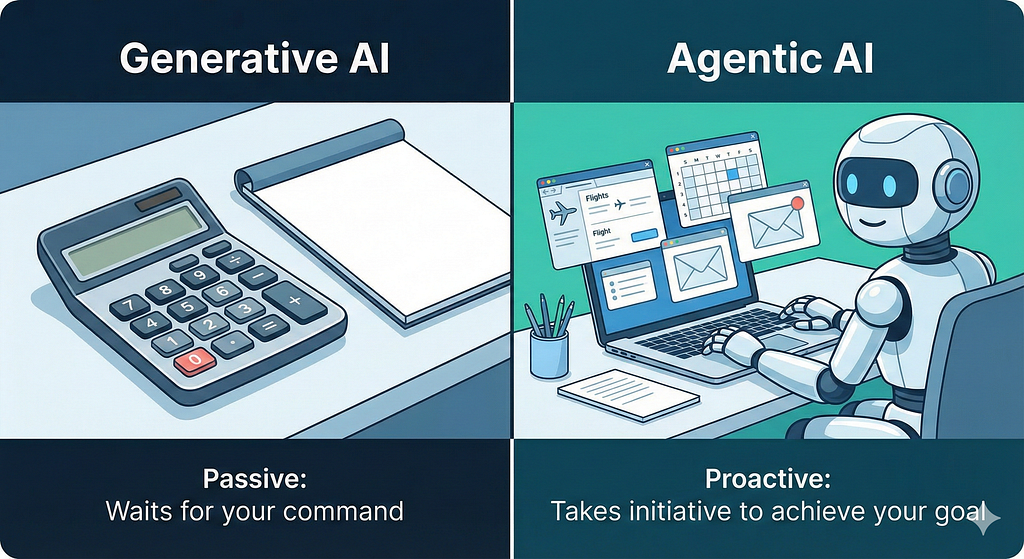
This is not science fiction. This is gonna happen in India through Razorpay’s partnership with OpenAI, launched in October 2025 [ You are scrolling through ChatGPT, casually asking about dinner ideas. “I am craving Thai curry tonight,” you type. The AI responds, “I found three options on BigBasket. The Panang curry from Thai Express is $12, rated 4.5 stars, and can be delivered by 7 PM. Want me to order it for you?” You say yes. The AI places the order, processes your UPI payment, and confirms delivery. You never left the chat. You never opened another app. You just talked. This is not science fiction. This is gonna happen in India through Razorpay’s partnership with OpenAI, launched in October 2025 [Source]. Welcome to the world of agentic AI. In this world, your money does not just sit in accounts waiting for you to move it. It acts on your behalf. Here is the thing most people miss about AI in banking. We are not just getting better chatbots. We are witnessing a fundamental change in how AI operates. Generative AI is passive. You ask ChatGPT a question, and it answers. Then it waits. You stop typing, and it stops working. It is powerful, but it is still just sitting there like a calculator on your desk, waiting for you to press the next button. Agentic AI is proactive. It has agency. You give it a goal, and it figures out the steps, uses whatever tools it needs, executes the tasks, and checks its own work until the job is done. Think of it this way: Behind the scenes, these agents use frameworks like LangGraph that work completely differently from traditional AI. Instead of generating text in a straight line, agentic AI operates in a loop: This is why it feels different. It does not need you to babysit every step. The numbers tell a story of massive, coordinated investment. The market for generative AI in financial services hit USD 1.95 billion in 2025 [Source]. By 2034, analysts project it will reach USD 15.69 billion, growing at 26.29% annually [Source]. Banks are not watching from the sidelines. They are spending over $80 billion on AI in 2025 alone [Source]. But here is the stunning gap that represents the biggest opportunity in fintech right now: That 87-point gap? That is where fortunes will be made. The demand is nearly universal. The execution is still rare. Let me show you what is actually deployed right now, not pilot programs or demos. JPMorgan’s COIN platform handles something that used to crush their legal team: reviewing commercial loan agreements. Picture this: thousands upon thousands of dense legal documents, each one needing careful review by lawyers and loan officers. The manual process consumed roughly 360,000 hours of work every year [Source]. COIN’s agents read, understand, extract key terms, and flag issues in these documents autonomously. The same work that took 360,000 human hours now happens in seconds. But that is not even the most impressive part. JPMorgan built an internal LLM suite that now serves over 250,000 employees, with roughly half using it daily [Source]. Tasks that used to eat up junior bankers’ entire days, like creating a five-page investment deck on a company like Nvidia, now take about 30 seconds [Source]. It plans to cut 10% of operations staff over the next five years [Source]. For digital banks, customer onboarding is the ultimate bottleneck. Every new account means document verification, compliance checks, identity confirmation, and a maze of regulatory requirements. ING deployed agentic workflows to handle this automatically. The agents verify documents, cross-check databases, and flag anything suspicious without human intervention. The results: a 90% reduction in onboarding time and a 30% decrease in staff workload [Source]. Think about what that means. Customer experience improves dramatically (nobody wants to wait days for account approval), and human employees stop spending their days staring at passport photos and utility bills. They focus on complex cases that actually need human judgment. We started with this example because it shows where all of this is heading. Razorpay, NPCI, and OpenAI launched “Agentic Payments on ChatGPT” in October 2025 [Source]. The agent lives inside your chat interface. You mention wanting groceries, it finds them, orders them, and pays through UPI without you switching apps or opening payment portals. With ChatGPT serving 800+ million users globally [Source], this pilot could fundamentally change how we think about transactions. The friction between intent and action essentially disappears. According to a Google Cloud survey of 556 financial services leaders [Source], here is where agents are being deployed right now: The fraud prevention market alone is exploding from $2.7 billion to $10.4 billion by 2027, according to Juniper Research [Source]. Let me be honest with you. This is not all smooth sailing. There are serious challenges that most hype articles completely ignore. The 40% Failure Rate Building agents is genuinely hard. They can get stuck in loops, make terrible decisions, or simply fail to understand nuanced goals. 40% of agentic AI projects are predicted to be cancelled by 2027 due to unclear ROI, technical failures, or escalating costs [Source]. If you are building in this space, you need to know that this is high risk territory. The Black Box Problem Banks are heavily regulated. If an AI agent denies your loan application, the bank must explain exactly why. But deep learning models are often “black boxes.” Even the engineers who built them cannot always explain how they reached a specific conclusion. This creates massive compliance risks [Source]. Regulators do not accept “the AI said no” as an answer. The Integration Nightmare 87% of IT executives say interoperability is crucial, and lack of it is the second biggest reason these pilots fail (right after data quality issues) [Source]. Modern AI agents need to talk to banking systems built in the 1980s. Legacy code. Mainframes. Systems that were never designed to have APIs. Getting these pieces to work together is brutally difficult. What Happens to the People? Here is the question everyone is thinking but few articles address: what about the humans? JPMorgan is planning to cut 10% of operations staff over five years [Source]. ING reduced staff workload by 30% [Source]. These are not abstract numbers. These are jobs. The honest answer is complicated. Some roles will disappear. The junior banker spending hours on PowerPoint decks? That job is already obsolete at JPMorgan. The loan officer is manually reviewing documents? COIN does it better and faster. But new roles are emerging. Someone needs to train these agents, monitor them, handle edge cases they cannot figure out, and make judgment calls on complex situations. The skills that matter are shifting from manual execution to strategic oversight. By 2026, we are looking at a fundamentally different financial landscape. The fintech world is splitting into two groups: those building the agents and those being replaced by them. This is not about whether agentic AI will transform banking. That is already happening. JPMorgan’s 250,000 employees using it daily. Razorpay processes payments through chat. ING onboarding customers in a tenth of the time. The question is simpler and more personal: which side of this transformation will you be on? The data shows the race has already started. The only question left is whether you are running in it or watching from the sidelines. Agentic AI in Fintech: How Autonomous Agents End “Click and Pray” Banking was originally published in Towards AI on Medium, where people are continuing the conversation by highlighting and responding to this story.
The Shift You Need to Understand: From Tools to Agents
How This Actually Works

Why This Is Exploding Right Now
What This Looks Like in the Real World
JPMorgan Chase: The 360,000 Hour Savings
ING: The 90% Faster Onboarding
Razorpay: Payments That Feel Like Magic
Where Banks Are Actually Deploying This
The Hard Truths Nobody Wants to Talk About
Where This Goes Next