 Presented by BulletMagnet
Note from racketboy: Once again, it’s a pleasure to have BulletMagnet back to guide us through another blockbuster shmup library. Â His guides to the Sega Saturn and Playstation Shmup Libraries are required reading for those looking to explore the genre. Â This time he looks at some more modern, but equally thrilling shooters on the Playstation 2.
Hello again everyone – before we begin, please note the newly-added designations in parentheses which are found below each game’s title. The fi…
Presented by BulletMagnet
Note from racketboy: Once again, it’s a pleasure to have BulletMagnet back to guide us through another blockbuster shmup library. Â His guides to the Sega Saturn and Playstation Shmup Libraries are required reading for those looking to explore the genre. Â This time he looks at some more modern, but equally thrilling shooters on the Playstation 2.
Hello again everyone – before we begin, please note the newly-added designations in parentheses which are found below each game’s title. The first part, to the left of the comma, denotes the region(s) each game was released in: “JP†for NTSC-J (Japan/Asia), “US†for NTSC-U (North America), and “PAL†for, well, PAL (Europe/Australia). If you see an asterisk (*) next to any of these, it means that some sort of exclusion, exception or other unusual situation exists for that region’s version, and should be explained in further detail within the underlying text. To the right of the comma you’ll learn whether the media format of each game is a CD or DVD – again, an asterisk indicates some manner of anomaly to be elaborated in the main body.
Hopefully this extra information will be of additional use to you: as always, if there’s something I’ve missed or misstated anywhere in here, please let me know in the comments so I can get to fixing it (if poor RB doesn’t strangle me first). Above all, of course, I hope you enjoy reading this, as well as hopefully tracking down and playing some of this stuff afterwards too!
Shmups 101 | Beginner Shmups | Defining Shmups | Hidden Gem Shmups
Shmup Libraries: TG16/PC Engine | Genesis/Megadrive | PS1 | Saturn | Dreamcast | PS2 | Gamecube | | Game Boy Advance | Odyssey 2 | Amiga |
DoDonPachi Dai-Ou-Jou
(JP, DVD)
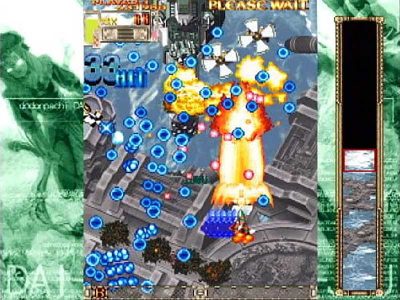 The third (or fourth, if you count the outside-developed Bee Storm) entry in Cave’s marquee “DonPachi†series, Dai-Ou-Jou (roughly “peaceful deathâ€) abandons the relatively accessible style of its forebears; this sucker is among the company’s most challenging offerings, if not one of the toughest shmups ever, period. The traditional trio of selectable craft is replaced by a Progear-esque lineup of two planes and three stat-altering cyber-loli “co-pilotsâ€, but shooting, lasering, bombing, and chaining are much as you remember them, with one major addition: the “Hyperâ€. As you rack up sequential kills and collect hidden bee medals (which now must be snatched mid-chain for worthwhile rewards), a “hyper meter†fills up, and once topped out a “Hyper†item will appear; up to five can be stocked. The next time you push the “bomb†button, all stored “Hypers†will be spent at once to boost your weapon power (and the resulting hit count) to ridiculous levels; careful though, as frequent hyper use makes enemies even angrier at you.
There are only five stages to traverse (if you don’t count the super-difficult second loop), but they’re more than nasty enough to keep even the best players busy: the onslaught of big flashy baddie bullets is unrelenting, and you’ll be amazed at the effort it takes to weave your pint-sized hitbox out of so much trouble. And that’s just when playing to survive: if you thought putting together high scores in the first two DonPachis was difficult, be prepared to train like a Shaolin monk before so much as glimpsing a respectable point total here. Thanks to Hypers it’s now possible to extend chains much longer than before, but success on this front still demands split-second timing and incredibly precise movements; if you DO somehow manage to tame this monster, the blazing flames engulfing your formerly-fierce adversaries seem to shine brighter than ever.
It’s a perilous journey no matter how you play, but at least you don’t have to worry about the technical end giving you any problems. While Arika, the company behind this port, is probably best-known for the less-than-stellar Street Fighter EX series, they definitely hit a home run here. The gloomy, post-apocalyptic atmosphere (which, to be fair, might not appeal to those who like a bit more color), slowdown level, and almost everything else are very faithful to the arcade original; they’re accompanied by some nifty extras too, most notably a cracked-out boss rush mode aptly titled “Death Label†(not to be confused with the game’s “Black Label†arcade revision, later ported to the 360). You also get a wide array of display options, an image gallery, optional arranged music, a full-featured “simulation†mode (including a “no-bullet†mode ideal for chaining practice), replay saving, and a viewable superplay on the game disc; more is available on the second “Special DVD†that comes packed in. If the admittedly harrowing challenge doesn’t put you off, consider this one of the PS2’s essential shmup imports. Shop for DoDonPachi Dai-Ou-Jou on eBay Shop for DoDonPachi Dai-Ou-Jou on Amazon.com
ESPGaluda
 (JP, DVD)
On the other hand, if you like Cave’s style but Dai-Ou-Jou sounds like too tall an order, ESPGaluda ought to be right up your alley: though its name is reminiscent of 1998 arcade exclusive ESP Ra.de, it has little in common with that game, save the fact that you still control a flying person instead of an aircraft. You’ve also got the expected shot/laser/bomb setup going, but now all killed enemies leave behind green gems: these shiny stones aren’t worth much in terms of points, so what’s their purpose? Glad you asked: they fuel the game’s primary gimmick, “kakusei (awakening) modeâ€, which is basically Matrix-style “bullet timeâ€. Hit the “B†button to switch into kakusei, and everything onscreen except your character slows down drastically, making your life a lot easier: the catch is that you need gems to use it, and being in this state constantly drains your supply. Watch out if your reserves run completely dry before you swap back into “normal†mode – enemy bullets become faster, and tougher to dodge.
(JP, DVD)
On the other hand, if you like Cave’s style but Dai-Ou-Jou sounds like too tall an order, ESPGaluda ought to be right up your alley: though its name is reminiscent of 1998 arcade exclusive ESP Ra.de, it has little in common with that game, save the fact that you still control a flying person instead of an aircraft. You’ve also got the expected shot/laser/bomb setup going, but now all killed enemies leave behind green gems: these shiny stones aren’t worth much in terms of points, so what’s their purpose? Glad you asked: they fuel the game’s primary gimmick, “kakusei (awakening) modeâ€, which is basically Matrix-style “bullet timeâ€. Hit the “B†button to switch into kakusei, and everything onscreen except your character slows down drastically, making your life a lot easier: the catch is that you need gems to use it, and being in this state constantly drains your supply. Watch out if your reserves run completely dry before you swap back into “normal†mode – enemy bullets become faster, and tougher to dodge.
“Kakuseiâ€, as it turns out, is also the key to scoring – whenever you dispatch a slowed-down adversary, all of its onscreen bullets are transformed into shiny gold pieces, your main source of points. Moreover, the greater the amount of gold you can pile up in one “shift†before switching back to “normal†mode, the more each piece is worth, so to hit the jackpot you’ll want to look for spots where you can either stay in Kakusei awhile or cancel a big pattern all at once (or both) to rake in maximum profits. The beauty of ESPGaluda’s system lies in the fact that almost any player type can tailor it to his own needs: less-experienced shmuppers can save up gems for rough spots where the reduced bullet speed can help them pull through, while seasoned shooter fans can blow it all on mining that sparkly gold. On that note, Galuda’s inherent difficulty level lies on the lower end of the scale (for Cave, anyway), but the presence of even more advanced scoring techniques (check an FAQ for further details) gives just about every shmupper something to love.
Arika handled this port as well, and did at least as good a job as on Dai-Ou-Jou: the standard Arcade mode is again just about perfect, and accompanied by the same gallery, practice, and replay options as their previous effort (plus another supplementary DVD). The biggest bonus here, though, is a full-fledged “Arrange†mode, featuring meaner baddies and two exclusive playable characters. The level layouts haven’t changed, but these new recruits have access to both kakusei mode and the secondary “piercing shot†from Ra.de, which multiplies the value of enemy kills when used correctly; combine the two and some truly insane scoring possibilities open up (if you can juggle all the required buttons with enough skill). It’s unfortunate that neither this nor Dai-Ou-Jou ever saw release outside of Japan, but trust me: if you’re a shmup fan you definitely have to try them. Shop for ESPGaluda on eBay Shop for ESPGaluda on Amazon.com
Gradius V
 (JP/US/PAL, CD)
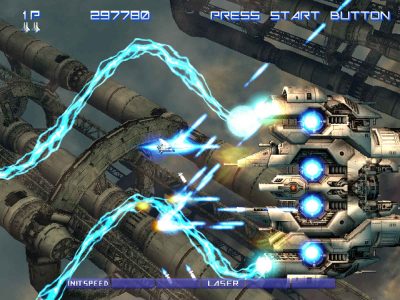
It took the combined efforts of Konami, Treasure and G. Rev to make it happen, but lo and behold, the fifth “numbered†Gradius game: like its immediate series predecessor the graphics are polygonal, but the action remains classically two-dimensional. Players again have four (slightly-)varying weapon setups to choose from, but thanks to the new “Option Type†affixed to each one this decision is more important than ever – depending on the “type†you choose, your “option†helpers will do different things when you hold down the R button, such as freezing in place, spreading out/clustering together, or rotating around your ship. These handy abilities drastically alter how the game is played: each comes with distinct advantages and disadvantages, but no matter which you pick you’ll need to make good use of it to survive. This, however, is not the biggest change in store for longtime fans: Treasure’s influence on the formula is strongly felt, and not just in the big, beautiful explosions. Gradius V plays more like a “bullet hell†shmup than any of its forebears: enemy shots and other obstacles frequently clog up most of the screen, forcing players to rely on precise maneuvering and a newly-tiny hit area to stay in one piece.
(JP/US/PAL, CD)
It took the combined efforts of Konami, Treasure and G. Rev to make it happen, but lo and behold, the fifth “numbered†Gradius game: like its immediate series predecessor the graphics are polygonal, but the action remains classically two-dimensional. Players again have four (slightly-)varying weapon setups to choose from, but thanks to the new “Option Type†affixed to each one this decision is more important than ever – depending on the “type†you choose, your “option†helpers will do different things when you hold down the R button, such as freezing in place, spreading out/clustering together, or rotating around your ship. These handy abilities drastically alter how the game is played: each comes with distinct advantages and disadvantages, but no matter which you pick you’ll need to make good use of it to survive. This, however, is not the biggest change in store for longtime fans: Treasure’s influence on the formula is strongly felt, and not just in the big, beautiful explosions. Gradius V plays more like a “bullet hell†shmup than any of its forebears: enemy shots and other obstacles frequently clog up most of the screen, forcing players to rely on precise maneuvering and a newly-tiny hit area to stay in one piece.
Once you’ve adjusted to these anomalies, things start to look more familiar: the standard power-up bar, “core†bosses, and lack of any real scoring system are all accounted for, not to mention that you’ll still occasionally get swatted by a hard-to-see gray bullet or an unannounced enemy approaching from the rear, so this is definitely still a Gradius game. It is fair to state, though, that it’s a different breed of Gradius than any other, and while many fans won’t mind the shakeup others might prefer to stick to the classics (if only for the ambience; the scenery here is decidedly less varied than its predecessors’). If you do decide to take the plunge into this flashy new brand of Bacterion extermination the game isn’t hard to find, but it IS hard to beat (and as if finishing one run isn’t tough enough, infinite loops await those stubborn enough to get to them). Hanging in there will eventually unlock some extra “custom†weapon configurations, a la Gradius III, while similar doggedness on the secondhand market might net you the “History of Vic Viper†booklet or “Options†DVD included with first-print Japanese (and Asian) editions. If you really want to round out the collection you can also seek the Konamistyle-exclusive “Perfect†superplay DVD or the USA preorder “Breakdown†DVD…the “Director’s Cut†edition or other super-rare prizes awarded to winners of the official Western scoring competition, however, are likely beyond your grasp, so for your sanity’s sake you might just want to enjoy the game instead. Shop for Gradius V on eBay Shop for Gradius V on Amazon.com
Shikigami no Shiro (Series)
 (JP/US/PAL, CD)
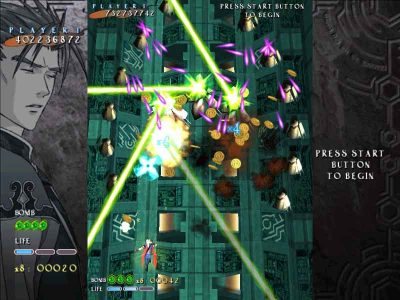
Alfa System, a small developer comprised largely of ex-Taito employees, has been an esoteric industry presence for a number of years, but shmuppers know them best for their Shikigami no Shiro shooters (a “shikigami†is a sort of helper spirit, while “shiro†means, among other things, “castleâ€), two of which made appearances on the PS2. The first game lays out the basic premise: you take control of one of several super-powered human characters in an effort to exorcize the creepy monsters appearing all over Tokyo. Tapping the fire button activates your “normal†weapon, but holding it down unleashes a more specialized “shikigami†attack, and focuses your movement speed: defeated enemies drop coins, which boost both your offensive abilities and your score. Finishing baddies off with your shikigami auto-collects the resulting loot, so you’ll want to utilize the former as much as possible.
(JP/US/PAL, CD)
Alfa System, a small developer comprised largely of ex-Taito employees, has been an esoteric industry presence for a number of years, but shmuppers know them best for their Shikigami no Shiro shooters (a “shikigami†is a sort of helper spirit, while “shiro†means, among other things, “castleâ€), two of which made appearances on the PS2. The first game lays out the basic premise: you take control of one of several super-powered human characters in an effort to exorcize the creepy monsters appearing all over Tokyo. Tapping the fire button activates your “normal†weapon, but holding it down unleashes a more specialized “shikigami†attack, and focuses your movement speed: defeated enemies drop coins, which boost both your offensive abilities and your score. Finishing baddies off with your shikigami auto-collects the resulting loot, so you’ll want to utilize the former as much as possible.
Things get far more interesting, though, once you factor in the series’ main claim to fame, the “Tension†system: the closer you are to enemies or their projectiles at any given time, 1) the stronger your “normal†shot gets, 2) The more coins enemies leave behind, and 3) The more points you earn for both kills and coinage (up to 8 times base value). For optimal results you’ll want to bring down as many targets as possible with your secondary weapon, deliberately cheating death while doing so: of course, this is much easier said than done, and you’ll likely need to unload a bomb or two to get out of tight spots (use them sparingly, though, as these do NOT restock after dying). On the periphery players can access a practice mode, boss rush, image gallery and story recap, as well as a healthy selection of gameplay options: thankfully, all of these extras were carried over into the sequel.
The first Shikigami no Shiro is built around an intriguing concept (and features a cameo character from gun shooter Elemental Gearbolt), but its mixture of 2-D sprites and 3-D backgrounds is somewhat unsightly, and being powered down upon death serves to compound players’ frustrations, since this makes it increasingly difficult to earn coins and power back up. Moreover, while the game received both a limited edition (which included a figure of one of the characters) and a reprint in Japan, US and PAL gamers had to make do with the dreadful localization “Mobile Light Force 2â€, which saw fit to ditch all of the story segments and many of the options, replacing them with abysmally bad redubbed voices and utterly nonsensical cover art: it’s cheap to buy, but still not recommended.
Thankfully, Shikigami no Shiro II improves things on almost every front: the graphical style is more unified (though still nothing too impressive overall), new “Easy†and “Extreme†modes and an arranged OST have been added, the playable cast is larger, everyone’s attack options have been expanded, and you no longer need to worry about being gimped offensively after messing up. Again, Japanese shmuppers got an LE (with a different model figure) and a reprint, but the rest of us didn’t make out too badly this time either: the localized edition, simply dubbed “Castle Shikigami 2†(the PAL version tacks on a weird “War of the Worlds†subtitle), leaves all of the most important original features intact, though the text translations and dubbed voices are still laughable. It’s a bit more slowdown-laden (if you don’t turn “wait†off) than ports to other systems and lacks a few of their extras, but is also much less pricey: if the risk/reward contrast of the “tension†system sounds appealing to you, by all means spend a few measly bucks to pick this up.
As a final note, there is a third Shikigami no Shiro game on the PS2, subtitled “Nanayozuki Gensoukyoku†(“Fantasy of the Seven-Moon Nightâ€), but it is an offshoot, not a “true†Shikigami title: most of its content is in the “visual novel†style, with only a handful of pared-down shmup segments sprinkled throughout. Shop for Shikigami no Shiro Series on eBay Shop for Shikigami no Shiro Series on Amazon.com
Psyvariar (Series)
 (JP/PAL*, CD)
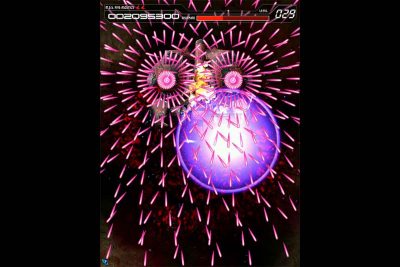
The Psyvariar series, which comes to you courtesy of Korean developer Skonec, centers around the so-called “buzz†mechanic, which is similar in spirit to Shikigami no Shiro’s “tensionâ€. As you both shoot down baddies and closely “graze†them and their bullets, not only does your score increase, but a “level†bar at the top of the screen gradually builds – upon reaching maximum capacity you’ll “level up†and get a moment or two of invincibility, during which you can bullet-scratch with impunity and ram baddies for damage. Level up enough times and your craft will change form, gaining extra firepower as well as access to tougher (and more lucrative) branching stage paths in the process – you can also make the ship “roll†by rapidly moving the joystick back and forth, which alters its movement speed, focuses its shot, and widens its “buzzing†range. Individual areas are short in length, but boss battles are the real highlight: you can shoot (or smart bomb) them into submission if you want, but to fully exploit these harrowing encounters you’ll want to let them live (and “buzz†as many of their bullet-rich patterns as you can) until they self-destruct instead.
(JP/PAL*, CD)
The Psyvariar series, which comes to you courtesy of Korean developer Skonec, centers around the so-called “buzz†mechanic, which is similar in spirit to Shikigami no Shiro’s “tensionâ€. As you both shoot down baddies and closely “graze†them and their bullets, not only does your score increase, but a “level†bar at the top of the screen gradually builds – upon reaching maximum capacity you’ll “level up†and get a moment or two of invincibility, during which you can bullet-scratch with impunity and ram baddies for damage. Level up enough times and your craft will change form, gaining extra firepower as well as access to tougher (and more lucrative) branching stage paths in the process – you can also make the ship “roll†by rapidly moving the joystick back and forth, which alters its movement speed, focuses its shot, and widens its “buzzing†range. Individual areas are short in length, but boss battles are the real highlight: you can shoot (or smart bomb) them into submission if you want, but to fully exploit these harrowing encounters you’ll want to let them live (and “buzz†as many of their bullet-rich patterns as you can) until they self-destruct instead.
The first Psyvariar, subtitled “Medium Unitâ€, pioneered the features detailed above, but a closely-following update, “Psyvariar Revisionâ€, puts a slightly different spin on the action: not only have the visuals and overall layout been remixed, but while Medium Unit only allowed you to “buzz†each onscreen bullet once, in Revision you can linger around and leech off of shots infinitely as long as they’re visible, fueling your “level-up†meter to the point where you can (and should) “chain†invincibility bursts together at length in quite a few places. Players can also opt to use “small†bombs instead of screen-filling ones if they want to slip out of a jam without eliminating enemies or their buzz-able attacks. “Medium Unit†and “Revision†were originally ported to the PS2 together, as “Psyvariar Complete Edition†– while somewhat spartan, each includes a handy “roll†button, which allows you to spin your ship without killing your controller or your thumbs (though some purists refuse to utilize it). Japan scored not one but two limited editions, a “Sound Box†which packs in a soundtrack CD, and a “Capture Box†with a superplay DVD – later on the two games got individual reprints under the “SuperLite†budget label. Europe was lucky enough to rate a well-handled localization of the “regular†Complete edition, but the other side of the Atlantic was shafted completely.
A few years later, along comes a bona fide Psyvariar sequel: not only have the graphics been dramatically improved, but you now choose between either a “shooter-type†or “buzz-type†mech at the beginning to correspond with your play style (though you’ll still need skill in both areas to succeed, regardless of your preference). In most other respects this followup is similar to Revision, though now the difficulty level of each stage is automatically chosen based on your performance in the previous one; moreover, your craft will no longer “evolve†mid-stage, but will wait until the current mission is finished to do so. The PS2 version, subtitled “Ultimate Finalâ€, is widely considered the best port available: though load times are a bit longer and some of the graphical effects aren’t as flashy as in the Naomi or Dreamcast originals, the exclusive extra content more than makes up for it . Along with the return of the “roll†button, you get a stage select, a “mission†mode, a gallery, a “visible hitbox†option, and a pack-in replay DVD – sadly, unlike its predecessors this one never left Japan, and is a ways trickier to track down. Shop for Psyvariar Series on eBay
Homura
 (JP/PAL, CD)
While the Psyvariars have managed to garner themselves a bit of a cult following, only a handful of shmuppers are familiar with Skonec’s “other†shooter, Homura (“flame†or “blazeâ€): a shame, as it’s rather good too. You play as some sort of fallen angel/samurai, who not only fires off shots but slashes with a close-range sword: in similar fashion to Giga Wing the latter attack can knock shots back at enemies, but you’ll need to “recharge†for a few seconds between strikes. Your blade has another, more impressive function as well: if you take a swing directly at a (non-boss) enemy instead of a bullet, your character will go nuts and zoom invincibly all over the place, insta-killing all adversaries present. This technique is not only a handy “screen wipeâ€, but your key to high scores: the number of enemies you bring down in one berserker rush becomes your point multiplier (i.e., kill 20 enemies and everything’s now worth x20). This value slowly decreases over time, so once you come across another big group of drones you’ll want to slice them up to keep the value high: don’t just decimate everything you see, though, because the multiplier is reduced every time you slash, and not every screenful of enemies will be crowded enough to make up for the difference.
(JP/PAL, CD)
While the Psyvariars have managed to garner themselves a bit of a cult following, only a handful of shmuppers are familiar with Skonec’s “other†shooter, Homura (“flame†or “blazeâ€): a shame, as it’s rather good too. You play as some sort of fallen angel/samurai, who not only fires off shots but slashes with a close-range sword: in similar fashion to Giga Wing the latter attack can knock shots back at enemies, but you’ll need to “recharge†for a few seconds between strikes. Your blade has another, more impressive function as well: if you take a swing directly at a (non-boss) enemy instead of a bullet, your character will go nuts and zoom invincibly all over the place, insta-killing all adversaries present. This technique is not only a handy “screen wipeâ€, but your key to high scores: the number of enemies you bring down in one berserker rush becomes your point multiplier (i.e., kill 20 enemies and everything’s now worth x20). This value slowly decreases over time, so once you come across another big group of drones you’ll want to slice them up to keep the value high: don’t just decimate everything you see, though, because the multiplier is reduced every time you slash, and not every screenful of enemies will be crowded enough to make up for the difference.
Otherwise, Homura is pretty straightforward: defeated enemies leave behind fixed-value tokens which both add to your score tally and power up your bullets, while pressing both “shot†and “sword†at the same time will set off a smart bomb (you can map this function to a separate “bomb†button, but need to refrain from pressing any other keys at the same time for it to work, which feels awkward). There are only a handful of stages (with one hidden final level if you can 1CC the first few), but you do have the choice of an “easy†or “hard†route halfway through each, which injects a bit of variety. Apart from an image gallery there’s not much to see in terms of add-ons, but the game is a solid bet just as it is: moreover, thanks to a capably-handled PAL localization and a “Best†edition in Japan, it’s not a prohibitively elusive acquisition either. Shop for Homura on eBay
Mushihime-sama
 (JP, DVD)
Shmuppers familiar with the anime/manga Nausicaa of the Valley of the Wind might recognize some of the superficial concepts at work in Cave’s Mushihime-sama (roughly “insect princessâ€), which stars a young lady astride a gigantic beetle: her job? To shoot down even BIGGER insects, of course (one thing not borrowed from Miyazaki is any hint of nuance). “Mushi†does little you haven’t seen before as far as the core experience is concerned: collect power-ups to earn better weaponry (plus switch your shot/speed “mode†if you let them float around long enough), drop the odd bomb to get out of trouble, and deploy up to four laser-equipped “option†helpers for a bit of supporting fire. One admittedly handy new feature, a standard in later Cave games, is your hit area’s becoming openly visible while the “shot†button is held down: this helps to take a lot of the guesswork out of tap-dodging.
(JP, DVD)
Shmuppers familiar with the anime/manga Nausicaa of the Valley of the Wind might recognize some of the superficial concepts at work in Cave’s Mushihime-sama (roughly “insect princessâ€), which stars a young lady astride a gigantic beetle: her job? To shoot down even BIGGER insects, of course (one thing not borrowed from Miyazaki is any hint of nuance). “Mushi†does little you haven’t seen before as far as the core experience is concerned: collect power-ups to earn better weaponry (plus switch your shot/speed “mode†if you let them float around long enough), drop the odd bomb to get out of trouble, and deploy up to four laser-equipped “option†helpers for a bit of supporting fire. One admittedly handy new feature, a standard in later Cave games, is your hit area’s becoming openly visible while the “shot†button is held down: this helps to take a lot of the guesswork out of tap-dodging.
That said, the real draw here, apart from the attractive graphical and aural styling, is the disparate trio of play modes to choose between: the first, “Originalâ€, emits something of an “old-school†vibe, what with its bare-bones scoring system (just shoot stuff and collect what’s left behind), fast enemy bullets, and a slightly larger hit area to protect. “Maniacâ€, on the other hand, plays more like your “standard†Cave title, with lots of slow enemy patterns to weave through and a modified DonPachi-esque chaining system (which can be exploited in a rather unusual fashion; check an FAQ for more info). “Ultra†has the same basic rules as Maniac, but enemies are much, MUCH nastier – the game even displays an ominous warning if you try to select it. Want to prove your worth as an elite shmupper? Mastering Ultra mode ought to do the trick…best of luck with that, by the way.
Instead of outsourcing the project, as they did with Dai-Ou-Jou and Galuda, Cave ported this game themselves, with Taito handling the publishing end: while the conversion is passable, it’s definitely not in the same league as Arika’s work. For starters, those exquisite visuals have been converted lazily from the original hardware, leaving them looking particularly blurry on some screen setups; more importantly, slowdown levels don’t match those of the arcade version, and certain areas feel jerky to navigate as a result. The options menu provides the bare essentials (and a gallery), but the practice and replay options are pretty limited – the rapid-fire adjust, which replicates the “full auto†hack on some cabinets, is a boon to score attackers though.
There is an Arrange mode too, though it’s also something of a disappointment – it plays closest to Maniac, with some of Ultra’s shenanigans thrown in (including the stupidly hard “true†final boss), but you start off with extra options, can swap your weapon’s “type†at any time, and automatically “bomb†when you’re hit. In most respects it’s basically a “beginner†mode, but at least it offers (non-credit-feeding) lower-tier players an opportunity to see more of the game than they might have otherwise. Warts and all, Mushi’s PS2 port got a “Taito Best†reprint which makes it a bit easier to find, though collectors will be most interested in the pricey first-print Limited Edition, which came in a cardboard outer box and included a figurine of Reco (the heroine) as a young child, plus a phone card: a separate “grown-up†statuette was available as an accompaniment to the game’s soundtrack, if you want to complete the set. Shop for Mushihime-Sama on eBay
Ibara
 (JP, DVD)
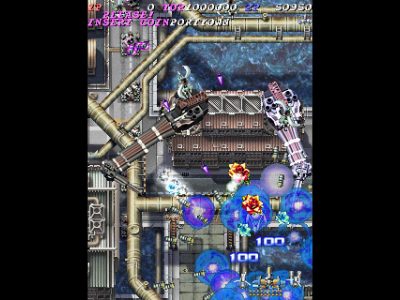
Fans of cult developer Raizing could only lament the end of an era in the year 2000, when the team was folded into sister company 8ing and ceased producing its own games. Some time down the line, though, former rival Cave decided to bring Raizing bigwig Shinobu Yagawa on board for a new shooter, and Ibara (“roseâ€, “thornâ€, or “briarâ€) was the result of this once-unlikely partnership. As might be expected, in many ways this isn’t really a “Cave gameâ€; it’s best-described as a spiritual sequel to Raizing’s iconic Battle Garegga. Once again the main keys to scoring (and, by extension, survival) are expending your bombs (which you must “build†by collecting shards) on specific score-rich targets, dismantling (and greatly angering) the bosses, and weaving through enemy fire to snatch falling medals. The game’s “rank†level, which bumps up the challenge, tends to increase quickly, and the only way to knock it back down a peg is to die, so you’d better keep racking up those points (and resulting extra lives) if you want to last very long.
(JP, DVD)
Fans of cult developer Raizing could only lament the end of an era in the year 2000, when the team was folded into sister company 8ing and ceased producing its own games. Some time down the line, though, former rival Cave decided to bring Raizing bigwig Shinobu Yagawa on board for a new shooter, and Ibara (“roseâ€, “thornâ€, or “briarâ€) was the result of this once-unlikely partnership. As might be expected, in many ways this isn’t really a “Cave gameâ€; it’s best-described as a spiritual sequel to Raizing’s iconic Battle Garegga. Once again the main keys to scoring (and, by extension, survival) are expending your bombs (which you must “build†by collecting shards) on specific score-rich targets, dismantling (and greatly angering) the bosses, and weaving through enemy fire to snatch falling medals. The game’s “rank†level, which bumps up the challenge, tends to increase quickly, and the only way to knock it back down a peg is to die, so you’d better keep racking up those points (and resulting extra lives) if you want to last very long.
Even when you’ve got a good “rank-control†rhythm down this game is no easy clear, but it does offer players some concessions that its unofficial predecessor didn’t: while you can’t manually shift the formation of your helper gunpods anymore, you can collect different ammo types for each, and thus have a variety of attacks at your simultaneous disposal. For another, if you’re having trouble with one of the game’s impractically-dressed lady bosses/mascots (trust me, you will) you can “charge up†a bomb before release to launch a “hadou burstâ€, and inflict big damage to your target. Finally, while bullet visibility is still less than ideal, it’s been improved a ways over Garegga’s layered neutral tones, so you’re less likely to wonder what the heck just killed you – you’ll still be dying a lot, mind, but at least you’ll (probably) know why. If you somehow still find the regular game too easy, “Harder†and “Extended†modes are also available – how nice of them. Ibara’s reboot of one of gaming’s most unusual and counter-intuitive design mentalities didn’t result in a major commercial hit, but the villainous “Rose sisters†became popular enough to later star in their own game.
As for the PS2 version, it was handled by the same coalition that ported Mushihime-sama, and the overall quality is about the same: not awful, but hardly great. The lovingly-detailed graphics have again been muddied up some (though not quite so much as in Mushi), slowdown is still off-kilter, and the option settings aren’t as robust or user-friendly as they could be. On a brighter note, there’s another Arrange mode here, and it’s substantially more interesting than Mushi’s – it plays a little like Ibara’s later “Black Label†arcade version. The player hitbox is smaller, bullets can be made brighter, the soundtrack has been remixed, the main shot can be “focusedâ€, and both option formations and secondary weapons (once collected) can be cycled through at will. Most importantly, the current “rank†level is (finally) openly displayed, and works differently than before: the difficulty now goes up only as you collect items, and can be lowered by bombing away large masses of bullets. This process also awards lots of points, so Arrange players can either limit their pickups for a relatively “safe†journey, or get greedy and tempt fate for last-second screen clears and massive score boosts. Ibara received a relatively low PS2 print run (certain pre-order copies came with a collectable hint booklet) and plans for a “Best†re-release were eventually scrapped, so expect to fork out handsomely for this payload of digital masochism; more importantly, make sure you’re up for it before you do. Of course, the separately-released official figurines of all six Rose sisters will bankrupt you even more quickly, should you covet them… Shop for Ibara on eBay Shop for Ibara on Amazon.com
Twinkle Star Sprites (Series)
 (JP, DVD)
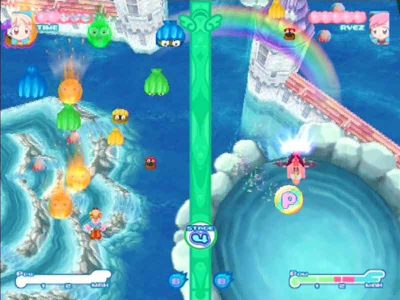
ADK’s unique mid-90’s “versus puzzle shmup†enjoys a devoted fan base to this day, but surprisingly few are aware that it eventually received a PS2-exclusive sequel: publisher SNK’s disappointing decision against localization (despite early hints to the contrary) certainly didn’t help matters. Anyway, apart from new 3-D graphics and a reshuffled cast, “La Petite Princesse†follows closely in the footsteps of its elder sibling: players get a half-screen to fly around in, and one’s main goal is to take out patterned enemy formations in one shot by setting up chain reactions. This, in turn, sends fireballs (which can be volleyed back and forth) and other nuisances over to the opponent’s territory, while simultaneously building up a “charge†meter which can be expended for additional attacks: of course, you’ve still got a supply of smart bombs, occasional floating items, and the “Fever†mode power-up to keep things interesting. The play modes (Story, Character, and Versus) are also the same as before, though the presence of a gallery and lots of voice acting spruce the place up a bit – online play is technically supported, though it’s largely a moot point by now, especially for non-Japanese gamers.
(JP, DVD)
ADK’s unique mid-90’s “versus puzzle shmup†enjoys a devoted fan base to this day, but surprisingly few are aware that it eventually received a PS2-exclusive sequel: publisher SNK’s disappointing decision against localization (despite early hints to the contrary) certainly didn’t help matters. Anyway, apart from new 3-D graphics and a reshuffled cast, “La Petite Princesse†follows closely in the footsteps of its elder sibling: players get a half-screen to fly around in, and one’s main goal is to take out patterned enemy formations in one shot by setting up chain reactions. This, in turn, sends fireballs (which can be volleyed back and forth) and other nuisances over to the opponent’s territory, while simultaneously building up a “charge†meter which can be expended for additional attacks: of course, you’ve still got a supply of smart bombs, occasional floating items, and the “Fever†mode power-up to keep things interesting. The play modes (Story, Character, and Versus) are also the same as before, though the presence of a gallery and lots of voice acting spruce the place up a bit – online play is technically supported, though it’s largely a moot point by now, especially for non-Japanese gamers.
Based on what’s been written so far you might be inclined to think that La Petite Princesse is a straight-up reskin, but spend some time with it and you’ll start to notice a handful of changes. In a nutshell, you might say that LPP is a bit more “mellow†than its ancestor: the overall pace is a tad slower, fireballs can’t be “juggled†as many times as before, and the CPU difficulty has been toned down. This is nowhere near enough to totally kill the experience, but TSS veterans should still be advised that this sugar rush is a bit less of a buzz than they’re probably used to: don’t let that discourage you too much, since anyone remotely interested in this sort of thing (basically, any gamer who can stomach the art style, which is somehow even more sickeningly cute than the first’s) still ought to pick this up, and thanks to a budget reprint that shouldn’t be very hard to do. But dangit SNK, I’m still a bit miffed at that judgment call back there…and your undying determination to bring us Samurai Showdown Sen does not improve my mood.
By the way, readers might have noticed that the above subheading mentions the Twinkle Star Sprites “series†– the reason for this is that the original Neo-Geo version is also available (twice over, actually) on the PS2, though sadly it hasn’t survived the transition unscathed. First and foremost it’s packed in as an unlockable extra on La Petite Princesse, but you’ll probably end up ignoring it, since the graphics have been garbled up somewhat and slowdown levels are ridiculously high (and non-adjustable, unlike on the superior Saturn and Dreamcast ports). Your second retro option is “ADK Tamashiiâ€, a Japan-only set of five ADK arcade titles, TSS included: the gameplay is more faithful here, but the visuals are still a bit of a mess. If you crave the sprite-based Twinkle Star Sprites experience (and who doesn’t?) you’re probably best-served seeking it on a different system. Shop for Twinkle Star Sprites Series on eBay Shop for Twinkle Star Sprites Series on Amazon.com
Double Shienryu
 (JP/PAL, CD)
If you’ve looked through the Saturn or PS1 shooter lists on this site, you might remember coverage of Shienryu (“purple flame dragonâ€), a vertical shmup most directly comparable to the Raiden series; rumors once circulated that developer Warashi was working on a sequel, but nothing concrete ever came of it. Then one day, out of the blue, the company re-releases Shienryu for the PS2 as Volume 37 of the “Simple 2000†budget series, and bundles a completely new “vertizontal†shmup with 3-D graphics, “Shienryu Explosionâ€, onto the disc with it. Whether this latter title was ever intended as a true sequel is unclear, especially considering how differently the two games play.
(JP/PAL, CD)
If you’ve looked through the Saturn or PS1 shooter lists on this site, you might remember coverage of Shienryu (“purple flame dragonâ€), a vertical shmup most directly comparable to the Raiden series; rumors once circulated that developer Warashi was working on a sequel, but nothing concrete ever came of it. Then one day, out of the blue, the company re-releases Shienryu for the PS2 as Volume 37 of the “Simple 2000†budget series, and bundles a completely new “vertizontal†shmup with 3-D graphics, “Shienryu Explosionâ€, onto the disc with it. Whether this latter title was ever intended as a true sequel is unclear, especially considering how differently the two games play.
Let’s start with Explosion, which has more in common with modern “bullet hell†shooters than anything else, though it’s a much less challenging entry than most, thanks in part to a generous extend rate. After choosing one of three ships at the beginning (plus a pilot, which only has cosmetic effects), you have constant access to “lightâ€, “mediumâ€, or “heavy†weapon fire, each of which affects your speed and spread as well as your strength – these can all be set to a single button, which will vary shot output based on how hard you press it, or to separate “fixed†keys. This gimmick is tied nicely into the scoring system, which awards you more handsomely for killing enemies with “stronger†shots, but will reduce the points gained if you collect the “star†items they leave behind while continuing to fire heavily: this means you’ll be juggling your shot status back and forth a lot to maximize your score as you zoom around the screen. Two “hidden†stages are your reward for a bit of extra effort, but otherwise the game is solid if unexceptional: definitely not a bad acquisition for the asking price though.
Its companion port of the “original†Shienryu, for that matter, is pretty nice too, complete with tate mode and low-res screen options: the one thing it’s missing (besides a way to get back to the main title screen without resetting the PS2) is a high-score save, which is especially odd considering that both these features (and a practice mode to boot) are accessible in Explosion. Later on the two were again packaged together in Volume 5 of the Simple series’ “2-in-1†collections (simply retitled “The Shootingâ€) and paired with some sort of 3-D “Helicopter†game – the suggested retail price remains the same, so just pick up whichever one you can get cheaper and disregard the bits you don’t care for. European gamers did receive a localization dubbed “Steel Dragon EXâ€, but it’s plagued by borders, slowdown, and a (further-) reduced challenge level, so spring for the import if you can. Shop for Double Shienryu on eBay
Strikers 1945 I & II / Gunbird 1 & 2
 (JP/PAL, CD)
Prolific shmup developer Psikyo put together no fewer than four “double packs†of its arcade shooters on the PS2, most of them under the “Psikyo Shooting Collection†label – Strikers 1945 I & II came first, featuring (obviously) the first two entries in the alternate-WWII series (sorry, Strikers III fans – your wait continues). The games play very much alike in most areas: fast orange bullets, slightly-delayed bomb activation, randomly-ordered stage progression, transforming mecha bosses, and snagging shiny gold bars with good timing for extra points are the order of the day in each. The only major difference between them, apart from the stage layouts and selection of playable aircraft, lies in how the “charge shot†is implemented – in the first game it’s a standardized “strong†attack affected only by your plane’s weapon level, but in Strikers II it’s reliant on a separate “power meter†which fills up as your kill count rises and is expended for more potent charged blasts. Both games are serviceable, but the porting job is less than optimal: load times are lengthy, high scores aren’t saved, and neither the graphics nor the sound (especially on II) are arcade-accurate. Collectors will want a first-print copy of the Japanese version, especially one containing a replay DVD; more economically-minded sorts can seek out the “Taito Best†reprint instead. The PAL release (“1945 I & II: The Arcade Gamesâ€) retains tate mode, but lacks a 60-Hz option.
(JP/PAL, CD)
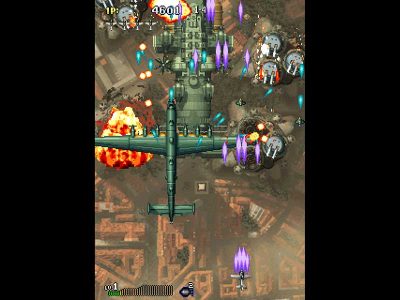
Prolific shmup developer Psikyo put together no fewer than four “double packs†of its arcade shooters on the PS2, most of them under the “Psikyo Shooting Collection†label – Strikers 1945 I & II came first, featuring (obviously) the first two entries in the alternate-WWII series (sorry, Strikers III fans – your wait continues). The games play very much alike in most areas: fast orange bullets, slightly-delayed bomb activation, randomly-ordered stage progression, transforming mecha bosses, and snagging shiny gold bars with good timing for extra points are the order of the day in each. The only major difference between them, apart from the stage layouts and selection of playable aircraft, lies in how the “charge shot†is implemented – in the first game it’s a standardized “strong†attack affected only by your plane’s weapon level, but in Strikers II it’s reliant on a separate “power meter†which fills up as your kill count rises and is expended for more potent charged blasts. Both games are serviceable, but the porting job is less than optimal: load times are lengthy, high scores aren’t saved, and neither the graphics nor the sound (especially on II) are arcade-accurate. Collectors will want a first-print copy of the Japanese version, especially one containing a replay DVD; more economically-minded sorts can seek out the “Taito Best†reprint instead. The PAL release (“1945 I & II: The Arcade Gamesâ€) retains tate mode, but lacks a 60-Hz option.
For some odd reason the company’s Gunbird compilation (dubbed “Gunbird Premium Package†in Korea and “Gunbird Special Edition†in Europe) isn’t technically part of the “Psikyo Shooting Collection†series, so don’t look for it under that name. In any event, the first Gunbird plays very much like the original Strikers 1945, minus the variable score items and plus a somewhat annoying “automatic power-down†mechanic; its true defining characteristics are the “semi-cute†fantasy setting and brief, silly story sequences that give it some personality. Sequel Gunbird 2 pumps up the challenge level and expands outward in several areas: the charge meter from Strikers II has been adopted, and moreover can be spent either on the usual charge shot or a powerful close-range melee hit. “Timed item collection†scoring has arrived too, and doles out additional rewards for “chaining†together two or more “perfect†coin grabs in a row; also keep an eye out for special spots where you can uncover a bonus-loaded “gem head†with a well-placed attack. By the way, just so you know, hidden samurai character Ayin is available, but guest star Morrigan from Darkstalkers isn’t – she’s a Dreamcast exclusive. While this collection never got a reprint, Psikyo put more effort into the port this time: high score saving and a handy Practice mode have both been implemented, and while the first game lacks the “gallery†extras of the 32-bit versions, otherwise it looks and plays pretty nicely. Gunbird 2 doesn’t fare quite so well: some stage elements have been shifted around and there’s a bit of mid-stage loading too. PAL gamers, meanwhile, finally got a 60-Hz option, along with all the other new features…EXCEPT a score save, dangit!
One last thing: Korea also scored an exclusive 2-in-1 (or should that be 4-in-1?) release which stuffs both the Strikers and Gunbird comps into a single package: both of them are pretty much exactly the same as the Japanese releases (minus the replay DVD), so if you want to pick up the whole kit ‘n caboodle in one shot this might be your most cost-efficient way to do so. Shop for Strikers 1945 Collection on eBay Shop for Gunbird 1 & 2 on eBay Shop for Gunbird 1 & 2 on Amazon.com
Sengoku Ace & Sengoku Blade / Sol Divide & Dragon Blaze
 (JP/PAL*, CD)
Psikyo’s later PS2 collections tend to be the most sought-after, since each of them boasts a game which has yet to see a home port on any other system. Sengoku Ace, Psikyo’s very first release, fills that role on Psikyo Shooting Collection Volume 2, a.k.a. the “Sengoku†pack – obviously it’s a very basic vertical shooter in the company’s signature style, and also contains the unpopular “auto-power down†mechanic which wasn’t scrapped until several releases later. What does help to set the game apart, aside from the goofy story scenes (which set the template for Gunbird), is its evocative atmosphere, heavily steeped in Japanese mythology – this ambience remains strong in the sequel, which shifts to a side-scrolling perspective. The auto-power down is gone by now, and catching coins at the right moment leads to extra points, but otherwise it’s basically the first game turned on its side, with a few minor tweaks: one notable new feature is the ability to pick one of two final stage routes, each of which leads to a different ending for your chosen character(s). The programming job here is solid, if unremarkable: single-stage practice modes and a sound test are present, random stage order can be turned off, and everything runs pretty smoothly, though Sengoku Blade is missing the bonus contents from the Saturn version (including Marion’s playable cameo, though Ayin’s still hanging around). As with the Strikers collection, Japanese first-print reserves came with a replay DVD, and later on a budget edition hit the shelves; Europe received both games too, though each was localized separately, under their Western arcade names, “Samurai Aces†and “Tengaiâ€. Thankfully, both have high score saving (finally!) and a 60-Hz option too.  Appropriately enough it’s again overshadowed here, this time by Dragon Blaze, Psikyo’s last and best-looking vertical shmup – you play as a dragon rider with the ability to “shoot†his or her mount straight forward for a powerful up-close attack (and some bonus coins).
(JP/PAL*, CD)
Psikyo’s later PS2 collections tend to be the most sought-after, since each of them boasts a game which has yet to see a home port on any other system. Sengoku Ace, Psikyo’s very first release, fills that role on Psikyo Shooting Collection Volume 2, a.k.a. the “Sengoku†pack – obviously it’s a very basic vertical shooter in the company’s signature style, and also contains the unpopular “auto-power down†mechanic which wasn’t scrapped until several releases later. What does help to set the game apart, aside from the goofy story scenes (which set the template for Gunbird), is its evocative atmosphere, heavily steeped in Japanese mythology – this ambience remains strong in the sequel, which shifts to a side-scrolling perspective. The auto-power down is gone by now, and catching coins at the right moment leads to extra points, but otherwise it’s basically the first game turned on its side, with a few minor tweaks: one notable new feature is the ability to pick one of two final stage routes, each of which leads to a different ending for your chosen character(s). The programming job here is solid, if unremarkable: single-stage practice modes and a sound test are present, random stage order can be turned off, and everything runs pretty smoothly, though Sengoku Blade is missing the bonus contents from the Saturn version (including Marion’s playable cameo, though Ayin’s still hanging around). As with the Strikers collection, Japanese first-print reserves came with a replay DVD, and later on a budget edition hit the shelves; Europe received both games too, though each was localized separately, under their Western arcade names, “Samurai Aces†and “Tengaiâ€. Thankfully, both have high score saving (finally!) and a 60-Hz option too.  Appropriately enough it’s again overshadowed here, this time by Dragon Blaze, Psikyo’s last and best-looking vertical shmup – you play as a dragon rider with the ability to “shoot†his or her mount straight forward for a powerful up-close attack (and some bonus coins).
Sol Divide, another Psikyo side-scroller, headlines Volume 3; its main hallmarks are digitized graphics, a medieval/fantasy setting, and a focus on close-range melee attacks (it also spawned home versions on the Saturn and PS1, and was written up in those corresponding articles). This is instead a faithful reproduction of the arcade original, but that means it lacks the marquee RPG-flavored “Original Mode†of its previous conversions, which was the only thing preventing many players from abandoning the game due to its rather imprecise, clunky mechanics.
Appropriately enough it’s again overshadowed here, this time by Dragon Blaze, Psikyo’s last and best-looking vertical shmup – you play as a dragon rider with the ability to “shoot†his or her mount straight forward for a powerful up-close attack (and some bonus coins). This technique can also be used to position your dragon (who is invincible) in prime offensive position while you keep your character out of dangerous spots: careful, though, as splitting up decreases your overall offensive power, and changes your charge attack too. The hidden “gem heads†from Gunbird