Over the past decade, the JavaScript Rising Stars rankings have tracked which projects capture the most developer attention each year. The list is not a forecast, but with ten years of data to compare against, the 2025 results stand out. The projects gaining momentum today differ in meaningful ways from those that led in 2024.
The rankings are based on the number of GitHub stars projects added over the past twelve months, using data compiled by Best of JS, a curated index of web platform projects. While GitHub stars are an imperfect signal, the year-over-year view offers a consistent way to compare shifts in developer attention.
n8n’s Star Growth Was Unmatched in the History of the Rankings[#](#n8n’s-Star-Growth-Was-Unmatched-in-the-History-…
Over the past decade, the JavaScript Rising Stars rankings have tracked which projects capture the most developer attention each year. The list is not a forecast, but with ten years of data to compare against, the 2025 results stand out. The projects gaining momentum today differ in meaningful ways from those that led in 2024.
The rankings are based on the number of GitHub stars projects added over the past twelve months, using data compiled by Best of JS, a curated index of web platform projects. While GitHub stars are an imperfect signal, the year-over-year view offers a consistent way to compare shifts in developer attention.
n8n’s Star Growth Was Unmatched in the History of the Rankings#
The most striking result this year is n8n. After adding around 17,000 GitHub stars in 2024 and finishing fifth overall, the workflow automation platform added more than 112,000 stars in 2025, ranking first by a wide margin. According to the Rising Stars organizers, no project has recorded that level of single-year growth across any previous edition.
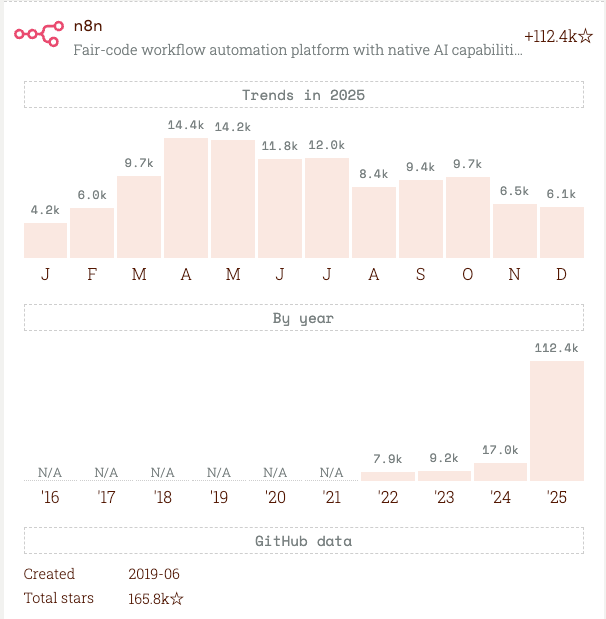
The number is notable less for its size than for what it reflects about the type of project gaining traction. n8n is not a framework or a library, but a workflow automation platform that coordinates services, APIs, and tools. Unlike many developer tools, it often runs continuously in the background rather than in response to direct user interaction.
Other Fast-Growing Projects Reflected Growing Interest in Automation and Workflows#
n8n was not alone. Other fast-growing projects in 2025 also climbed into prominent positions in the rankings. Stagehand ranked among the top ten overall after strong growth in browser automation tooling. Dyad and Motia also posted substantial gains, reflecting increased attention to local-first AI application development and backend frameworks built around long-running workflows and orchestration.
Across AI, testing, and backend categories, tools designed to run and coordinate work consistently saw larger gains than tools focused purely on how developers write or structure code.
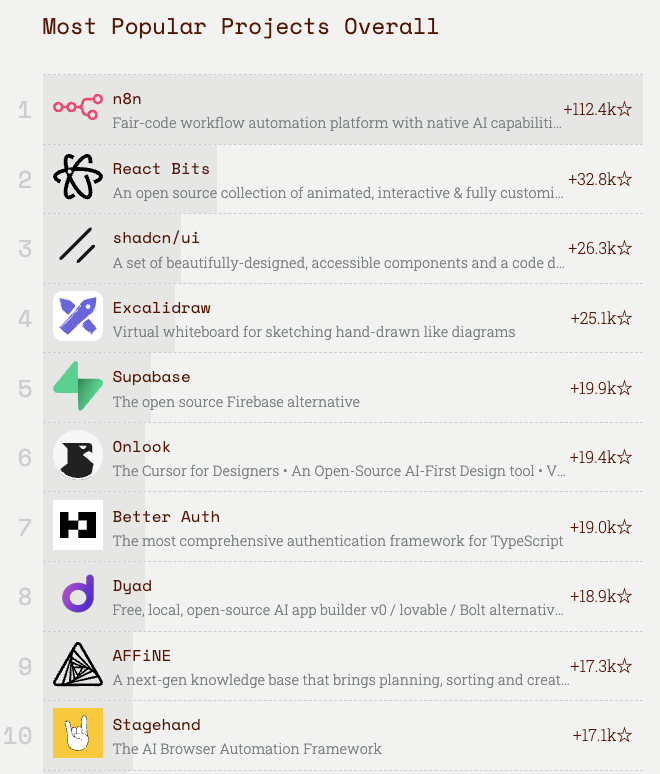
This marks a contrast with 2024’s results. Last year’s overall leaders included shadcn/ui, Excalidraw, AFFiNE, and Bruno. These projects sat close to the user interface and developer experience layer, emphasizing composition, customization, and productivity while building applications.
Those projects remain widely used and highly ranked, but they were no longer the primary drivers of growth in 2025. The center of attention shifted toward platforms that manage behavior once software is already deployed.
AI Tools Shifted From Prompting Interfaces to Orchestrated Workflows#
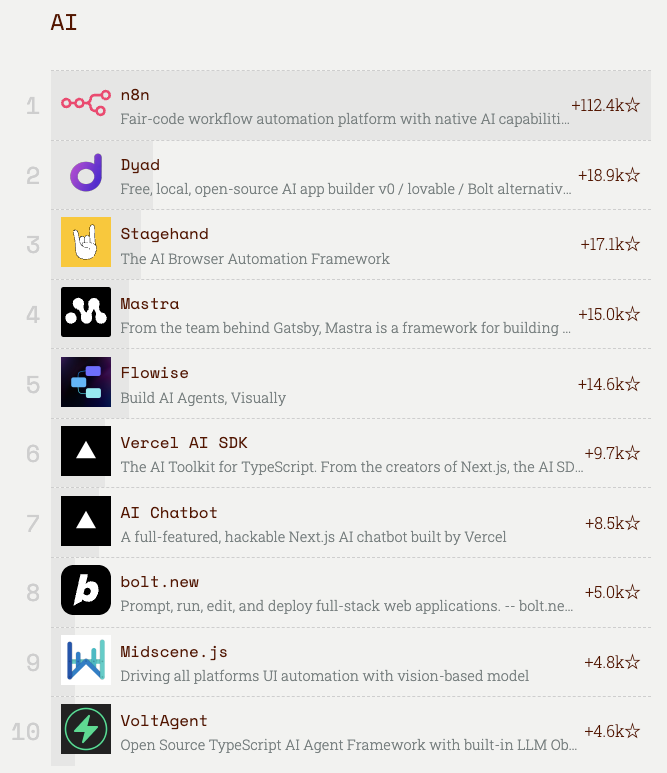
The AI category is the clearest example of this progression. In 2024, tools like n8n and Flowise shared attention with prompt-driven builders such as bolt.new. In 2025, growth concentrated around platforms that treat AI as one component in a broader workflow rather than the entire product.
The emphasis moved away from generating responses and toward coordinating actions: triggering jobs, calling external services, automating browsers, and handling long-running processes.
Framework Popularity Held Steady Even as Context Changed#
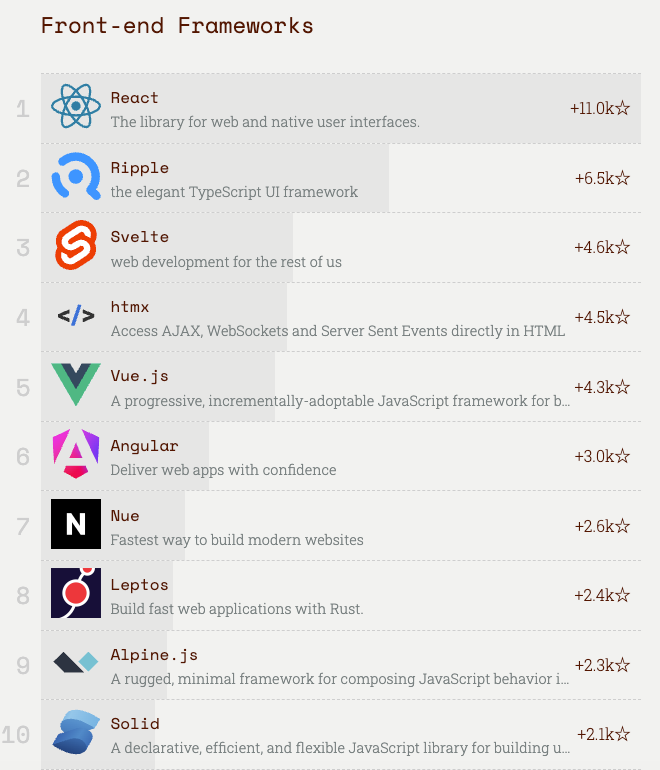
None of this suggests frameworks became less important. React reclaimed the top spot in the front-end framework rankings in 2025, after htmx led the category in 2024. React’s continued prominence reflects how deeply embedded it remains across the ecosystem.
What changed is the context around it. As server components, server actions, and streaming architectures became more widely adopted, React continued to move closer to the backend and infrastructure layer. Discussion increasingly focused on server behavior and operational complexity alongside component APIs and rendering.
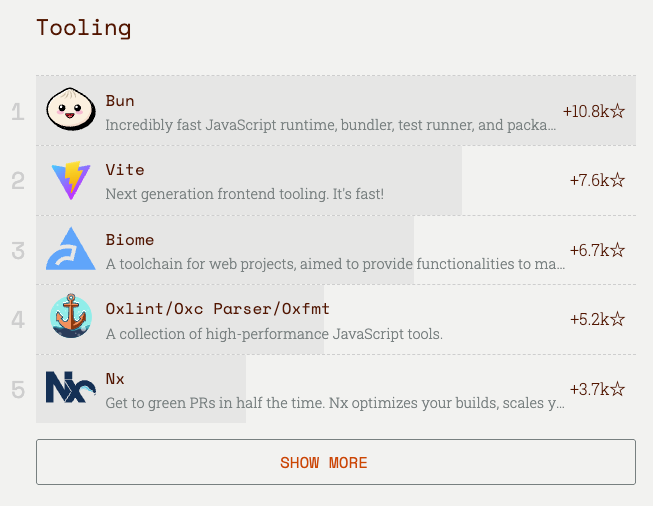
Bun Pulled Ahead of Other JavaScript Tooling in 2025#
Tooling rankings in 2025 were shaped less by a broad shift across the JavaScript toolchain than by Bun’s breakout year. In 2024, Biome, Bun, and Vite were closely grouped, each addressing different layers of the toolchain. In 2025, Bun pulled ahead following a year of increased Node.js compatibility work, broader ecosystem support, and its acquisition by Anthropic.
That separation did not signal declining interest in developer utilities, but it did reflect where momentum concentrated most sharply within tooling during the year.
Growth Concentrated Around Platforms That Reduce Manual Coordination#
Overall, the 2025 rankings do not point to a replacement of frameworks or UI libraries. Instead, they show where attention accelerated most sharply. Projects that reduce manual coordination, manage long-running processes, or sit closer to production workflows captured a disproportionate share of new interest.
Compared with 2024, JavaScript’s fastest-growing projects in 2025 were less about how applications are assembled and more about how they operate once deployed. The Rising Stars rankings do not explain why developers make these choices, but they do show where momentum gathered as modern JavaScript applications continued to expand beyond the browser.
For the complete 2025 rankings and a look back at all ten years of Rising Stars, check out the JavaScript Rising Stars website.