- 10 Dec, 2025 *
Today marks the official release of a project I’ve been working hard on over the past few months: the next generation of the Copernicus Arctic Regional Reanalysis CARRA. This new system, CARRA2, extends coverage to the entire pan-Arctic domain north of 60°N and will span all years from 1986 to 2025. The complete dataset is planned for release in 2026.
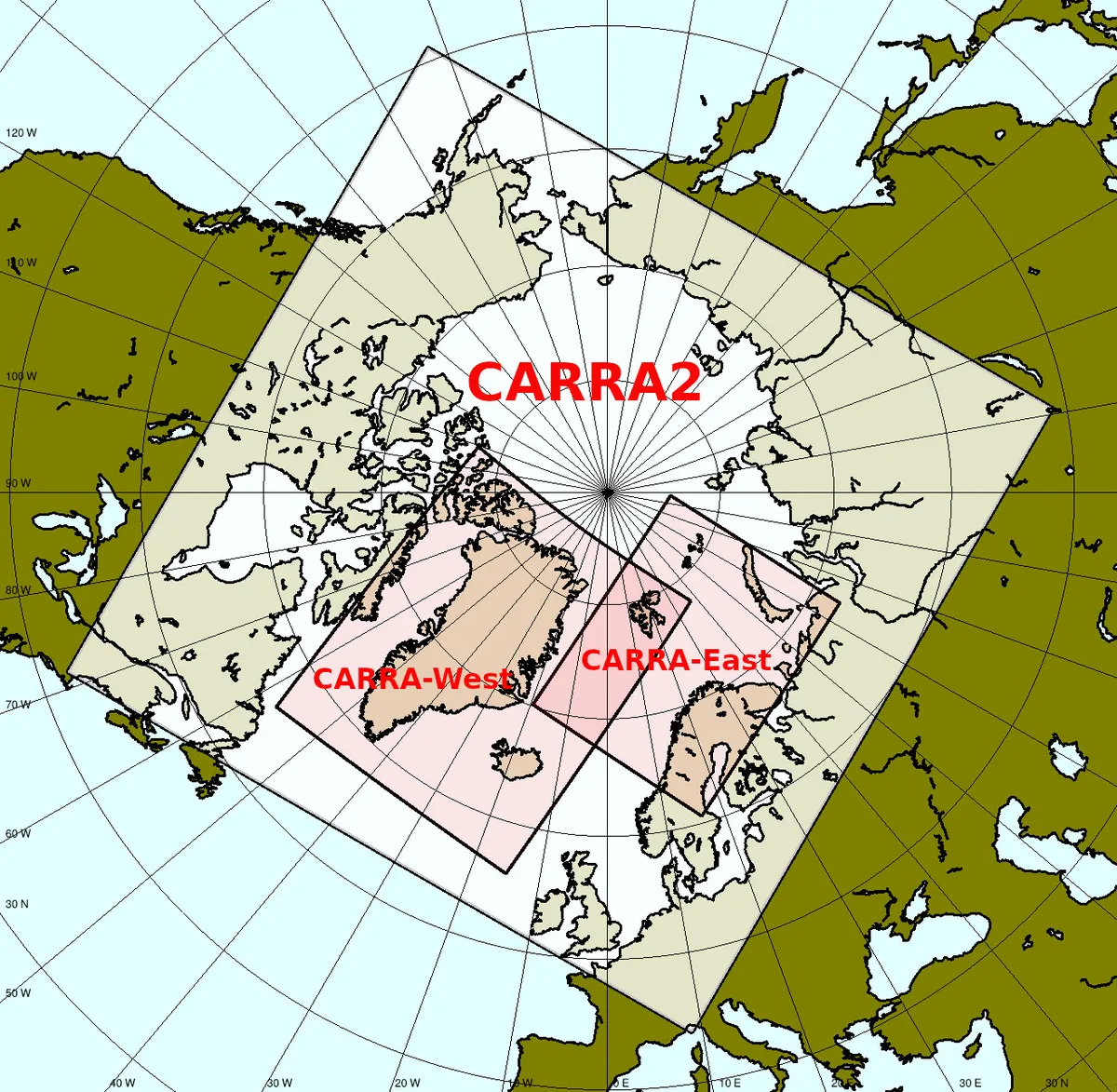 CARRA2 domain, compared to CARRA1 (East and West domains).
The first batch of d…
- 10 Dec, 2025 *
Today marks the official release of a project I’ve been working hard on over the past few months: the next generation of the Copernicus Arctic Regional Reanalysis CARRA. This new system, CARRA2, extends coverage to the entire pan-Arctic domain north of 60°N and will span all years from 1986 to 2025. The complete dataset is planned for release in 2026.
CARRA2 domain, compared to CARRA1 (East and West domains).
The first batch of data (24 non-contiguous years between 1986 and 2023) has been released in the C3S Climate Data Store today. I was responsible for producing the daily and monthly climate means.
Once completed, CARRA2 will provide the highest-resolution pan-Arctic regional reanalysis currently available (2.5 km horizontal resolution). New features such as geographic subsetting, combined vertical levels in a single entry, and dedicated products for means, extremes and totals are designed to make this large dataset more accessible to a wide range of users.
CARRA2 has a particular focus on extreme events. With improved representations of snow, sea ice and glaciers and thousands of additional Arctic observations, it offers much finer detail than global reanalyses like ERA5 for high-impact weather and climate extremes. This allows us to better characterise events such as severe windstorms, intense precipitation, rapid melt episodes and record-breaking warm spells that are critical for local communities and infrastructure across the Arctic.
In a region warming more than twice as fast as the global average, this level of detail is essential for understanding how climate change is altering the frequency, intensity and spatial patterns of extremes. The CARRA2 record will support studies of long-term trends from 1986 onwards, help attribute individual events to underlying climate drivers, and provide a robust basis for risk assessment and adaptation planning. I’m very excited to see how the community will use this new dataset to advance Arctic climate research and inform decisions in a rapidly changing environment.