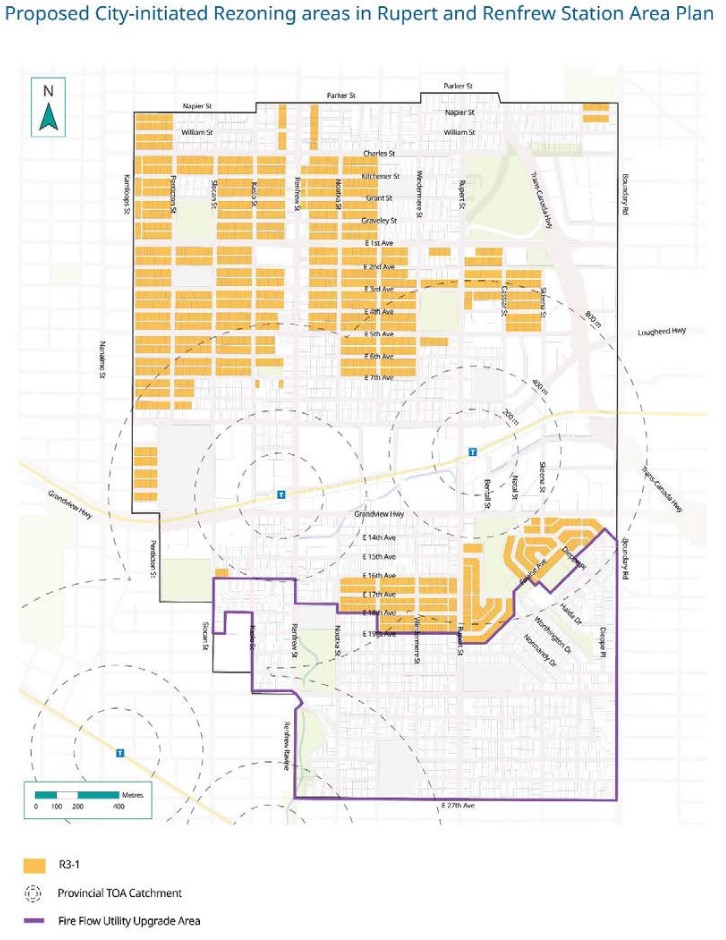
Tomorrow, Tuesday January 13th, Vancouver city council will consider a zoning amendment to rezone approximately 200 blocks to match what was already approved in principle as part of the years-long Rupert & Renfrew Station Area planning process. Like the recent "pre-zoning" [sic] of the Cambie Corridor and Broadway plans, this is an important step towards making it easier build apartments by zoning for what the City says it wants. We support it, and you should too! That said, there are major issues with this zoning bylaw. Chiefly, that our city planners remain committed to housing policies that their own analyses show are only ma…
Tomorrow, Tuesday January 13th, Vancouver city council will consider a zoning amendment to rezone approximately 200 blocks to match what was already approved in principle as part of the years-long Rupert & Renfrew Station Area planning process. Like the recent "pre-zoning" [sic] of the Cambie Corridor and Broadway plans, this is an important step towards making it easier build apartments by zoning for what the City says it wants. We support it, and you should too! That said, there are major issues with this zoning bylaw. Chiefly, that our city planners remain committed to housing policies that their own analyses show are only marginally or not viable at current rents, and thus cannot be expected to improve affordability vs. today, although they will help prevent affordability from getting worse. You can show your support, and encourage improvements, by writing to council or requesting to speak at the hearing on Tuesday evening. It is item 2 on the agenda for Jan. 13th.
How we got here - Pretextual zoning
Since the 1970s, the City has made permitting housing an increasingly discretionary process. Whereas a $5 million house can generally be built by-right on any residential land, building even low-rise apartments, even where community plans notionally allow them, requires discretionary approvals. This has culminated in pretextual zoning, withholding apartment zoning to force an individual spot rezoning process for each building, where the City can make arbitrary demands of the applicant/owner. Spot rezonings impose a cost on society, increasing the time, cost and uncertainty involved in building housing, which is ultimately paid by home buyers and all renters, including those moving into older buildings through broad increases in market prices, and those becoming homeless. Spot rezonings also increase the perception of special treatment, or even corruption, despite that they became the only legal route to build more apartments. Long story short, we welcome a return to using zoning more as it was intended and turning away from pretextual zoning.
Part of reason for pretextual zoning was the ability to levy "voluntary" fees, known Community Amenity Contributions. In order to encourage more honest and efficient zoning, the BC government introduced Amenity Cost Charges, so that cities can fund similar things, like parks, plazas, and community centres, even where apartment zoning is done proactively. ACCs cannot be levelled arbitrarily on a per project basis, but there is otherwise very little restriction on how rates are set.
What still needs improving - Too little, too late
Vancouver has a shortage of housing, not a shortage of symbolic gestures towards improving affordability. To varying degrees, basically every broad housing policy involving zoning over the last 8+ years has been only marginally economically viable. While the reasons for this are not totally clear nor simple, it’s safe to say that this is deliberate. To the extent that these policies, from allowing mulitplexes to allowing towers around Broadway, they are working because prices and rents have gone up since the economic testing was completed.
In the case of the R3-1 zone proposed for the Rupert & Renfrew area, the City’s economic testing, performed by Coriolis Consulting, indicates that condo (strata) development is not viable and market-rate development is only viable at around 2.7 FSR (floor space ratio), which is the maximum allowed.
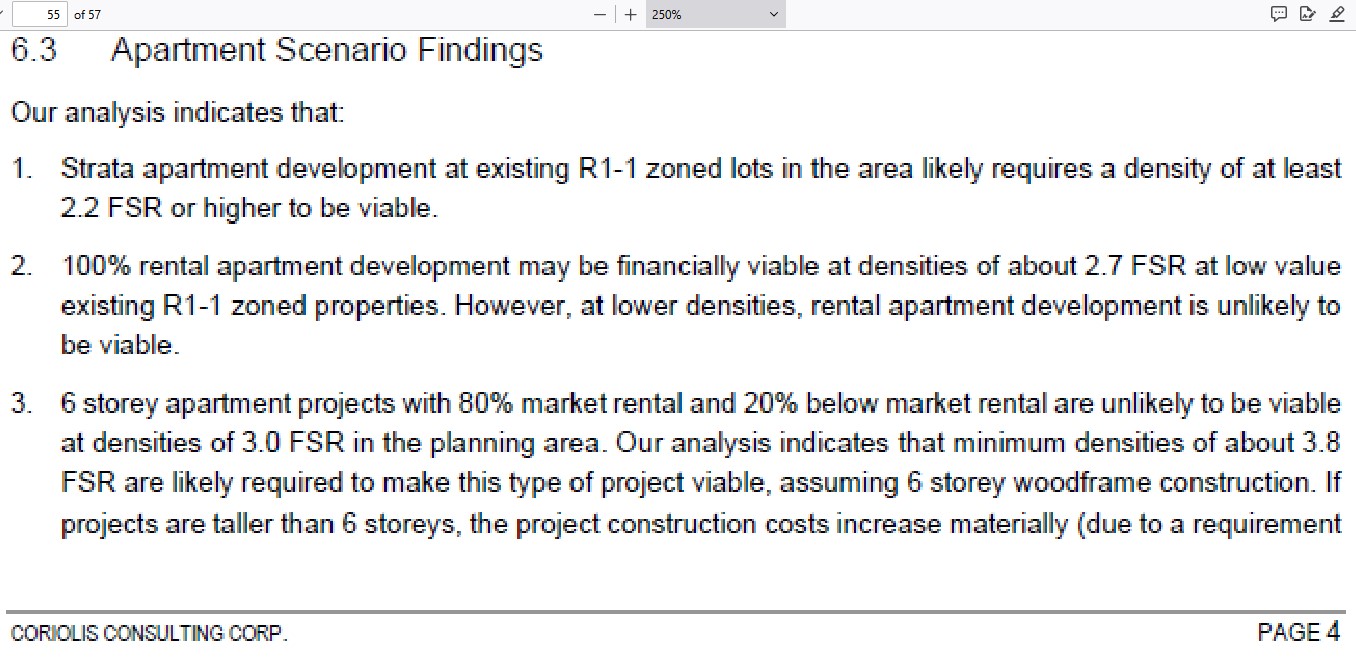
Excerpt from Coriolis Consulting’s analysis of the apartment feasibility in the Rupert & Renfrew plan area.
The 2.7 FSR maximum is not applicable to all areas. It requires a minimum frontage of 40.2m, which generally means a developer would have to assemble 4 adjacent 33’-wide lots, and is only allowed at corners. 2.7 FSR is also allowed for shallow-depth lots, but it is unclear if this would be viable and would require a larger frontage to meet the minimum site area requirement. Since the analysis assumes four older houses that are close to replacement age, that means only corners of blocks that happen to have 4 adjacent older houses will be viable for building apartments.
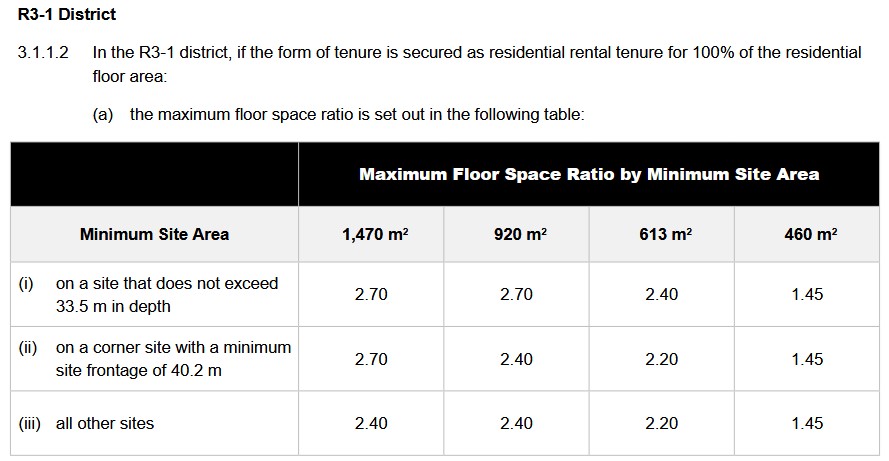 (1,470 sq.m. is ~15,815 sq.ft., or approximately 4 standard-depth, 33’ x 120’ lots)
To put it mildly, 200 blocks sounds like a lot more than it is. The large majority of zoned sites will simply not be viable. Council could improve the likelihood of viable sites for desperately-needed apartments (and condos) by:
- Allowing larger buildings: increase the allowed FSR, perhaps to 3.0 FSR, what is allowed for below-market apartments, which the analysis shows are even less viable anyway. Allowing 2.7 FSR everywhere instead of just corner lots would greatly increase the number of potentially viable sites.
- Decreasing minimum site frontage and size requirements: Requiring only 3 lots instead of 4 would greatly increase the odds of finding a viable assembly. Allowing 6-storey, single-stair buildings to be built on 33’ or even 50’+ lots would be much better! (check out this exterior stair concept from Lanefab)