 GP Vivienda developments in Mexico using Holcim’s carbon-reducing cement [Source: Holcim]
Charles R. Goulding and Preeti Sulibhavi explore how earth-derived calcined clay cement is reshaping 3D printed construction by reducing carbon emissions, simplifying materials, and bringing buildings literally back to the ground they stand on.
Concrete is the backbone of modern construction, but it comes with a heavy environmental cost. Traditional Portland cement is responsible for roughly eight percent of global CO₂ emissions, largely due to the energy-intensive process of producing clinker. As construction scales globally and additive manufactur…
GP Vivienda developments in Mexico using Holcim’s carbon-reducing cement [Source: Holcim]
Charles R. Goulding and Preeti Sulibhavi explore how earth-derived calcined clay cement is reshaping 3D printed construction by reducing carbon emissions, simplifying materials, and bringing buildings literally back to the ground they stand on.
Concrete is the backbone of modern construction, but it comes with a heavy environmental cost. Traditional Portland cement is responsible for roughly eight percent of global CO₂ emissions, largely due to the energy-intensive process of producing clinker. As construction scales globally and additive manufacturing begins to play a larger role, that footprint becomes harder to ignore.
One material gaining serious attention is calcined clay-based cement. Once considered a niche alternative, it is now being deployed by major cement producers, used in pilot housing projects, and adapted for large-scale concrete 3D printing. Its appeal is straightforward: significantly lower emissions, broad raw material availability, and mechanical properties compatible with automated construction.
As 3D printed buildings move from demonstrations to real infrastructure, calcined clay cement is emerging as one of the most practical ways to decarbonize digital construction.
What Is Calcined Clay-Based Cement?
Calcined clay cement is not a single product, but a family of blended cements that partially replace Portland clinker with thermally activated clay. The most common formulation is known as LC3, or Limestone Calcined Clay Cement.
The process starts with kaolinite-rich clay, which is heated to about 700–850°C. This “calcination” drives off chemically bound water and transforms the clay into a highly reactive material called metakaolin. Unlike clinker production, which requires temperatures around 1,450°C and releases CO₂ from both fuel and limestone decomposition, calcining clay uses far less energy and avoids most process emissions.
In LC3 formulations, calcined clay is typically combined with limestone and a reduced amount of clinker. The result is a cement that can replace up to 40–50 percent of clinker while maintaining comparable strength, durability, and workability.
This chemistry is particularly attractive for regions without access to supplementary cementitious materials like fly ash or blast furnace slag, both of which depend on coal and steel production. Clay, on the other hand, is almost everywhere.
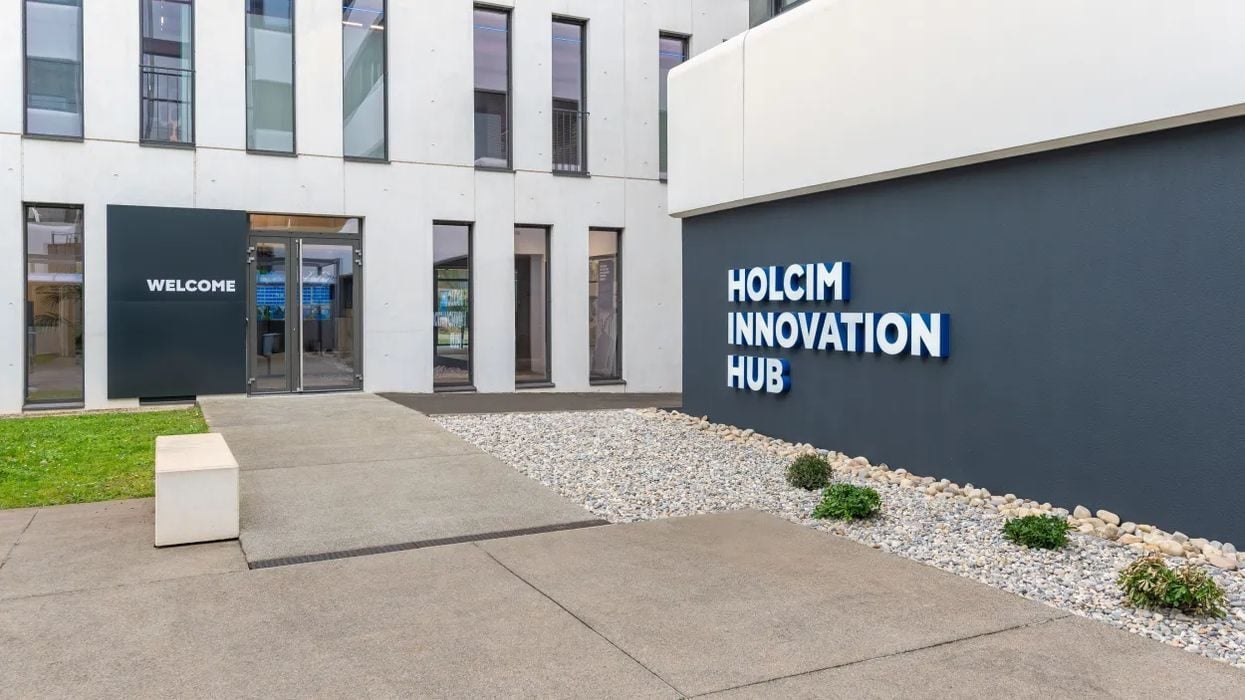 Holcim’s Innovation Hub, inaugurated in 2023, in Lyon, France[Source: Holcim]
Why Calcined Clay Works for 3D Concrete Printing
Concrete 3D printing has unique material requirements. Unlike conventional concrete, printable mixes must flow easily through pumps and hoses, set quickly enough to support subsequent layers, and develop early strength without collapsing or slumping.
Calcined clay-based cements are just the right fit.
First, their fine particle size and reactivity improve rheology control. This makes it easier to tune a mix that extrudes smoothly but stiffens rapidly after deposition. Second, LC3 systems show good early-age strength development, which is critical for layer-by-layer construction without formwork.
Another advantage is thermal behavior. Because calcined clay reduces clinker content, the heat of hydration is lower. This helps control cracking in thick or continuous prints, especially in hot climates or large structural elements.
Researchers and material suppliers are now developing print-specific LC3 mixes that integrate accelerators, fibers, and admixtures designed for robotic deposition. In many cases, these blends outperform traditional Portland cement mixes when used in automated systems.
Sustainability Gains That Actually Scale
The sustainability argument for calcined clay cement is not theoretical. It is measurable and scalable.
Replacing half of the clinker in cement can reduce CO₂ emissions by 30–40 percent per ton. When combined with renewable energy in calcination and grinding, the reduction can be even greater. Water demand is often lower, and the reliance on scarce industrial byproducts is eliminated.
For 3D printed construction, the impact compounds. Additive manufacturing already reduces material waste by placing concrete only where it is structurally needed. When paired with low-carbon cement, the overall lifecycle footprint of a building can drop dramatically.
This combination aligns well with global net-zero targets and emerging regulations around embodied carbon in construction. Governments and developers are starting to demand not just faster or cheaper buildings, but demonstrably cleaner ones.
Holcim’s Push Into Calcined Clay and 3D Printing
Holcim has become one of the most visible champions of calcined clay cement. The company markets several LC3-derived products under its ECOPlanet and ECOPact lines, positioning them as low-carbon alternatives to conventional cement and concrete.
One of Holcim’s most notable initiatives is its investment in large-scale calcined clay production facilities in regions such as India, Latin America, and Africa. These markets combine rapid urbanization with abundant clay resources, making LC3 both economically and environmentally attractive.
In India, Holcim has supported pilot projects demonstrating LC3’s performance in structural concrete, pavements, and low-rise housing. These projects are often cited as proof that calcined clay cement can meet national standards while cutting emissions at scale.
Holcim has also been active in digital construction partnerships. Through collaborations with construction technology firms and academic institutions, the company has tested low-carbon concrete mixes in robotic 3D printing systems. These trials focus on printable ECOPact formulations that incorporate calcined clay while meeting extrusion and buildability requirements.
Beyond individual projects, Holcim is promoting calcined clay as part of a broader systems approach. This includes digital design optimization, material-efficient structural geometries, and automated placement methods. In that context, 3D printing is not just a novelty but a way to fully exploit the benefits of low-carbon binders.
Other Companies and Research Groups Using Calcined Clay
Holcim is not alone.
Cemex has been actively researching LC3 and other calcined clay blends through its global R&D network. The company has run pilot projects in Mexico and Europe, exploring both precast and additive manufacturing applications. Cemex has also published data showing LC3’s compatibility with advanced admixtures used in printable concrete.
Heidelberg Materials has invested in calcined clay as part of its “eco cement” portfolio, particularly in markets where slag and fly ash supplies are limited. The company has supported demonstration buildings using low-clinker cement and is increasingly integrating digital fabrication into its innovation programs.
Startups and academic groups are also driving adoption. Research teams at EPFL, IIT Delhi, and other institutions have been instrumental in developing LC3 chemistry and adapting it for 3D printing. Several construction tech startups are now licensing this research to create proprietary printable mixes tailored to robotic systems.
In emerging markets, local cement producers are adopting calcined clay not as a premium product, but as a cost-effective solution to rising fuel prices and carbon constraints. This bottom-up adoption could ultimately have more impact than high-profile demonstration projects.
The Research & Development Tax Credit
The now permanent Research & Development Tax Credit (R&D) Tax Credit is available for companies developing new or improved products, processes and/or software.
3D printing can help boost a company’s R&D Tax Credits. Wages for technical employees creating, testing and revising 3D printed prototypes can be included as a percentage of eligible time spent for the R&D Tax Credit. Similarly, when used as a method of improving a process, time spent integrating 3D printing hardware and software counts as an eligible activity. Lastly, when used for modeling and preproduction, the costs of filaments consumed during the development process may also be recovered.
Whether it is used for creating and testing prototypes or for final production, 3D printing is a great indicator that R&D Credit-eligible activities are taking place. Companies implementing this technology at any point should consider taking advantage of R&D Tax Credits
The Road Ahead
Calcined clay-based cement will not replace cement overnight. Standards, supply chains, and contractor familiarity all take time to change. But the direction is clear.
As 3D printed construction moves toward real-world deployment, materials that combine performance, availability, and sustainability will win. Calcined clay fits that profile better than almost any alternative binder currently available.
For additive manufacturing, this is especially important. 3D printing promises faster construction, less waste, and new architectural freedom. Pairing that promise with low-carbon cement ensures those gains are not offset by hidden environmental costs.
The real significance of calcined clay cement is not that it is new or exotic. It is that it works, scales, and aligns with where construction technology is already heading. In the coming years, it is likely to become a default material for digitally manufactured buildings rather than an experimental option.
For the construction industry and the 3D printing sector alike, that shift could be transformative.