Charles R. Goulding and Preeti Sulibhavi explore how in Abruzzo, a region better known for sheep trails and red wine, Italian researchers are 3D printing plant-based foods designed for Earth, orbit, and beyond.
In the rugged heart of central Italy, the verdant hills and dramatic peaks of Abruzzo are witnessing the dawn of a new kind of gastronomy. This ancient region — long associated with traditional pastoral life, striking landscapes, and hearty peasant cooking — has become an unlikely hub for future-focused food technology. Here, scientists and private innovators are pioneering 3D printed foods, crafted from plant cells and agricultural by-products, pointing tow…
Charles R. Goulding and Preeti Sulibhavi explore how in Abruzzo, a region better known for sheep trails and red wine, Italian researchers are 3D printing plant-based foods designed for Earth, orbit, and beyond.
In the rugged heart of central Italy, the verdant hills and dramatic peaks of Abruzzo are witnessing the dawn of a new kind of gastronomy. This ancient region — long associated with traditional pastoral life, striking landscapes, and hearty peasant cooking — has become an unlikely hub for future-focused food technology. Here, scientists and private innovators are pioneering 3D printed foods, crafted from plant cells and agricultural by-products, pointing toward a future where sustainable nutrition meets precision manufacturing.
Abruzzo: Italy’s “Greenest Region”
Abruzzo is a region of contrasts. Shielded by the Apennine Mountains to the west and caressed by the Adriatic Sea to the east, it is one of Italy’s most geographically diverse areas. Nearly a third of the region is protected as national parks and nature reserves, a fact that earns it the nickname “the greenest region in Europe.” This wilderness supports wolves, golden eagles, and the rare Marsican brown bear — species that are increasingly the focus of conservation efforts.
Historically, Abruzzo’s past stretches back to ancient Italic tribes and Roman conquest, and its terrain has shaped generations of shepherds and farmers who practiced the seasonal movement of sheep known as transumanza. Centuries of rule by Lombards, Normans, and other powers have left a patchwork of cultural influences that still infuse local life and cuisine. The region is also an agricultural and viticultural center. Its rugged hillsides produce wines like Montepulciano d’Abruzzo and Trebbiano d’Abruzzo, while the coastline features fishing villages and seafood traditions. Whether you’re skiing the Apennines in the morning and swimming in the Adriatic by afternoon, or enjoying skewered lamb known as arrosticini, Abruzzo encapsulates both Italy’s wild natural beauty and its deep culinary roots.
ELT Group and EltHub: A New Kind of Makerspace
Amid this pastoral setting sits EltHub, an R&D unit of Italy’s ELT Group, a private technology company that specializes in additive manufacturing and advanced materials. While ELT Group’s public presence is often tied to industrial engineering and manufacturing technology, EltHub represents its foray into food innovation — specifically, 3D food printing. According to public reporting, EltHub collaborates with researchers to use cutting-edge printers to convert novel food “inks” into finished edible products.
EltHub operates in Abruzzo, where it houses specialized 3D printing equipment capable of working not with plastic filaments or metals, but nutrient-rich food pastes developed in partnership with Italy’s national research agency, ENEA (Agenzia nazionale per le nuove tecnologie, l’energia e lo sviluppo economico sostenibile). Although specific make and model details of the printers are not disclosed in the original reporting, it’s clear that the technology involved is similar to industrial extrusion systems used for layered additive manufacturing — only adapted to extrude biocompatible, edible pastes rather than engineering materials.
ENEA’s Plant-Based “Inks”: Science Meets Sustainability
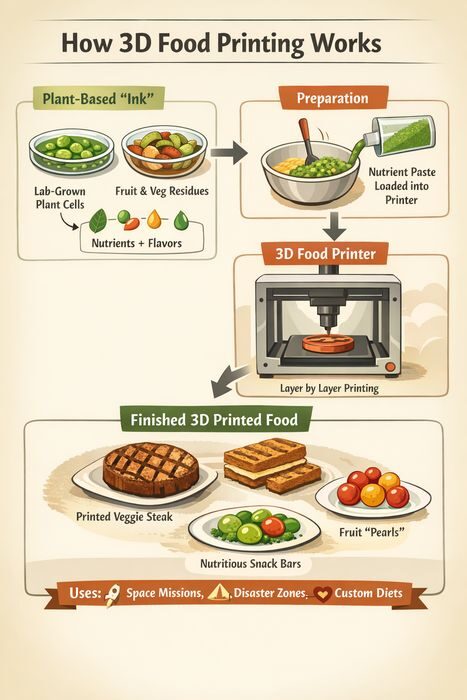
At the core of this innovation is the concept of plant-based 3D food inks — materials formulated from lab-grown plant cells and agricultural residues such as fruit by-products. Rather than cultivating full crops, scientists are focusing on growing the cells themselves and mixing them with fruit peels and pulps left over from conventional food production. This creates paste-like materials rich in nutrients and flavor potential, suitable for printing into shapes.
 [Source: AI-generated image]
Under the project name Nutri3D, ENEA’s Agriculture 4.0 lab in Rome has prototyped items ranging from multilayer snack bars to glossy, spherical “honey pearls.” These prototypes are designed to maximize nutritional density and preserve taste even after printing. Researchers stress that the technology isn’t just about novelty — it’s a response to global challenges like shrinking arable land, climate change, and food insecurity.
An internal ENEA survey found that roughly 59% of respondents said they would be willing to try foods produced in this way, highlighting growing consumer openness to alternative food technologies.
Potential Uses: Space, Conflict Zones, Personalized Nutrition
One of the most intriguing aspects of this work is its potential for extreme environments. EltHub’s director Ermanno Petricca has suggested that these 3D food printing systems could be deployed in locations where traditional agriculture is impractical — such as space missions or regions devastated by conflict, where supply chains are broken. In such settings, compact printers fed with shelf-stable “inks” could produce fresh, tailored nutrition on demand. Researchers have even nicknamed some of these prototypes “fruit for astronauts.”
Back on Earth, the technology could be used for personalized diets, enabling clinicians to tailor texture and nutrient profiles to individuals with special dietary needs — from the elderly with swallowing difficulties to athletes requiring precise macronutrient balances. It represents a merging of food science, additive manufacturing, and healthcare that could reshape institutional food service and therapeutic nutrition.
ENEA is not only experimenting with printed snacks but also testing microgreens and “nano-tomatoes” for growth in controlled environments, potentially for future long-duration space missions where local fresh food production could enhance astronaut wellbeing.
Rigoni di Asiago: Tradition Meets Innovation
The Nutri3D project is being developed in partnership with Rigoni di Asiago, a storied Italian organic food company. Founded in 1923 by Elisa Rigoni, a beekeeper on the Altopiano di Asiago plateau, the business began with honey and has grown into a respected producer of organic fruit spreads, honey, and hazelnut creams, selling millions of jars under brands like Fiordifrutta and Nocciolata. Rigoni was among the first companies in Italy to commit fully to certified organic production in the 1990s and has expanded both domestically and internationally ever since.
The Rigoni family’s philosophy — rooted in respect for nature, sustainability, and quality — aligns well with ENEA and EltHub’s experimental ethos. Their involvement brings a venerable culinary brand into the realm of futuristic food science, bridging heritage and innovation in meaningful ways.
From Lab to Plate: 3D Printing in Restaurants
These technologies are beginning to show up outside the research lab as well. In Rome, a plant-based steakhouse called Impact Food has started incorporating 3D printed sliced meat alternatives into its menu. These products mimic the texture and appearance of traditional meats while being derived from plant-based formulations, blurring the line between culinary craft and engineered food.
While detailed menu listings for Impact Food are not widely published, images from press coverage show the restaurant offering plant-based slices resembling deli meats, demonstrating that the technology has practical, consumer-facing applications today, not just theoretical ones.
The Research & Development Tax Credit
The now permanent Research & Development Tax Credit (R&D) Tax Credit is available for companies developing new or improved products, processes and/or software.
3D printing can help boost a company’s R&D Tax Credits. Wages for technical employees creating, testing, and revising 3D printed prototypes can be included as a percentage of eligible time spent for the R&D Tax Credit. Similarly, when used as a method of improving a process, time spent integrating 3D printing hardware and software counts as an eligible activity. Lastly, when used for modeling and preproduction, the costs of filaments consumed during the development process may also be recovered.
Whether it is used for creating and testing prototypes or for final production, 3D printing is a great indicator that R&D Credit-eligible activities are taking place. Companies implementing this technology at any point should consider taking advantage of R&D Tax Credits
Why It Matters for the Future of Food
Italy is a country fiercely protective of its culinary legacy, where food traditions are deeply woven into cultural identity. That such a place is embracing 3D printed plant-based foods speaks volumes about global pressures on food systems. Whether driven by climate stress, the need for sustainable nutrition, or the desire to serve highly personalized meals, the convergence of biotechnology and additive manufacturing opens up a new chapter in how food is grown, produced, and enjoyed.
From the pastoral landscapes of Abruzzo to the high-tech labs at ENEA and the artisan kitchens of Rome, Italy’s exploration of 3D printed food blends tradition with innovation. It’s a story about preserving the essence of what we eat while radically reimagining how we produce it — for a future that might extend from mountain farms to distant stars.