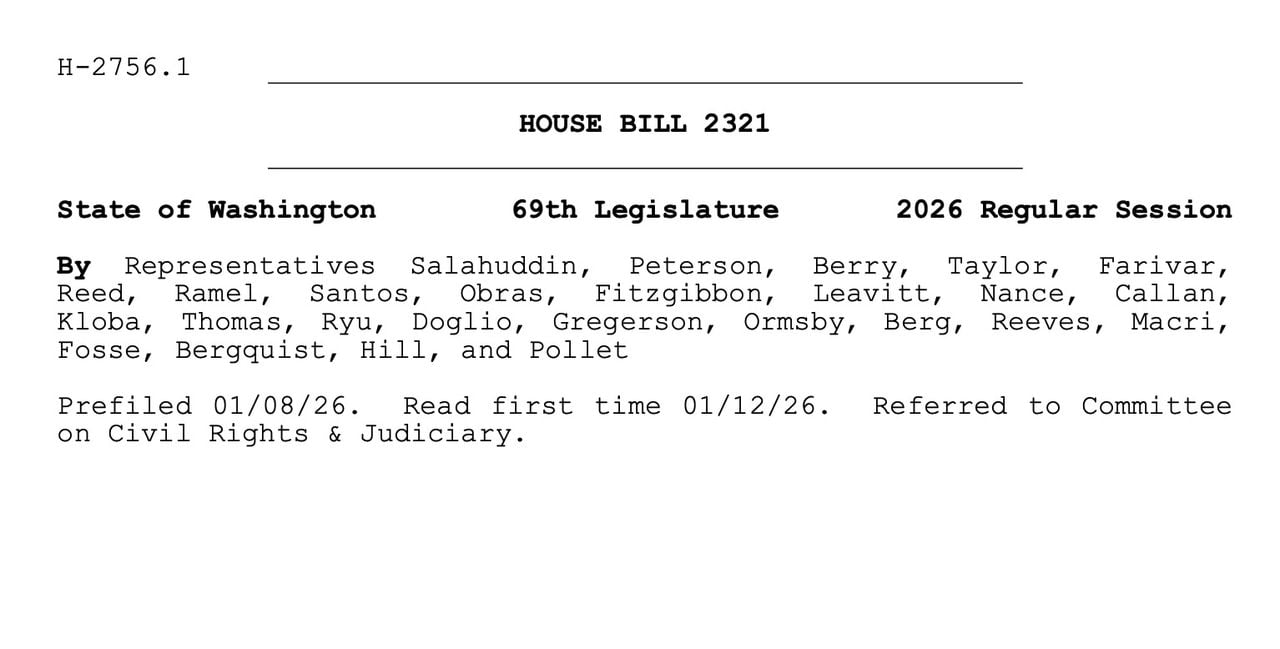
 Top of a bill in the Washington state government [Source: Washington State]
Two US states appear to be launching new laws to prevent 3D printing of weapons.
The “ghost gun” phenomenon is a real problem in many areas. The concept is to make key parts of a gun that normally require licensing on a 3D printer, thereby circumventing the licensing. The remainder of the weapon is assembled from license-free parts commonly available.
Police forces and legislators have been struggling with this issue for some time, and in the past month, not one, but two US states are developing laws to govern the production of these weapons using 3D printers. New York State has introduced Bill S00227A (Senate) and A01777A (As…
Top of a bill in the Washington state government [Source: Washington State]
Two US states appear to be launching new laws to prevent 3D printing of weapons.
The “ghost gun” phenomenon is a real problem in many areas. The concept is to make key parts of a gun that normally require licensing on a 3D printer, thereby circumventing the licensing. The remainder of the weapon is assembled from license-free parts commonly available.
Police forces and legislators have been struggling with this issue for some time, and in the past month, not one, but two US states are developing laws to govern the production of these weapons using 3D printers. New York State has introduced Bill S00227A (Senate) and A01777A (Assembly), and Washington State has introduced House Bill 2321. Both of these initiatives are similar.
But what’s actually in these bills? If enacted, how would they affect the 3D printing industry? Let’s take a look at what they say.
The one-page New York bill establishes offences for the following:
Manufacturing of [long list of possible weapons] is guilty of a felony. Sales or distribution of digital files that may be used to produce [long list of possible weapons] is guilty of a felony.
They also formally define a “three-dimensional printer” as a means for production.
What about the Washington state bill? It is much longer, six pages, and includes far more specifics. However, it does not establish rules for manufacturing or selling weapons, which presumably are already in effect. Instead, it focuses on the 3D printers themselves. The bill requires 3D printers to include “blocking features” to prevent them from printing weapons or associated parts.
The bulk of the bill lists in detail how this is to take place. The blocking feature is to identify “firearms blueprints” and stop them from being printed. They require the machine’s firmware and “pre-print software” (the slicer) to use an official database of “disallowed firearms blueprint files” that have been identified by law enforcement to perform this identification. The database is to be created by the Washington State Attorney General and be updated at least once per year.
They also require the 3D printer to include a “watermark” function to verify the pre-print software (the slicer), so that only authorized slicers can be used.
Is it their intention to block every possible weapon part? The bill says this:
“An algorithm does not need to produce a perfect success rate at detecting disallowed files to effectively serve in blocking technology but must meet the technical standards for detection and flagging of disallowed files.”
But also this:
“Equipped with blocking features” means a three-dimensional printer has integrated a software controls process that deploys a firearms blueprint detection algorithm, such that those features identify and reject print requests for firearms or illegal firearm parts with a high degree of reliability and cannot be overridden or otherwise defeated by a user with significant technical skill.”
Finally, the bill makes it illegal to sell 3D printers that do not have these features in Washington State, with penalties being up to five years in the big house with a US$15,000 fine.
These are both attempting to control the same situation, yet taking very different approaches. To me, the New York State approach seems more feasible: make the distribution and manufacturing illegal and then go catch the perps.
On the other hand, the Washington State approach seems ill-conceived. It is simply unimplementable:
- No 3D printer manufacturer would accept those terms and would immediately stop selling equipment in that state.
- The database approach would be wildly behind the current state of designs and would therefore accomplish little.
- The proposed authorized slicer approach would preclude the use of any open-source slicing software.
- The proposed approach would require 3D printers to be constantly online to check the database, but this is a major security problem for the military, manufacturers, and the government itself.
- The entire system could be relatively easily overcome by responding “OK” to any outgoing database requests by a small software program someone will immediately create.
- Few would consider buying printers with these required features due to the side effects of the restrictions.
The Washington State bill reads as a non-technical person’s fantasy of how things should work. Clearly, no one with any knowledge of the situation was consulted on this bill’s contents, as it is absolutely unimplementable.
Via New York State and Washington State

By Kerry Stevenson
Kerry Stevenson, aka "General Fabb" has written over 8,000 stories on 3D printing at Fabbaloo since he launched the venture in 2007, with an intention to promote and grow the incredible technology of 3D printing across the world. So far, it seems to be working!
View all of Kerry Stevenson’s posts.