Classroom change: Starting Wednesday October 5, lectures will be in 370-370 (rather than McCullough 115)
Description
Statistical concepts and methods developed in a mathematical framework: Hypothesis testing, point estimation, confidence intervals. Neyman-Pearson theory, maximum likelihood estimation, likelihood ratio tests, Bayesian analysis. Asymptotic theory and simulation-based methods.
Prerequisites: Probability theory (STATS 116), multivariable calculus (MATH 52), and basic computer programming (or willingness to learn as you go!)
Lectures
Monday, Wednesday, and Friday 11:30AM - 12:20PM Building 370, Classroom 370
Teaching staff
**Instructor: **Zhou Fan Sequoia Hall 242 zhoufan@stanford.edu OH: Mondays 1-3PM in Sequoia Hall 220, or by appointm…
Classroom change: Starting Wednesday October 5, lectures will be in 370-370 (rather than McCullough 115)
Description
Statistical concepts and methods developed in a mathematical framework: Hypothesis testing, point estimation, confidence intervals. Neyman-Pearson theory, maximum likelihood estimation, likelihood ratio tests, Bayesian analysis. Asymptotic theory and simulation-based methods.
Prerequisites: Probability theory (STATS 116), multivariable calculus (MATH 52), and basic computer programming (or willingness to learn as you go!)
Lectures
Monday, Wednesday, and Friday 11:30AM - 12:20PM Building 370, Classroom 370
Teaching staff
**Instructor: **Zhou Fan Sequoia Hall 242 zhoufan@stanford.edu OH: Mondays 1-3PM in Sequoia Hall 220, or by appointment
Teaching assistants: Alex Chin, ajchin@stanford.edu OH: Tuesdays and Thursdays 9:30-10:30AM in Sequoia Hall 220
Andy Tsao, andytsao@stanford.edu OH: Thursdays 3-5PM in 460-301
Pragya Sur, pragya@stanford.edu OH: Mondays 3-4PM in Sequoia Hall 207 and Fridays 3-4PM in Sequoia Hall 220
Yiguang Zhang, yiguang@stanford.edu OH: Wednesdays and Fridays 10:20-11:20AM in Sequoia Hall 207
Requirements and policies
Homework
Approximately weekly, due Wednesdays at 5PM. Late homeworks will NOT be accepted (unless with advance written permission from the teaching staff). Your lowest homework grade will be dropped.
Homework assignments will include simple computing exercises asking you to perform small simulations, create histograms and plots, and analyze data. You may use any language (e.g. R, Python, Matlab) and will be graded only on your results, not on the quality of your code.
Collaboration
You are encouraged to discuss homework problems with your classmates, but you must submit your own individual homework write-up, in your own words and using your own code for the programming exercises. Please indicate at the top of your write-up the names of the students with whom you worked.
Exams
Midterm: 6:30-8:30PM, Tuesday, November 1, Building 320 room 105 Final: 8:30-11:30AM, Friday, December 16, Mudd Chemistry Building auditorium
Grading
Your final grade will be the maximum of the following two weightings: 30% x (average homework) + 35% x (midterm exam) + 35% x (final exam) 30% x (average homework) + 20% x (midterm exam) + 50% x (final exam) Your lowest homework grade will be dropped when computing your average homework score.
Textbook
 John A. Rice, Mathematical Statistics and Data Analysis, 3rd edition.
For reference:
 Morris H. DeGroot and Mark J. Schervish, Probability and Statistics, 4th edition.
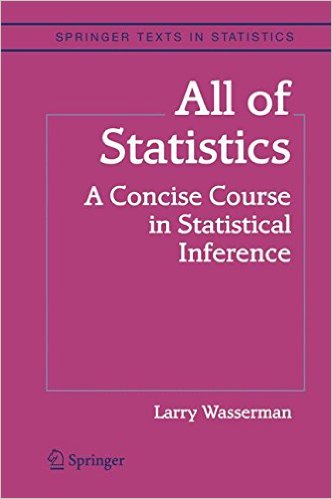 Larry Wasserman, All of Statistics: A concise course in statistical inference.