By Shelley Shan / Staff reporter
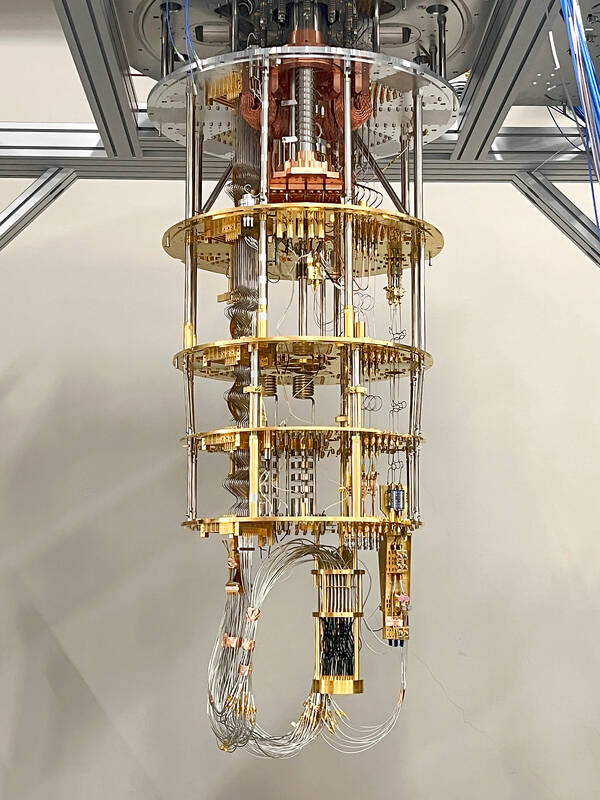
Academia Sinica yesterday unveiled its 20-quantum-bit (qubit) superconducting quantum computer, a milestone in the nation’s quantum research since introducing its 5-qubit computer in 2023.
“With the development of the 20-qubit superconducting quantum computer, Taiwan is officially at the starting point of the large-scale quantum chip fabrication process,” Academia Sinica president James Liao (廖俊智) said in a statement.
While information in traditional computers is represented as either a 1 or a 0, qubits can be processed as both 1 and 0, using quantum superposition, enabling the computation of calculations that would take traditional computers years to complete.
…
By Shelley Shan / Staff reporter
Academia Sinica yesterday unveiled its 20-quantum-bit (qubit) superconducting quantum computer, a milestone in the nation’s quantum research since introducing its 5-qubit computer in 2023.
“With the development of the 20-qubit superconducting quantum computer, Taiwan is officially at the starting point of the large-scale quantum chip fabrication process,” Academia Sinica president James Liao (廖俊智) said in a statement.
While information in traditional computers is represented as either a 1 or a 0, qubits can be processed as both 1 and 0, using quantum superposition, enabling the computation of calculations that would take traditional computers years to complete.
Taiwan’s domestically developed 20-quantum-bit superconducting quantum computer is pictured in an undated photograph.
Photo courtesy of Academia Sinica
Quantum computing, which is being pursued with substantial investments by numerous nations, is widely recognized as a key enabler for integrating high-performance computing and artificial intelligence, the institute said.
The 20-qubit quantum computer project was started last year by first creating high-quality superconducting qubits using an 8-inch wafer fabrication platform, it said.
The production process helped create the nation’s first quantum semiconductor fabrication research and development platform, as well as the first quantum computing testing platform, it said.
The researchers also applied semiconductor industry methods to control the quality of large-diameter wafers during manufacturing, ensuring stricter standards of quality and uniformity as the number of qubits increased, the institute said.
Chen Chii-tung (陳啟東), executive director of Academia Sinica’s Thematic Center for Quantum Computer, said that a practical quantum computer requires high-quality, large-scale qubits to realize its full functionality.
“The 20-qubit quantum computing system not only accommodates a larger computational variable space, but also symbolizes Academia Sinica’s mastery of reliably fabricating multiple qubits and coupling them, as well as the successful development of key technologies, such as laser-based fine-tuning of qubit frequencies,” he said.
The research team continues to refine chip stacking techniques to reduce crosstalk between qubits, while simultaneously improving qubit control and readout efficiency, he added.
The team also extended qubit coherence times from 15 to 30 microseconds in the 5-qubit era to 530 microseconds, significantly improving the stability of quantum states and enabling longer computation durations, the institute said.
Ke Chung-ting (柯忠廷), assistant research fellow at Academia Sinica’s Research Center for Critical Issues, said that superconducting qubits are extremely sensitive to electromagnetic interference.
Beyond the control microwave signals, any stray signals penetrating the packaging system can adversely affect qubit performance, he said.
Academia Sinica plans to host the International Superconducting Quantum Computing Workshop at the Research Center for Key Issues at its southern campus from Wednesday to Friday next week, when academicians and industry professionals would have the opportunity to test the 20-qubit superconducting quantum computing system firsthand.