- Introduction
- Europe as a global scapegoat
- Is the United States about to attack Iran?
- Venezuela: a real path to democracy or simply a replacement of Chavista elites?
- Rubio before the Senate: strength, limits and ambiguities of Trump’s policy towards Venezuela
- Panama: Latin American summit on organised crime
- Japan: inflation enters the campaign
- [Tesla cuts vehicle range and turns to AI](#tesla-cuts-vehi…
- Introduction
- Europe as a global scapegoat
- Is the United States about to attack Iran?
- Venezuela: a real path to democracy or simply a replacement of Chavista elites?
- Rubio before the Senate: strength, limits and ambiguities of Trump’s policy towards Venezuela
- Panama: Latin American summit on organised crime
- Japan: inflation enters the campaign
- Tesla cuts vehicle range and turns to AI
- Starmer in Beijing: British rapprochement with China amid tensions with Washington
- Venezuela in the mainstream media: contradictory signs of openness and authoritarian continuity
- Europe, Ukraine and the narrative of fatigue
- Media Rack
- Editorial commentary
Introduction
Europe is once again at the centre of the stage, not so much because of what it does but because of what others project onto it: Trump, Xi, Putin and Zelensky use ‘Europe’ as a screen on which to resolve their own geopolitical neuroses, while the continent attempts to rebuild its strategic autonomy amid wars, technological revolution and economic fatigue.
At the same time, the Trump administration is escalating its standoff with Iran to the brink of military action, Latin America is torn between fragile hope in Venezuela and coordination against organised crime in Panama, Japan is holding elections defined by inflation and the discontent of a middle class accustomed to deflation, and Tesla’s shift towards artificial intelligence symbolises the new phase of global geo-economic competition.
Europe as a global scapegoat
**Facts **
Leaders as disparate as Donald Trump, Xi Jinping, Vladimir Putin and Volodimir Zelensky have intensified their discourse of contempt towards Europe—including the United Kingdom—in recent weeks, presenting it as a soft, slow, moralistic actor, incapable of defending itself and making timely decisions.
This wave of ‘Europe-bashing’ is largely a response to internal political battles in Washington, Beijing, Moscow and Kiev, rather than a dispassionate assessment of the continent’s economic, regulatory and strategic weight. The critical diagnosis highlights real vulnerabilities – military dependence on the United States, low growth, political fragmentation and the gap between regulatory ambition and hard power – but the narrative of a terminal or irrelevant Europe is clearly overplayed.
**Implications **
For Trump, rhetorically punishing Europeans who are ‘freeloaders’ in defence and trade allows him to justify a transactional doctrine, tariffs and a rethinking of alliances to his nationalist-populist base. For Xi, highlighting European division and hypocrisy is a cheap way to exert pressure on trade, investment and industrial standards, while attempting to fracture transatlantic coordination without completely breaking with Brussels.
Putin exploits the image of a decadent Europe controlled by Washington to legitimise his aggression against Ukraine and reinforce the narrative of Western siege to his public; Zelensky, for his part, resorts to public reproaches at the slowness and ambiguity of some European capitals in an attempt to speed up critical decisions on arms, financing and sanctions.
**Outlook and scenarios **
In the short term, verbal contempt for Europe is likely to increase as electoral milestones and difficult decisions on Ukraine, Iran and China approach, because it is politically profitable to blame Brussels, Berlin or Paris for one’s own internal dilemmas. In the medium term, the key will be whether Europe uses this cycle of rhetorical humiliation as leverage to accelerate its rearmament, its integration in defence and its capacity for rapid decision-making, or whether it takes refuge in moral superiority while third parties redraw the map of power.
The Atlanticist and pro-European editorial line demands precisely the opposite of the caricature: less complacency, more strategic autonomy, more investment in defence and an unapologetic defence of liberal democracy against autocrats of any stripe.
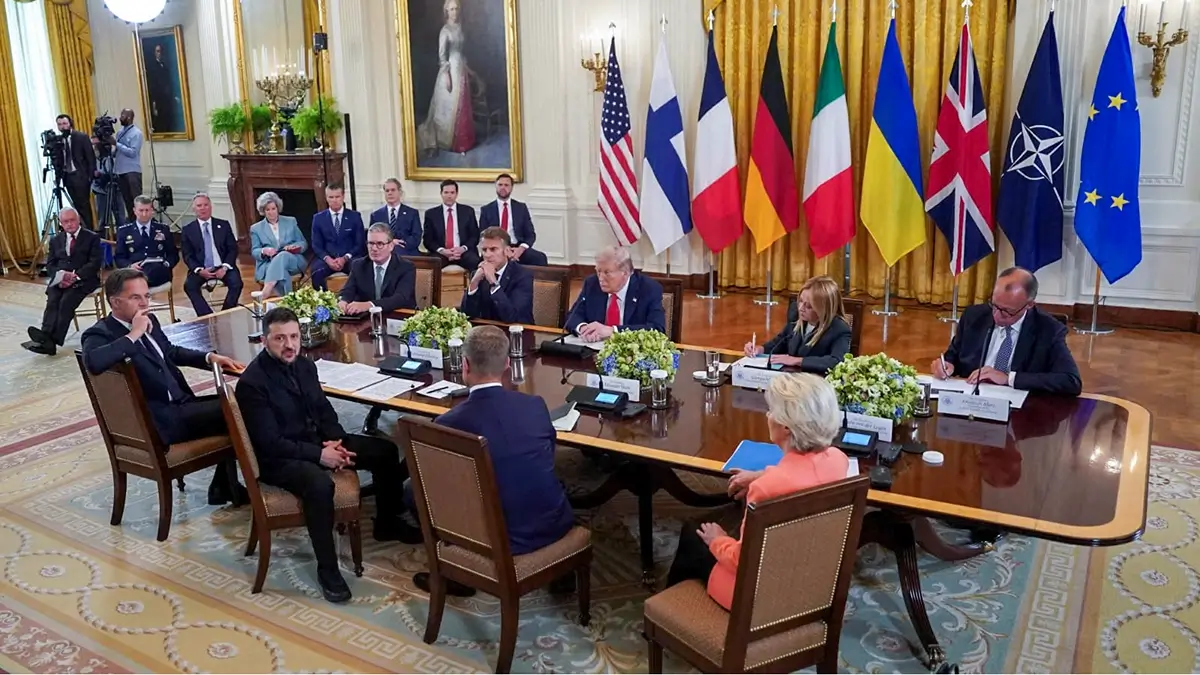 Ukrainian President Volodymyr Zelenskiy speaks during a meeting with US President Donald Trump, German Chancellor Friedrich Merz, French President Emmanuel Macron, British Prime Minister Keir Starmer, Italian Prime Minister Giorgia Meloni, Finnish President Alexander Stubb, NATO Secretary General Mark Rutte, and European Commission President Ursula von der Leyen, amid negotiations to end Russia’s war in Ukraine, at the White House in Washington, D.C., USA, on 18 August 2025 - REUTERS/Alexander Drago
Is the United States about to attack Iran?
**Facts **
Donald Trump has publicly announced that a ‘massive US armada’ is heading towards Iran, assuring that it is prepared to use ‘violence, if necessary’, and warning Tehran that it will not have ‘nuclear weapons’. The president has linked this deployment to the possibility of a new operation against Iranian nuclear facilities, recalling the June attack in which the United States claimed to have destroyed much of the regime’s nuclear infrastructure.
The White House insists that its goal is to force Iran to negotiate a ‘fair’ and ‘equitable’ nuclear agreement, but the rhetoric and naval movements increase the risk of miscalculation in a region saturated with pro-Iranian militias, critical energy routes and accumulated tensions.
**Implications **
From a perspective critical of Tehran’s jihadist-terrorist regime — a systematic exporter of terrorism via Hezbollah, Iraqi militias, Houthis and Hamas — Trump’s policy of maximum pressure has a deterrent logic: it reminds the Iranian leadership that the use of proxies will not come without a price. However, the precedent of ‘Midnight Hammer’, the June bombing of nuclear facilities, and the display of naval muscle increase the risk of inadvertent escalation if a drone, missile or regional militia crosses ill-defined red lines.
European allies, despite their weariness with Iranian adventurism, face the dilemma of supporting their American ally against a destabilising regime or insisting on a diplomatic path that Tehran has used too many times to buy nuclear time.
**Outlook and scenarios **
In the very short term, the most likely scenario is a combination of show of force and negotiating pressure, with cyberattacks, covert operations and calibrated sanctions before an open attack. A limited strike against military or nuclear infrastructure cannot be ruled out if Iran crosses clear thresholds – new enrichment to military levels, a massive attack by militias against US or allied interests – which could trigger asymmetric retaliation in the Gulf, Iraq, Syria or the Red Sea. The consistent editorial position is to maintain maximum firmness towards a terrorist regime that must never obtain nuclear weapons, while at the same time demanding a clear exit strategy and close coordination with Europe, Israel and Arab partners to avoid an open regional war that would only benefit extremists.
 A Tomahawk Land Attack Missile (TLAM) is launched from the guided missile cruiser USS Cape St. George - REUTERS/US Navy/Petty Officer 1st Class Kenneth Moll
Venezuela: a real path to democracy or simply a replacement of Chavista elites?
**Facts **
Following the US operation that ended with the kidnapping and transfer to New York of Chavista dictator Nicolás Maduro, Delcy Rodríguez has taken power in Caracas, presenting herself as the architect of a supposed ‘irreversible’ transition to democracy. In-depth analysis indicates that, for now, what is advancing is an agenda of economic reforms—partial reopening to foreign capital, gradual normalisation of the oil industry, and rapprochement with Washington—while the repressive structure of the regime remains intact.
Key commanders such as Defence Minister Vladimiro Padrino López retain control of the armed forces, have publicly renewed their loyalty to Rodríguez and are emerging as the ultimate arbiters of any political change, in a context of suspected internal rivalries, military cartels and possible ‘palace coups’.
**Implications **
From the perspective of an editorial line diametrically opposed to the Chavista narco-dictatorship, Maduro’s capture was a historic blow to a state mafia, but it does not guarantee a democratic transition as long as the military and intelligence pillars remain in the hands of the same actors. Washington has opted for a graduated strategy—modulated sanctions, oil incentives, close supervision—trusting that Delcy Rodríguez can steer an economic liberalisation compatible with a certain political openness, an approach that runs the risk of consolidating a ‘Madurismo without Maduro’.
Mixed signals—lower hyperinflation and slightly higher consumer spending, but little progress on electoral guarantees—fuel suspicions that this is a facelift for a regime that remains infiltrated by drug trafficking, connections to Iranian terrorism, and global corruption networks.
**Outlook and scenarios **
The coming months will be decisive: without clear timetables for free elections, the release of political prisoners and guarantees for the opposition, the thesis of a democratic transition will lose all credibility. A plausible scenario is the coexistence of selective economic improvements—which reduce social pressure—with a reconfigured authoritarianism, underpinned by rival military factions that prefer a pact of impunity to violent collapse.
The consistent editorial position is to strongly support any real progress toward free elections, but without lowering our guard or legitimising a ‘Chavismo 2.0’ that maintains the impunity of the cartels and the tutelage of Havana, Moscow, and Tehran over a country that is key to the West’s energy and security interests.
 Venezuela’s interim president, Delcy Rodríguez, addresses the audience after receiving the insignia of commander-in-chief of the Armed Forces, alongside National Assembly President Jorge Rodríguez and Venezuelan Defence Minister Vladimir Padrino López, at Fort Tiuna in Caracas, Venezuela, on 28 January 2026. - PHOTO/ Daniella Milan / Miraflores Palace / via REUTERS
Rubio before the Senate: strength, limits and ambiguities of Trump’s policy towards Venezuela
**Facts **
Secretary of State Marco Rubio appeared before the Senate Foreign Relations Committee to defend the 3 January operation that culminated in Maduro’s capture and to explain the Trump administration’s strategy towards post-Maduro Venezuela. Rubio stressed that there is no ‘US war or occupation’ in the country, hailed the operation as a strategic success against a ‘hub of activity for almost all of the United States’ adversaries’ and emphasised that Washington is ‘prepared to use force’ if other methods of pressure fail.
The appearance came after a close vote in the Senate that blocked a resolution aimed at limiting Trump’s military powers in Venezuela, with Vice President JD Vance casting the tie-breaking vote, reflecting the unease of part of Congress over the executive branch’s growing role in war decisions.
**Implications **
Rubio, who knows the region well and has been a vocal critic of Chavismo for years, has become the diplomatic face of a strategy that combines a military heavy hand with a ‘no regime change’ narrative that convinces few on Capitol Hill. For Latin America, the precedent of capturing a head of state in his bedroom and transferring him to the United States opens an uncomfortable debate about sovereignty, international law and deterrence against narco-regimes, in a context where many citizens support any measure that helps to overthrow dictatorships, while a large part of the elite fears a replicable pattern.
The clash between an executive branch willing to act pre-emptively and a legislative branch asserting its constitutional prerogative over the use of force foreshadows further institutional tensions in Washington if the administration attempts to export the ‘Venezuela model’ to other crisis scenarios.
**Outlook and scenarios **
In the short term, the Rubio-Trump line seems to be consolidated: combined economic, diplomatic and—when deemed necessary—military pressure, without occupation troops, but with specific operations against criminal leaders and mafia power structures. In the medium term, the success or failure of the Venezuelan experience will be decisive: if it results in stabilisation, some social improvement and credible steps towards democracy, it will reinforce the idea that the surgical use of force against narco-dictatorships can be a legitimate tool; if, on the contrary, it leads to chaos, reprisals or a simple authoritarian reconversion, internal and external rejection of this type of intervention will increase. From a centre-right liberal perspective, the desirable combination is firmness without neo-colonial temptations: neither indulgence with state mafias nor adventures that replicate the mistakes of Iraq or Afghanistan.
 US Secretary of State Marco Rubio, alongside US Secretary of Defence Pete Hegseth, speaks to the media on the day of a briefing for the House of Representatives on the situation in Venezuela, at the Capitol in Washington, D.C., USA, on 7 January 2026 - REUTERS/ EVELYN HOCKSTEIN
Panama: Latin American summit on organised crime
**Facts **
A regional summit is being held in Panama — centred around an economic and political forum — at which several Latin American leaders are advocating a common strategy against transnational organised crime and the ‘mafias’ that cross borders, economies and political systems. Colombian President Gustavo Petro has called for a ‘pact for freedom’ and a regional justice mechanism against drug trafficking networks, while the host, Panamanian President José Raúl Mulino, presents the Panama Canal and the country’s position as a geopolitical and logistical lever with continental reach. In addition, a financing agenda of up to 100 billion dollars has been proposed for 2031, focused on infrastructure, economic integration and institutional strengthening.
**Implications **
The rhetoric of regional unity contrasts with the fragmented reality of Latin America, where liberal democracies, hybrid regimes and open dictatorships such as those in Cuba, Nicaragua and Venezuela coexist. The debate on drugs and security is marked by very different views: from those who want to thoroughly review the ‘war on drugs’ to those who call for more cooperation with the United States in interdiction, intelligence and surgical strikes against cartels, drug-trafficking boats and mafia structures.
For the editorial position—firmly against drug trafficking and dictatorships—the challenge is to articulate an agenda that combines socio-economic reforms, strengthening the rule of law and robust cooperation with Washington and Europe, while preventing the ‘anti-mafia’ discourse from being hijacked by authoritarian leaders to justify more control without more freedom.
**Outlook and scenarios **
In the short term, the summit is unlikely to produce a new regional security architecture, but it may serve to strengthen judicial cooperation networks, financial data exchange and joint operations against specific networks. In the medium term, if Washington maintains its priority of combating drug trafficking and Europe wakes up to the connection between cocaine, fentanyl and internal security, Latin America may find in the fight against organised crime a strong bargaining chip with advanced democracies, in exchange for internal reforms and transparency.
The worst-case scenario would be for anti-mafia rhetoric to coexist with the continuation of covert narco-states, where defence ministers, military leaders and dominant parties turn the state into a criminal enterprise with a flag.
 Panamanian President José Raúl Mulino delivers a speech during the 2026 International Economic Forum of Latin America and the Caribbean, in Panama City, Panama, 28 January 2026 - REUTERS/ ARIS MARTINEZ
Japan: inflation enters the campaign
**Facts **
Japan is heading for early general elections on 8 February, called by Prime Minister Sanae Takaichi in an unusual context: inflation, rather than chronic deflation, has become the central concern of the middle class. An analysis by the Financial Times describes the contest as the ‘discount election’, in which the key voters are ‘bargain-hunting’ families who, after decades of stagnant wages, are forced to cut spending in an environment of rising prices and tax pressure.
The discontent of these households, who feel that growth is not reaching them and that the cost of living is skyrocketing, is redefining the Japanese political agenda, traditionally dominated by debates on security, demographic ageing and technocratic management.
**Implications **
For a country that has been a benchmark for stability and deflation, the emergence of inflation as a central issue alters the coordinates of economic policy, reopens the discussion on wages, tax reform and social spending, and gives opposition forces room to accuse the government of mismanaging the exit from the deflationary cycle.
In geopolitical terms, public opinion that is more sensitive to the cost of living may become less tolerant of increases in defence spending or costly sanctions against Russia and other actors, just as Tokyo is strengthening its role in the Indo-Pacific vis-à-vis China. However, the core of the Japanese consensus – alliance with the United States, vigilance against Chinese expansionism and support for Ukraine – appears solid, so the debate will be fought more on the terrain of internal redistribution than on that of strategic orientation.
**Outlook and scenarios **
If the government manages to articulate a narrative of ‘responsible inflation’, combining wage increases, support for families and fiscal discipline, it can turn this crisis into an opportunity to modernise an exhausted model and reconnect with a middle class under strain. If, on the contrary, the measures are perceived as technocratic and belated, this will open the door to fiscal populism promising immediate relief at the expense of medium-term sustainability.
For a Spain that is observing Japan from the experience of its own middle-class crisis, the Japanese laboratory offers lessons on how to manage an inflationary turn without sacrificing institutional stability or Atlantic anchoring.
 A Japanese flag flies above the Bank of Japan headquarters in Tokyo, Japan - REUTERS/ MANAMI YAMADA
Tesla cuts vehicle range and turns to AI
Facts
Tesla has announced that it will eliminate its S and X models and allocate 2 billion dollars to xAI, Elon Musk’s artificial intelligence company, in a strategic shift that moves the company’s centre of gravity from automobiles to AI and robotics.
The move comes as Tesla reports its first-ever decline in annual revenue, pressured by competition from cheaper electric vehicles and the end of some tax incentives in the United States. The move comes as Tesla reports its first-ever decline in annual revenue, pressured by competition from cheaper electric vehicles and the end of some tax incentives in the United States. Although quarterly results have slightly exceeded expectations, margins are under pressure and investors are increasingly looking to the promise of autonomous driving and humanoid robots as drivers of future growth.
**Implications **
Tesla’s shift confirms that the battle for industrial leadership in the 21st century will not be fought solely on car production volumes, but on who controls the AI systems that manage fleets, data and associated services. In geopolitical terms, the strengthening of an American champion of AI and mobility has implications for Europe—with an automotive industry that has yet to find its narrative in the software revolution—and for China, which is aggressively competing with its own electric manufacturers.
The decision to move away from more iconic models towards more scalable platforms can be interpreted as an acknowledgement that automotive luxury is no longer enough; value is shifting to algorithms, chips and ecosystem control.
**Outlook and scenarios **
If Tesla succeeds in translating its investment in xAI into tangible advances in autonomous driving and robotics, it will consolidate a dominant position at the intersection of automobiles, data and services, reinforcing the technological primacy of the United States over China and lagging Europe.
If, on the other hand, the promise of AI is slow to materialise and competition in mid-range electric vehicles takes away market share, the company could become a symbol of a technological-financial bubble, with implications for confidence in the digital economy. For Europe, the message is clear: there is no time to lose if it does not want to be reduced to being a market, but not a player, in the new geo-economy of artificial intelligence.
 A Tesla robot is displayed at the World Artificial Intelligence Conference (WAIC) in Shanghai, China, on 6 July 2023 - REUTERS/ALY SONG
Starmer in Beijing: British rapprochement with China amid tensions with Washington
**Facts **
British Prime Minister Sir Keir Starmer has begun a four-day visit to China, the first by a British head of government in almost eight years, with the stated aim of ‘repairing’ relations and taking advantage of the economic opportunities of the world’s second-largest market. Starmer is travelling with a delegation of more than 50 business leaders and is scheduled to meet with Xi Jinping, Premier Li Qiang and Parliamentary Chairman Zhao Leji, as well as travelling to Shanghai for meetings with the private sector.
The trip comes amid growing tensions with the United States, following Trump’s threats to impose 100% tariffs on Canada for its trade rapprochement with China and general warnings to allies to strengthen ties with Beijing.
**Implications **
Starmer’s move reflects the temptation of some European capitals to rebalance their bets between an increasingly unpredictable American partner and an increasingly assertive Chinese partner, which is indispensable in trade, investment and energy transition.
The Atlanticist editorial line forces us to read this ‘pivot to China’ with caution: the search for economic opportunities cannot ignore political espionage, repression in Hong Kong, military pressure in the South China Sea and Beijing’s strategic proximity to Moscow. In any case, Starmer’s trip sends a message to Brussels: if Europe wants to speak with one voice to China, it cannot allow each capital to turn its relationship with Beijing into a particular competition for short-term contracts.
**Outlook and scenarios **
If Starmer manages to secure visible agreements – on trade, green investment or technological cooperation – without compromising on human rights or security, he will be able to present himself as the architect of a ‘managed risk’ relationship with China, compatible with the Atlantic alliance. If, on the contrary, the trip is perceived as an uncritical rapprochement with Beijing at a time of Chinese pressure on Taiwan and the Indo-Pacific, it will reinforce the thesis that some European allies underestimate the strategic dimension of the Chinese challenge.
For Spain and the rest of the EU, the visit is a reminder that strategic autonomy does not mean distancing oneself from the United States to get closer to China, but rather strengthening Europe’s ability to negotiate with both from a position of strength and principle.
 British Prime Minister Keir Starmer and Li Qiang, Premier of the People’s Republic of China, pose with their business delegations in the Great Hall of the People during their visit to China on 29 January 2026 in Beijing, China - PHOTO/ CARL COURT via REUTERS
Venezuela in the mainstream media: contradictory signs of openness and authoritarian continuity
**Facts **
A recent analysis highlights that, following Maduro’s fall, Venezuela is experiencing more of an ‘economic takeover’ than a democratic transition: the economy is showing signs of improvement thanks to the partial reopening to US oil and capital, but the authoritarian structures remain intact. The figure of Delcy Rodríguez, with close ties to Cuban intelligence and a history of repression, arouses suspicion among those who fear a disguised continuation of Chavismo; at the same time, sectors of the population are seeing an improvement in access to basic goods for the first time in years.
At the same time, analyses by research centres point out that real power continues to be shared between Rodríguez, Padrino López and Diosdado Cabello, a triangle in which latent rivalries could lead to both authoritarian restructuring and internal conflicts.
**Implications **
The combination of economic relief and persistent repression is a familiar formula in the region: social peace is bought with basic consumption, while any profound political reform is held back. For Europe and the United States, the risk is becoming unwitting partners in ‘authoritarian stabilisation’ in exchange for oil and migration containment, betraying their discourse of support for liberal democracy in a country martyred by two decades of Chavismo.
The editorial line demands consistency: the end of Maduro cannot mean the end of demands for accountability for human rights violations, links to drug trafficking and support for international terrorist networks linked to Iran.
**Outlook and scenarios **
In the short term, relative economic improvement may defuse mass mobilisations and give breathing space to a reconfigured regime; in the medium term, the absence of genuine political reforms will cause the conflict to reappear in the form of protests, internal fractures or new waves of migration. How the United States and the European Union manage the terms of their energy collaboration with Caracas will determine whether the Venezuelan experiment results in a supervised transition or the consolidation of a narco-state with a new face.
The only solution compatible with the defence of liberal democracy is to rigorously condition any easing of sanctions on verifiable progress in freedoms, elections and the dismantling of criminal networks.
 María Corina Machado gestures during a protest prior to the inauguration of President Nicolás Maduro on Friday, 9 January 2025, in Caracas, Venezuela - REUTERS/ LEONARDO FERNÁNDEZ VILORIA
Europe, Ukraine and the narrative of fatigue
**Facts **
The same analysis that describes ‘Europe-bashing’ recalls that, despite its doubts and delays, Europe has been a decisive player in sustaining Ukraine, channelling substantial financial, humanitarian and military aid at the cost of internal costs in energy, inflation and trade disruption. European intelligence services – especially the British – remain key partners for Washington in the information war, while European Union diplomacy maintains influence in multilateral organisations and strategic regions.
At the same time, internal political fragmentation—from the pro-Russian far right to the radical pacifist left—fuels the perception of ‘fatigue’ and opens the door to narratives of ‘realistic’ capitulation to Moscow.
**Implications **
The discourse of a ‘weak, moralistic and saturated’ Europe is of interest both to Putin and to those within the EU who would like to justify a selfish retreat, sacrificing Ukraine on the altar of economic comfort. Confusing the understandable fatigue of societies with strategic abandonment would be a historic mistake: what is at stake in Ukraine is not only the integrity of a country, but the validity of the fundamental principle that borders cannot be changed by force. Our Atlanticist Europeanism requires us to make it clear that lasting peace is not built by rewarding Russian aggression, but by strengthening European deterrence and defence capabilities, precisely to avoid the temptation of future military adventures.
**Outlook and scenarios **
In the short term, continued European support for Kiev will depend on the ability of political elites to explain to their citizens that the cost of not supporting Ukraine would be much higher in terms of security, prestige and the stability of the international order.
In the medium term, the real test will be whether Europe transforms this war into a catalyst for completing its defence union, reducing strategic dependencies and consolidating a less reactive and more proactive foreign policy. If it fails, the EU risks becoming a normative power without hard power, resigned to being a stage for history rather than a protagonist in it.
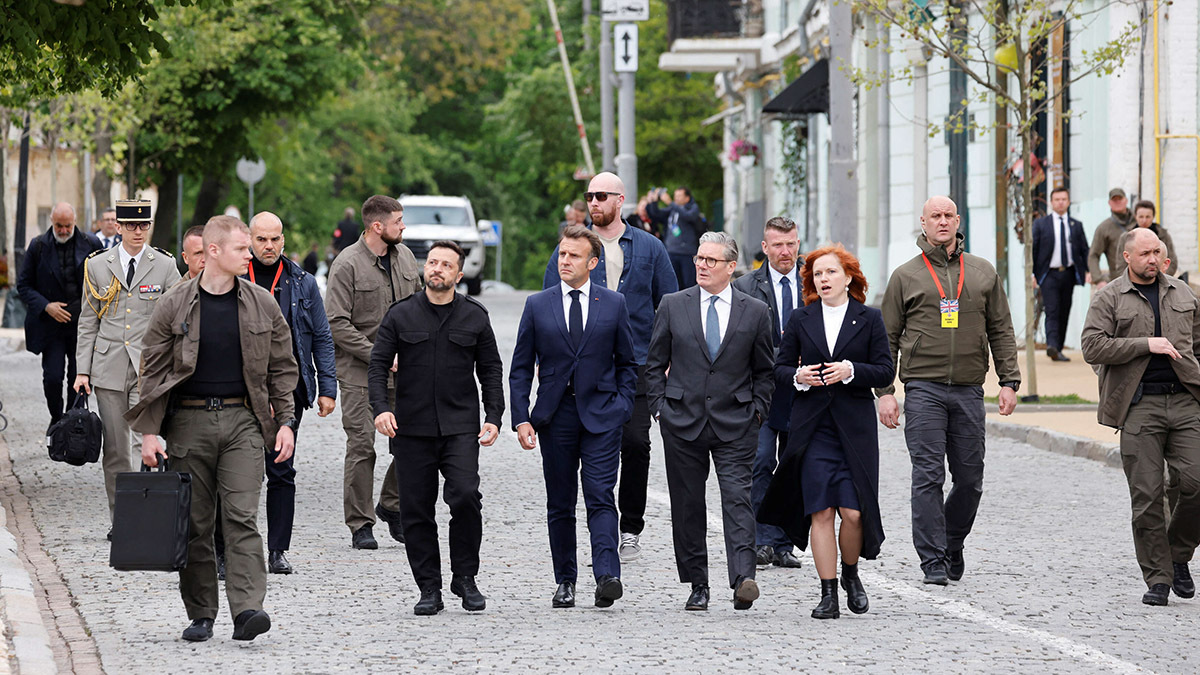 British Prime Minister Keir Starmer, French President Emmanuel Macron, and Ukrainian President Volodymyr Zelensky arrive to visit the Wall of Heroes of the Nation, a memorial wall for fallen Ukrainian soldiers, in Kyiv, Ukraine, on 10 May 2025 - REUTERS/LUDOVIC MARIN
**The Economist: **delves into the wave of rhetorical attacks against Europe, the internal debate in Washington over the use of force against Iran and the ambivalent signs of Venezuela’s supposed transition.
**Financial Times: **highlights Tesla’s shift towards AI in a context of falling revenues, and underlines the central role of ‘bargain hunters’ in Japanese elections marked by inflation.
**Reuters: **offers detailed coverage of Starmer’s trip to China, the British shift towards Beijing and Marco Rubio’s Senate appearance on Venezuela, focusing on tensions within the US political system itself.
Wall Street Journal: describes a Venezuela where economic hope coexists with deep scepticism about real democratic progress after Maduro’s departure.
**Other major media outlets (BBC, CNN, Fox, NYT, etc.) revolve around these same themes: **growing tension with Iran, the rebalancing of alliances vis-à-vis China, the wear and tear of the war in Ukraine on Europe, and the Venezuelan laboratory of ‘controlled transition.’
The sequence of events in recent hours paints an uncomfortable picture: while autocrats and populists make Europe their favourite verbal sparring partner, the old normative power faces the challenge of deciding whether it wants to remain a subject of history or simply endure the blows. Trump, Xi, Putin, Rodríguez and company know that Europe is too important to ignore, but too self-contained to fear; that is why they use it as a therapeutic scapegoat, as a screen on which to project their own insecurities, contradictions and failures.
Faced with an Iran playing on the brink of nuclear abyss, the response cannot be pacifist resignation or military adventurism, but rather coordinated firmness that makes it clear that no theocratic regime that exports terrorism can aspire to international respectability. Trump is right to refuse to normalise a system that feeds Hezbollah, Hamas and Iraqi militias, but forcefulness must be accompanied by strategic foresight: there is no such thing as an easy war, least of all in a Middle East saturated with gunpowder, memories of failed invasions and overlapping red lines.
In Latin America, the Venezuelan laboratory is testing the credibility of those of us who defend liberal democracy and the rule of law: it is not enough to decapitate a narco-dictatorship if the mafia structure that sustained it remains in place. The Panama summit offers an opportunity for the region to talk seriously about organised crime, justice and cooperation with the United States and Europe, but it will be useless if it fails to recognise that the main enemy of Latin American freedom is not supposed foreign ‘interference’, but the elites who have turned the state into a criminal enterprise.
Japan, with its ‘discount election,’ and Tesla, with its embrace of the new religion of AI, remind us that the battle for freedom and prosperity is also being fought on the terrain of everyday economics: in the ability of democracies to protect their middle classes without surrendering to fiscal populism, and in their ability to compete technologically without falling into self-destructive protectionism.
That is, ultimately, the real dilemma of our time: either liberal democracies regain confidence in themselves – in their Atlantic alliance, in their well-managed welfare state, in their culture of fundamental rights – or they will cede ground to those who offer security without freedom, identity without pluralism, and order without law. Europe cannot continue to be the world’s rhetorical punching bag; it must finally behave as what it still is: a central power in the international system that has a moral and strategic obligation to live up to its own values.