Space NASA International Space Station
It’s absolutely enormous once fully inflated.

Published Dec 27, 2025 10:00 AM EST
Max Space
The International Space Station was painstakingly assembled segment by segment, launched into orbit by many expensive and logistically complex rockets.
…
Space NASA International Space Station
It’s absolutely enormous once fully inflated.
Published Dec 27, 2025 10:00 AM EST
Max Space
The International Space Station was painstakingly assembled segment by segment, launched into orbit by many expensive and logistically complex rockets.
Now there’s intense interest in a radically different model: launching space habitats that can inflate like balloons once they’re in space, creating far more room for astronauts inside — and maximizing the amount of orbital real estate they can claim with just a single launch.
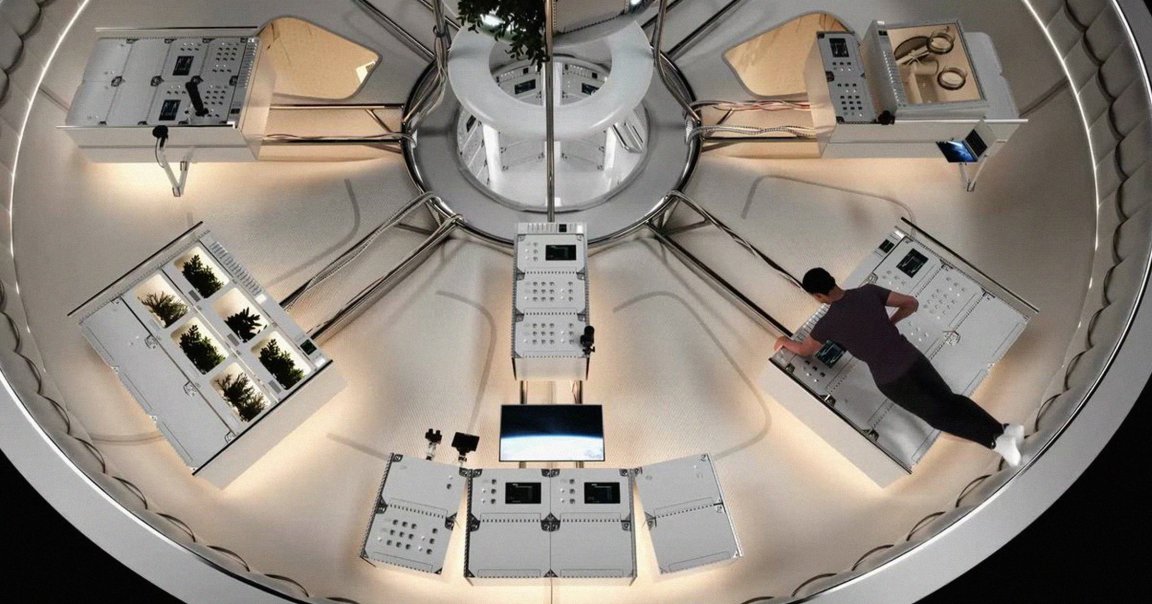
Case in point, the aptly-named startup Max Space recently unveiled plans for its private space habitat, dubbed Thunderbird Station, that can expand to a whopping 12,300 cubic feet — roughly a third of the volume of the ISS — while only requiring a single launch of a SpaceX Falcon 9 rocket.
Max Space is tentatively planning to launch the massive inflatable by 2029, giving future space travelers “unprecedented volume usable in all dimensions, per the firm’s website.

Thunderbird Station
While it remains to be seen whether the company will ultimately be successful in its ambitious endeavor — it’s only one of several companies working on inflatable space habitats — it’s an exciting vision for a far roomier and potentially luxurious future in our planet’s orbit.
It’s especially pertinent because the retirement of the ISS is a mere five years away, which could leave NASA without the ability to conduct scientific experiments in space. The agency has since called on the private industry to come up with a successor.
The Thunderbird Station concept features large, domed windows allowing astronauts to take in epic views while “huge screens for live Earth and space views” double for “entertainment and communications.”
Individual pods give astronauts privacy as well. The layout of the interior is also reconfigurable, allowing astronauts to “adapt and create working and living areas inside the space station that are fit for purpose — even during a mission,” per the firm.
After NASA announced a revision to its existing Commercial Low Earth Orbit Destinations (CLD) program in August, Max Space decided to throw its hat into the ring.
“It was pretty clear that was an opportunity for us to put a proposal forward to show how these modules can really be used for human habitation,” Max Space CEO Saleem Miyan told SpaceNews. “That CLD proposal gave us an incentive to strategically look at how we would bring forward the roadmap, and so that’s exactly what we’ve done.”
But going from concept to reality will be anything but easy. Max Space is hoping to launch a scaled-down prototype no sooner than early 2027 in a SpaceX rideshare mission.
A key test will be whether the module can withstand impacts from micrometeoroids and space debris, an important quality for anything orbiting an increasingly cluttered space. Just this month, China sent two astronauts outside its space station to install debris protection panels after one of its docked spacecraft sustained damage.
Despite plenty of engineering challenges to still overcome, Miyan is already eying even more ambitious targets, arguing that the habitat could be modified for lunar and Mars missions as well.
“We see so many interesting applications where habitats, whether human-rated or not, are required,” he told SpaceNews. “Those are the areas where I think we’re going to stand out.”
More on inflatable habitats: Full-Scale Prototype Space Habitat Explodes Under Pressure