It’s been quite a year. We came into it struggling with a massive GPU shortage, and we’re coming out of it with a brutal memory shortfall. Microsoft largely lost the plot with both Windows and Xbox, and the President of the United States was at the center of one of the most notorious vaporware announcements of all time.
It wasn’t all bad, though. We saw the launch of new Radeon GPUs that actually moved price/performance forward, the next Nintendo system that offers incredible power efficiency, folding phones exited their adolescence, Linux finally got taken seriously as a desktop alternative to Windows, and AI truly became som…
It’s been quite a year. We came into it struggling with a massive GPU shortage, and we’re coming out of it with a brutal memory shortfall. Microsoft largely lost the plot with both Windows and Xbox, and the President of the United States was at the center of one of the most notorious vaporware announcements of all time.
It wasn’t all bad, though. We saw the launch of new Radeon GPUs that actually moved price/performance forward, the next Nintendo system that offers incredible power efficiency, folding phones exited their adolescence, Linux finally got taken seriously as a desktop alternative to Windows, and AI truly became something more than a toy.
Let’s take a walk through our picks for the top 5 biggest tech wins this year, and then have a laugh at two of the most risible failures of 2025.
#5: AMD’s Radeon RX 9070 XT, Price-Performance King
Stupid naming scheme aside, AMD’s biggest win this year wasn’t raw performance; competitor NVIDIA’s high-end hardware still holds that crown. What makes the the Radeon RX 9070 XT our pick for the biggest GPU tech win this year is that it delivers the whole package: competitive ray-tracing performance, reasonable power efficiency, and a solid smack to the price/performance needle, which has remained painfully static for years. For the first time in a long while, an AMD GPU felt like a confident buy instead of a philosophical statement.
AMD’s AI-powered FSR 4 did a lot of heavy lifting here. FSR has long been the red-headed stepchild of the upscaling family, but no more; FSR4 is a real competitor with DLSS and XeSS. The new "Redstone" improvements mostly haven’t manifested yet, but they look promising, too. Pricing was a pain point early on; many people described AMD’s MSRP as a "lie". However, that was thankfully just down to launch-window supply issues, and the cards have come down considerably—even below MSRP at this point.
That combination of price, performance, and progress—but mostly the first two things—is what has us picking the Radeon RX 9070 XT as our #5 tech win of the year.
#4: Nintendo’s Switch 2, Defying All Expectations
After literally two years of endless leaks and rumors about the "Switch Pro" or "Super Switch", Nintendo finally launched the Switch 2 this year. Reactions were mixed; some balked at the higher pricing, and some complained of mediocre specs. By now, the games have largely shut down most of that noise; the Switch 2 is awesome.
Nintendo didn’t try to win a spec war, because it never does. Instead, the Switch 2 leans hard into AI-powered upscaling, and it shows. With NVIDIA’s upscaling doing the heavy lifting, Nintendo managed to push performance into "surprisingly close to Xbox Series S" territory while seriously sipping power at around ten watts. That’s a ridiculously tight power budget for something running games in 4K output resolution.
It hasn’t appeared in many games yet, but Nintendo’s new machine is even capable of ray tracing. It’s obviously not everywhere, but it’s absolutely present in games like Layers of Fear and Star Wars Outlaws. That’s absolutely wild considering how modest the hardware on offer is. Developers wrung miracles out of the original Switch hardware late in its life, and we’re looking forward to seeing what tricks they can pull on the Switch 2.
#3: Samsung’s Galaxy Z Fold 7, Folding Phones Grown-Up
For years, foldables were expensive party tricks; cool to look at, terrifying to own. The Galaxy Z Fold 7 is the model where that finally changed. It’s thinner, it’s lighter, and it has a stronger hinge with a barely-visible rease. Battery life and thermals both improved dramatically. It’s the first folding phone that doesn’t feel like you’re beta-testing the future.
Most critically, the Galaxy Z Fold 7 radically improved the durability of folding devices. Durability testing showed serious improvements while multitasking finally felt natural because the software stopped fighting the hardware. This is the phone that convinced a lot of skeptics that foldables aren’t a gimmick, and that folding phones offer real convenience over the classical flat slate form factor.
The majority of the improvements in the Galaxy Z Fold 7 aren’t revolutionary changes, but rather the result of gradual refinements across yearly iterations. With this model, Samsung didn’t reinvent the phone; instead, it simply finished the job.
#2: Linux Gaming’s Breakout Year (and the Legion Go S)
 Lenovo’s Legion Go S is leading the charge for Linux gaming in 2025.
Windows fatigue hit critical mass in 2025, and Linux quietly benefited. Between stability and performance frustrations, growing privacy concerns, and unwanted AI integrations, when Windows 10 support ended, a surprising number of PC gamers finally gave Linux a second look and discovered it didn’t suck anymore. Proton compatibility is excellent, performance is often superior to Windows, and most mainstream games "just work."
Earlier in the year, Valve added ROG Ally support to its Steam Deck recovery image, but the real milestone was Lenovo shipping the Legion Go S with SteamOS. That made it the first major non-Valve device to fully commit to Valve’s Linux ecosystem, and it sent a clear signal: SteamOS isn’t an experiment anymore, but a real competitor to Windows.
There are still pain points—anti-cheat, niche hardware, and the fragmentation of the Linux ecosystem itself—but for the first time ever, Linux gaming feels like a viable path instead of a hobbyist flex.
#1: Agentic AI — The Year AI Started To Do Stuff
Forget chatbots; 2025 was the year of agentic AI. This is the shift from "answering questions" to "accomplishing tasks" thanks to AI systems that can plan, execute, revise, and operate across tools without constant human input. Scheduling, research, coding, data analysis, and automation are all on the table. In 2025, suddenly AI stopped being reactive and started being operational.
There’s no denying that these tools aren’t perfect. They’re sometimes messy, occasionally spooky, and often wrong. But they’re also undeniably useful. If you haven’t experienced it, go ask ChatGPT, Copilot, Gemini, or Grok to research something for you. It’ll happily come back with a summary of the topic including dozens of source links for you to reference and double-check its work—which you should do, because again, these tools aren’t perfect. For casual use, though, they’re incredible time-savers.
AI is still controversial for all kinds of reasons and agentic AI is no exception. Still, to deny the utility of these tools feels a bit like insisting that the automobile will never replace the horse. AI can’t replace human reasoning or ingenuity; hopefully, it never will. It sure can help it along, though, and making effective use of these tools can absolutely make you more efficient at work and at home.
Tech Fail 1: The Trump Phone, A Masterclass in Vaporware

Look, whatever your opinion of Donald Trump, the "Trump Phone" (more specifically the "Trump T1SM") is going to go down as one of the most impressive non-products in recent memory. It had press releases, it had branding, and it had breathless coverage. What it didn’t have was... an actual phone. There’s no hardware; there was never any hardware, nor a supply chain. So naturally, there’s no price, no release date, and no reviews.
By mid-2025, even Trump sycophants were openly asking whether the thing existed at all. The answer, of course, remains "no," although it’s still listed on the Trump Mobile website as "coming soon." It’s a perfect example of how modern hype cycles can fabricate legitimacy out of thin air. If nothing else, it’s a reminder that in tech, if you can’t buy it and benchmark it, it doesn’t count.
Tech Fail 2: Windows 11’s Ongoing Chaos Tour
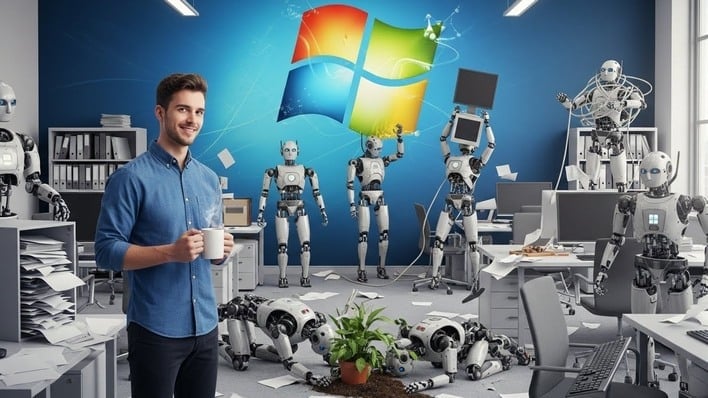 An accurate, if dramatized, representation of the state of Windows 11.
Don’t get us wrong; we like and use Windows around here, but 2025 was not kind to Windows 11. Microsoft spent much of the year putting out fires caused by its own updates: broken networking, malfunctioning recovery tools, unstable system components, and patches that required emergency follow-ups just to keep machines usable.
To make matters worse, this all happened while Windows 10’s end-of-support clock loomed, effectively forcing users to upgrade into a mess. At one point, even core components like the Start menu and File Explorer were breaking across updates. The result was a wave of frustration, a surge in Linux curiosity, and a growing sense that Windows had become less reliable, not more, with age, which is not exactly the vibe you want from the world’s most widely used desktop OS.
Topping it all off, Microsoft announced aggressive pushes to integrate more and more AI features into Windows 11—announcements that were met with massive pushback from the PC using populace. Incredibly, Microsoft’s execs were surprised by this result, but it doesn’t seem to have altered the company’s plans at all. The emphasis on AI features and a boast by an MS honcho that a significant portion of new code added to Windows was written by AI led many to wonder if this new AI code wasn’t responsible for some of the reliability issues.
Look, we like AI, conditionally; look at our #1 tech win of the year above. We just don’t need it integrated into our OS. In fact, we want as little as possible integrated into our OS. We’d like our OS to focus on being an OS first, not a platform for telemetry, advertising, and spurious AI functionality that is already better-served elsewhere. Hopefully Microsoft wises up to this message next year.
And that’s the year in a nutshell: progress ever marching forward, whether we like it or not. Did we miss your favorite epic win or legendary failure of the year? Let us know in the comments below.