French startup Alice and Bob announced today a new way to reduce errors in quantum computing. The approach involves moving logical qubits up and down during computation, giving rise to an ‘elevator code’ that helps achieve a logical error rate up to 10,000 times lower, the company said in a press release.
With quantum computing promising us computations that conventional supercomputers would take decades to complete, countries are keen to develop the technology as quickly as possible. However, the rapid pace of computation also increases the likelihood of errors being introduced into the system.
Since these computations cannot be verified by another system, scientists are keen on developing error-correction capabilities within the quantum computer instead.
However, different quantu…
French startup Alice and Bob announced today a new way to reduce errors in quantum computing. The approach involves moving logical qubits up and down during computation, giving rise to an ‘elevator code’ that helps achieve a logical error rate up to 10,000 times lower, the company said in a press release.
With quantum computing promising us computations that conventional supercomputers would take decades to complete, countries are keen to develop the technology as quickly as possible. However, the rapid pace of computation also increases the likelihood of errors being introduced into the system.
Since these computations cannot be verified by another system, scientists are keen on developing error-correction capabilities within the quantum computer instead.
However, different quantum computation systems use different chemistries to store information in quantum bits or qubits. Therefore, each of these systems needs to determine its own quantum correction approach.
French quantum startup Alice and Bob developed an innovative approach to move its logical qubit up and down, like an elevator.
Elevator code for error correction
Alice and Bob’s approach to quantum computing is inspired by the famous Schrondinger’s cat experiment. Their information storage units are not referred to as qubits alone but as cat qubits. However, this is not just a branding gimmick.
Just as a cat in the experiment can be both dead and alive, a cat qubit can store information in both phases, + and -. Compared to more conventional quantum computing, where a qubit stores information in only one phase, a cat qubit offers protection from bit flip errors – those involving unintentional changes in stored value to its opposite value.
Alice and Bob call this passive protection that its cat qubits inherit due to their design. But the team has gone a step ahead and provided it with ‘active’ protection with these elevator codes.
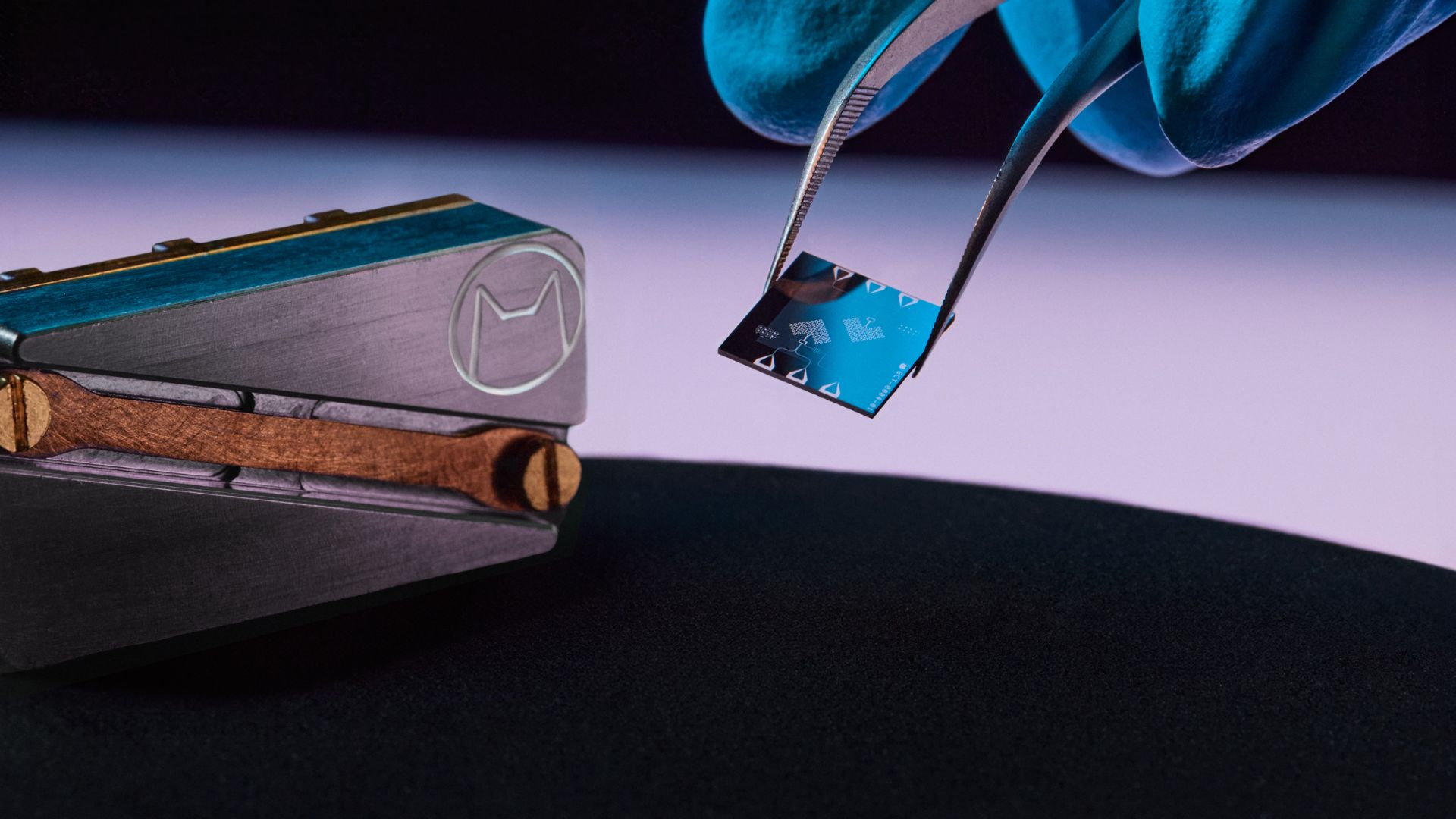 Quantum chip developed by Alice and Bob. Image credit: Alice and Bob/X
How is it done?
According to the press release shared with Interesting Engineering, the key to elevator codes is code concatenation. The team used a code on top of the repetition codes to give them bit-flip protection. During computation, the logical qubit moves up and down like an elevator running bit flips at a logical level.
“These error rates will make it possible to feasibly tackle problems like complex molecular simulation sooner than expected,” said Diego Ruiz, theoretical physicist at Alice and Bob in the press release.
“Also, this study is based on what our classical computers can simulate; it is reasonable to infer that even better performances could be reached using larger, higher-rate codes on quantum hardware.”
Error correction is inevitable if we are looking to build fault-tolerant quantum computers. However, building logical qubits requires adding more physical qubits, which increases costs and reduces the economic feasibility of quantum computing.
With Alice and Bob’s approach, adding a single logical ancilla is a low-cost affair that can significantly boost logical performance. This is because the same logical ancilla can be reset and reused after each check, while the code can pack more logical qubits in the same physical footprint, the press release added.
Compared to Alice and Bob’s previous quantum error correction approach, the elevator code would help the team achieve 10,000 times lower logical error rates while requiring only three times as many qubits.
The research findings were published on the pre-print server, arXiv.

Get the latest in engineering, tech, space & science - delivered daily to your inbox.
Ameya is a science writer based in Hyderabad, India. A Molecular Biologist at heart, he traded the micropipette to write about science during the pandemic and does not want to go back. He likes to write about genetics, microbes, technology, and public policy.