 Image: Kepler
A new phrase has been quietly circulating through space-industry discussions over the past year: Orbital data centers. The idea sounds futuristic – server farms in orbit – but it is gaining attention for a very practical reason. Space is producing more data than Earth can efficiently handle.
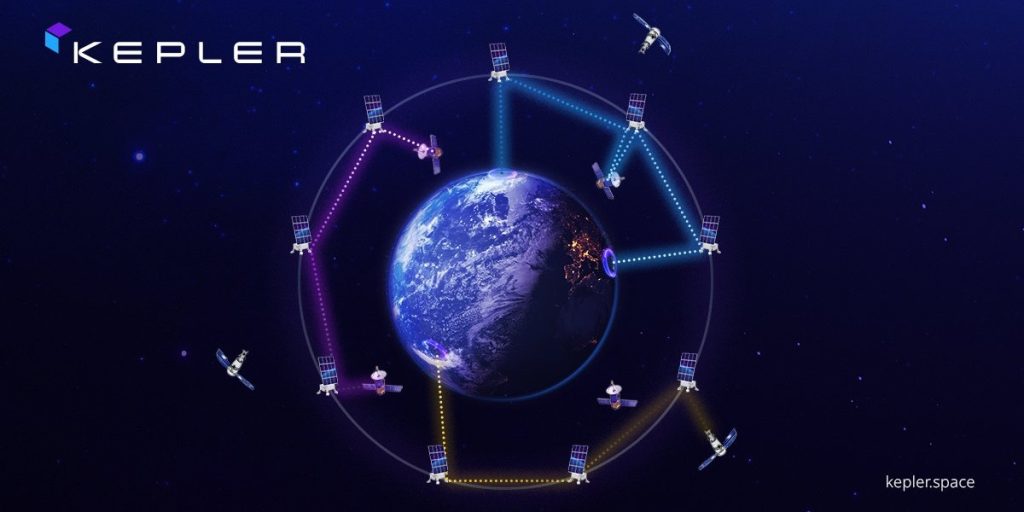
Orbital data centers are space-based computing and data-storage platforms, typically hosted on satellites or modular orbital structures. Rather than transmitting massive volumes of raw data back to Earth for processing, these systems aim to process information in orbit and send down only the most valuable results. The motivation is less about novelty than necessity. …
Image: Kepler
A new phrase has been quietly circulating through space-industry discussions over the past year: Orbital data centers. The idea sounds futuristic – server farms in orbit – but it is gaining attention for a very practical reason. Space is producing more data than Earth can efficiently handle.
Orbital data centers are space-based computing and data-storage platforms, typically hosted on satellites or modular orbital structures. Rather than transmitting massive volumes of raw data back to Earth for processing, these systems aim to process information in orbit and send down only the most valuable results. The motivation is less about novelty than necessity.
Modern satellites generate enormous amounts of data. High-resolution Earth-observation systems, synthetic aperture radar payloads, hyperspectral sensors, climate-monitoring instruments, and space-based telescopes collect information at rates that increasingly strain existing downlink capacity. The challenge is no longer gathering data, but moving it.
Downlink bandwidth is finite, expensive, and often oversubscribed. As satellite constellations grow and sensor capabilities improve, operators are forced to decide which data gets priority, what can be compressed, and what may never be transmitted at all. In some cases, valuable information is delayed or discarded simply because it cannot be sent to Earth quickly enough.
Orbital data centers propose a different approach: process the data where it is collected.
A batch of Starlink satellites is deployed by SpaceX. In late 2025, company CEO Elon Musk said Starlink would be expanding into data centers
The concept borrows from edge computing on Earth, where information is processed close to the source rather than sent to centralized cloud servers. In orbit, this means satellites or orbital platforms are equipped with substantial onboard computing power.
Instead of downlinking raw imagery or continuous sensor streams, an orbital data center could perform image preprocessing, change detection, anomaly identification, or artificial intelligence inference in space. Only actionable insights, such as alerts, metadata, or highly compressed outputs, would be transmitted to the ground.
For time-sensitive applications such as disaster response, weather monitoring, or maritime tracking, this approach could significantly reduce latency. For operators managing vast datasets, it could ease pressure on communications networks and reduce dependence on extensive ground infrastructure.
Interest in orbital data centers is rising as several trends converge. Space-generated data volumes are growing faster than communications capacity can scale. Commercial Earth-observation constellations, national security payloads, and scientific missions are all pushing sensors to higher resolutions and faster revisit rates.
At the same time, advances in artificial intelligence have changed how data is used. Many applications no longer require humans to review raw data. Instead, trained models identify patterns, changes, or anomalies, which are tasks that can increasingly be performed on specialized, power-efficient hardware suitable for space environments.
The physical environment of space also presents intriguing possibilities. Solar energy is abundant in orbit, and radiative cooling works efficiently in a vacuum. While power density and thermal management remain real constraints, these factors open architectural options that are difficult or costly to achieve on Earth.
Interest spans commercial, scientific, and defense communities. Startups are exploring modular orbital platforms designed for in-space data processing. Defense and intelligence organizations see on-orbit computing as a way to reduce reliance on vulnerable ground networks and improve resilience in contested environments. Major technology companies, while not publicly deploying hardware, are studying how space-based computing might complement terrestrial cloud infrastructure.
Much of this work remains experimental, and some of it deliberately opaque.
Orbital data centers are not poised to replace Earth-based cloud services. Launch costs remain high, hardware upgrades are difficult, and radiation-hardened processors lag behind the most advanced terrestrial chips.
Latency also matters. While orbital processing makes sense for space-generated data, it offers little advantage for consumer or enterprise workloads that originate on Earth. This is not a vision of moving the internet into orbit. It is about handling space data more intelligently.
What orbital data centers ultimately represent is a shift in how space is used. Satellites are no longer just remote sensors feeding data back to Earth. They are becoming active participants in analysis and decision-making. As reliance on space-based systems grows for climate monitoring, navigation, communications, and security, the ability to process information autonomously in orbit becomes increasingly valuable.
For now, orbital data centers remain an emerging concept rather than deployed infrastructure. But the fact that they are being discussed seriously across multiple sectors suggests a future where spacecraft do more than collect data, they process it.
FTC: We use income earning auto affiliate links. More.