Stereophile strives to distribute the wealth equally.
Did that get your attention? What the statement refers to, in terminology devoid of dollar signs, is that Stereophile attempts to review products from different companies rather than repeatedly focus on products from a single company. We may consecutively review an amplifier and its companion preamp or preamp/DAC/streamer, but I doubt we’ve ever reviewed three of a company’s top-level products in seven months. Until now.
Only a hermit, living remotely without access to media, need be told that we live in challenging times. Challenging times demand flexibility. After I experienced two consecutive product review cancellations—the first because tariffs forced the distributor to rebudget, the second because the product was not y…
Stereophile strives to distribute the wealth equally.
Did that get your attention? What the statement refers to, in terminology devoid of dollar signs, is that Stereophile attempts to review products from different companies rather than repeatedly focus on products from a single company. We may consecutively review an amplifier and its companion preamp or preamp/DAC/streamer, but I doubt we’ve ever reviewed three of a company’s top-level products in seven months. Until now.
Only a hermit, living remotely without access to media, need be told that we live in challenging times. Challenging times demand flexibility. After I experienced two consecutive product review cancellations—the first because tariffs forced the distributor to rebudget, the second because the product was not yet ready—Editor Jim Austin started reaching out. Kevin Wolff, director of global sales for CH Precision of Switzerland, jumped into the breach, offering two of CH’s reference products for review: the two-box version of the L10 line preamplifier ($80,500; $85,500 for premium finishes, followed by the two-much-larger-box M10 monoblock power amplifier. Together with Jim Austin’s review of the CH Precision C10 D/A processor, that amounts to three reviews of top-level CH Precision products between October 2025 and April 2026.
Another compelling reason to move forward with these CH Precision reviews: Wolff is based in the Seattle area, southeast of Port Townsend and the Olympic Peninsula—in other words, close. He was able to visit me several times to install the products, adjust settings, and conduct interviews, for which I am eternally grateful. Thanks to him, CH Precision VP of Marketing John Giolas, and Jim Austin, I’ve been able to get a grip on the sound CH Precision strives to deliver.
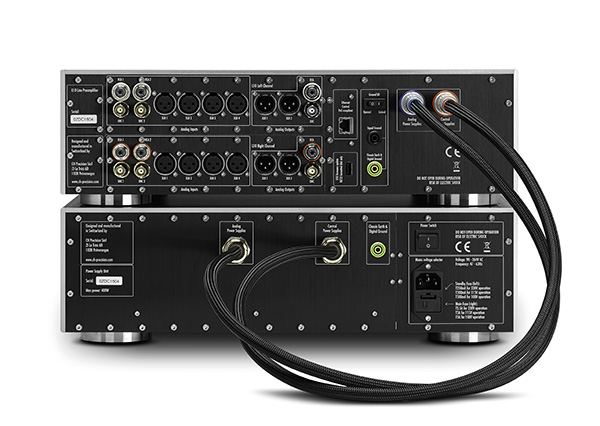
Those two boxes Having grown weary of describing, in exhaustive detail, every detail and setting of a component when photos (of, eg, the back panel; footnote 1) are easily viewable on its website, I’ll confine this description to what’s unique about the L10. For other information, including the number and type of inputs and outputs, feel free to consult the specs section of this review and the online manual (footnote 2).
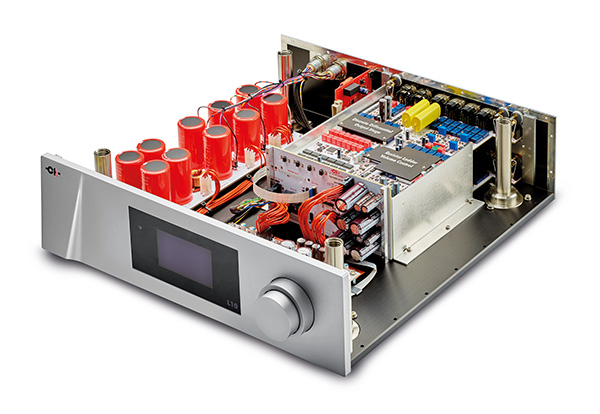
The L10’s most obviously striking attribute—a feature common to many CH Precision products—is its large, easy-to-read graphic display. To quote company cofounder/CEO Florian Cossy, it enables you to see "everything from unit status to operating temperature." Options extend to changing the color of the text on the display. While I didn’t bother with that one, I quickly grew to appreciate how much information the display reveals.
The front panel’s dual control knob enables you to burrow deep under the covers, out of sight of your master. Once there, you can adjust and change all the usual settings via a hierarchical menu scheme that includes shortcut options. You can view the menu structure in detail by searching out the online manual (see footnote 2). Or you can wing it. When I wanted to mute the preamp, I pushed the larger inner knob and discovered that Mute was the first option, with an arrow indicating which way to turn the knob to mute and unmute.
Nonetheless, I would advise telling your friends to keep their hands off the knob and only adjust volume and inputs via the simple, slim three-function handheld remote control (footnote 3). Once, a visitor attempted to adjust the volume from the large central knob on the front panel and inadvertently brought up settings, got flustered, turned one of the concentric rings, pushed madly, and ended up changing my feedback setting. It stayed that way until Wolff and Giolas visited midway during the review to set up the M10 monoblocks I’ll review in the April issue. That’s when Kevin noticed the indicator "GLOBAL-FB" at the top of the display. Because we had determined during initial setup that local feedback sounds better than global in my system, we returned to the original setting. My response: "Oh, now I know why, right after [name expunged to shield the guilty] visited, my sound seemed less transparent and colorful."
Also be careful fumbling around the packed rear panel in low light. Once, while probing for the main power button, I accidentally flipped the smaller "Ground lift" switch. In a complete CH system, this switch, along with similar switches on other components, allows you to configure a single-point star-grounding arrangement for signal grounds. The optimal position of this switch cannot be presumed in a system with components from multiple companies. More on this below.
What makes the L10 unique? In-person, phone, and WhatsApp discussions with Wolff and Florian Cossy, CEO of CH Precision and the "C" in CH (footnote 4) addressed the unique technology in the L10.
"When we developed our line stages, we worked on a different principle than what is typical," Wolff said. "The L10 has a signal/noise value of 141dB, and it is independent of volume level. Most manufacturers, engineers, and designers talk a lot about amplifying the low voltage. What they forget about in the amplification mode is that there’s another thing called current. Both of our line stages operate in the current domain—current mode rather than voltage mode. We believe the advantages of current mode are pretty significant."
In a conventional line stage preamplifier, the volume control is an attenuator. "In the old days, we would talk about the brand of potentiometer," he said. "Today, with modern, high-performance preamps, we talk about the resistor ladder network. It’s the same thing as the potentiometer except with much tighter tolerances. How it typically works is, you have your gain structure, let’s say it’s 18dB gain, that is placed in front of the attenuator, volume control, ladder network, or pot. This means you’re turning the volume down into the noisefloor. As you decrease volume, the noisefloor, albeit constant, becomes a bigger percentage of the sound you hear."
Translation: Relatively speaking, there’s more noise at lower volumes. Turning up the volume decreases the proportion of noise you hear—it increases the S/N ratio—but there’s only so far you can turn the proverbial knob before you damage your eardrums. Most preamps operate in voltage mode, where gain is fixed in front of the volume control. The L10 operates in current mode, and the gain comes after the volume control. CH claims the L10’s impressive signal/noise ratio remains the same irrespective of gain and requires far fewer resistors to adjust volume in 0.5dB increments.
Woolf continued. "There are several reasons the L10 is a two-piece device with an outboard power supply. One is to put the transformer—the noisiest part of the power supply—as far away from the line stage as possible and in its own shielded chassis. This is especially important when a good third of the preamp is a power supply with a huge storage capacity of 700,000 microfarads. That’s larger than in most typical monoblocks and larger than in most reference stereo power amplifiers. That enables the preamp to operate off its huge storage bank—capacitance—and avoid smearing in the time domain."
He then emphasized the importance of direct coupling. If a preamp isn’t direct-coupled, it’s capacitor-coupled. A capacitor, he said, is a filter, and filters have smearing, phase problems, time shifts, and the like.
"A direct-coupled preamp avoids capacitor-associated problems," he said. "Virtually every reference preamp I know of is direct coupled. It also shunts off DC offset—DC-associated noise—to the interconnect’s dielectric. We have a digital testing circuit—a completely galvanically isolated DC offset calibration circuit within the line stage—that is not in the signal path. When engaged, it will test the interconnects at both the input and output stages of the L10 and use current injectors, which operate in the analog domain, to compensate for DC offset. It’s a pretty compelling way to improve performance."
The L10’s DC-offset calibration, which Wolff performed for the specific XLR input I used for interconnects coming from the dCS Varèse, took less than 5 minutes (footnote 5). When, later on, I switched to one of the L10’s different, uncalibrated inputs, the difference in silent backgrounds and color saturation was apparent. CH Precision expects its dealers to perform this calibration for all CH customers upon delivery and to show them how to use the preamp’s front panel or control app (footnote 6) to adjust various parameters. Note that DC offset cannot be calibrated and compensated for via the app; the calibration can only be performed with the front-panel controls.
Thus spoketh the "C" "Simplicity of design is one of our secrets," Cossy said at the start of a separate conversation. "The L10’s signal path is as simple as possible. Basically, it’s just a buffer; then you have the volume control and the output stage. There are only two stages with a volume control in between.
"The other thing that makes our preamp different and unique is that it’s completely discrete. But with discrete circuitry, if you don’t use a ton of feedback, you have to compensate in each of the preamp’s stages. We precisely measure DC offset in the analog domain before it is converted into the digital domain. Then, we use a DSP, which monitors, analyzes, and drives some of the current injectors we use in the signal path, to drive some compensation.
"We need to perform the compensation in the digital domain because we don’t have enough filtering ability in the analog domain. Ultimately, by using A/D and D/A with the DSP in between, we correct the DC offset and nothing else. The signal itself remains analog; the DSP only addresses DC offset. And because our current sources are very, very quiet—the noise is so low, it’s unmeasurable—we correct DC offset without injecting any noise."
Cossy assured me that because a DAC’s DC offset does not normally change more than a few millivolts over time, the DC offset calibration need not be performed periodically. Once is enough. Then he addressed the L10 user’s option to employ either local or global feedback.
"The choice is between having the circuitry’s output stage open or included in the feedback loop," he said. "Using local feedback is usually more natural because the feedback loop is shorter. But global feedback measures a bit better and is close to not measurable. In the L10, THD + noise increases from 0.0001% with global feedback to 0.001% with local feedback. It’s a different story with the power amp."
Although CH Precision’s design team did not fine-tune the L10 by auditioning it with a host of different amplifiers, it did test the sound of its special leveling/grounding support spikes. "In the past we used plain steel spikes," Cossy said. "They sounded good but not outstanding. Then we tried different materials to remove the resonance of the long shaft of the spike itself; that resulted in the plastic you see on the spikes. We also tried different materials for the spike and chose two of them: hardened aluminum for the 1-series product, and the bit better titanium on the L10 you have."
When I asked if CH listened to different brands of resistors before choosing which to employ, he replied, "Maybe I’m going to disappoint you, but we did not listen to those components. We used industrial, high-performance components with very tight tolerances and chose them according to their specs.
"For me, layout and circuit topology matter more than the choice of component. Placement on our printed circuit boards is important, and we try to take into account high or low impedance for long or short traces. We also use as little internal wire as possible. For the signal path, there’s none.
"Only in the end do we listen. If we don’t like what we hear, we measure to find out where the problem is. So far, we’ve always been able to detect a problem through measurements. The devil sometimes hides in tiny details."
Cossy surprised me by noting that most of the test music he listens to is on Red Book CD (16/44.1). He cited some tracks from Yello and some big symphonic fare by Tchaikovsky and Shostakovich.
Now that CH Precision has grown to 20 employees, including six engineers, Cossy’s role has changed. "Now, I just check the engineers’ designs," he said. "But the first drive, DAC, and power amp in the series were my designs. For example, I designed our first product, the C1, which was released in late 2011 (footnote 7). The L10 contains the same signal path topology as in the original L1, which I designed and released in 2015, but the internal components are better, and the power supplies have been refined."
It was up to me to hear that refinement. But first, I had to fine-tune setup.

Space and spikes Of the two empty spaces on my rack available for the L10, only one was high enough to allow installation of CH’s special leveling/grounding support spikes. Because Wolff thought the spikes would make more of a difference under the preamp box, it earned the larger space. The power supply, in turn, ended up in the space with less breathing room.
We listened before installing spikes. With Audio Research 330M monoblocks for amplification, we began with the same track with which the 330Ms dazzled me at AXPONA 2025, Rimsky-Korsakov’s Danse Macabre from the classic Minnesota Orchestra collection Mephisto & Co. (16.44.1 FLAC download, Reference Recordings). Then we turned to a newer but not necessarily better high-resolution recording, of Thomas Adès’s The Exterminating Angel Symphony (24/96 FLAC, Pentatone/download) performed by the Minnesota Orchestra under Thomas Søndergård.
Then we installed the spikes under the preamp box and listened again. Highs were a bit more brilliant and tighter, the presentation even more alive, dynamic, and resolved. The spikes also delivered more transparency and textural clarity and further highlighted the Audio Research 330M’s luscious and colorful midrange. My customary component supports, Wilson Audio Pedestals, may have delivered highs that were a bit smoother, but CH’s spikes showcased the L10 at its best.
Footnote 1: See ch-precision.com/product/l10-dual-monaural-twin-chassis-line-preamplifier/.
Footnote 2: See soundsource.pl/wp-content/uploads/2023/02/210129-L10_Usermanual_compressed.pdf.
Footnote 3: The remote, which only adjusts input and volume, is so small that it’s easily mislaid or sat on. To help users keep track, its magnetized case easily adheres to the side of the L10.
Footnote 4: CH Precision cofounder Thierry Heeb died on July 22, 2024. HIs specialties were digital filtering and processing.
Footnote 5: Wolff emphasized that the signal source must be on but not playing. He typically pauses the source.
Footnote 6: At the time of the review, CH’s app only worked on Android tablets and phones. An iOS version was in prototype form.
Footnote 7: Cossy said that the new C1 has a new digital core, new printed circuit board with DSP, and far more power. "We can compute much more and interpolate with much more precision than the original C1," he said.