Twenty years ago, on December 28, 2005, Giove-A (Galileo In-Orbit Validation Element-A for those who like their expansions) was launched, one of two demonstration satellites to test and validate Galileo technologies in orbit. Ten days ago, on December 17, 2025, two Galileo satellites lifted off, further strengthening Europe’s Galileo constellation. A.S.Ganesh tells you more about this Galileo and what it is up to…
Published - December 28, 2025 12:02 am IST
Workmen prepare the Galilieo (Giove-B) satellite of the European Space Agency (ESA) on its launch pad at Kazakhstan’s Baikonur cosmodrome on April 23, 2008. This Galileo satellite was launched on April 27, 2008. | Photo Credit: AFP
What is Galileo?
A mention of Galileo, and you likely recall famed Italian astrono…
Twenty years ago, on December 28, 2005, Giove-A (Galileo In-Orbit Validation Element-A for those who like their expansions) was launched, one of two demonstration satellites to test and validate Galileo technologies in orbit. Ten days ago, on December 17, 2025, two Galileo satellites lifted off, further strengthening Europe’s Galileo constellation. A.S.Ganesh tells you more about this Galileo and what it is up to…
Published - December 28, 2025 12:02 am IST
Workmen prepare the Galilieo (Giove-B) satellite of the European Space Agency (ESA) on its launch pad at Kazakhstan’s Baikonur cosmodrome on April 23, 2008. This Galileo satellite was launched on April 27, 2008. | Photo Credit: AFP
What is Galileo?
A mention of Galileo, and you likely recall famed Italian astronomer and physicist Galileo Galilei. As someone who emphasised on experimentation and observation, he is often hailed as the “father of modern science”. By improving on the telescope, which was invented only during his time, he peered at the skies and made groundbreaking discoveries. He discovered Jupiter’s moons, Venus’ phases, sunspots and moon’s craters. Some of his experiments, like Galileo’s Leaning Tower of Pisa experiment, are still discussed, more than 400 years after he is believed to have performed it himself to discover that objects fell with same acceleration, regardless of their mass.
But no, we are not talking about this Galileo (even though we’ve digressed right at the start quite a bit). Your next guess, probably, would be the Galileo spacecraft, named after, well, Galileo. A NASA robotic mission launched in 1989, the Galileo spacecraft studied Jupiter and its system for over a decade, becoming the first to orbit the planet and even deploying a probe into the Jovian atmosphere.
Alas, we aren’t going to be discussing this spacecraft either. The Galileo we are talking about here is Europe’s own civilian-controlled Global Navigation Satellite System.
What?!? Don’t we already have the GPS?
Therein lies the reason why Europe wanted Galileo. When most of us talk about satellite navigation, our mind immediately jumps to GPS, or Global Positioning System. It is a form of genericisation, where a brand name actually becomes a common term for a product type. A bit like how Xerox is used for all photocopying, or Google/Googling for all online searches, or well, using Band-Aid, for any and all adhesive bandages.
This might come as a shock to you in case you belong to the “most” mentioned in the previous paragraph, but GPS is not synonymous with satellite navigation. While large sections of the world use it that way, technically it is a U.S.-owned system.
If GPS is just one such system, what is the broader term encapsulating all these systems, you seem to be wondering. We’ve given that to you already, actually. That term is GNSS or Global Navigation Satellite System.
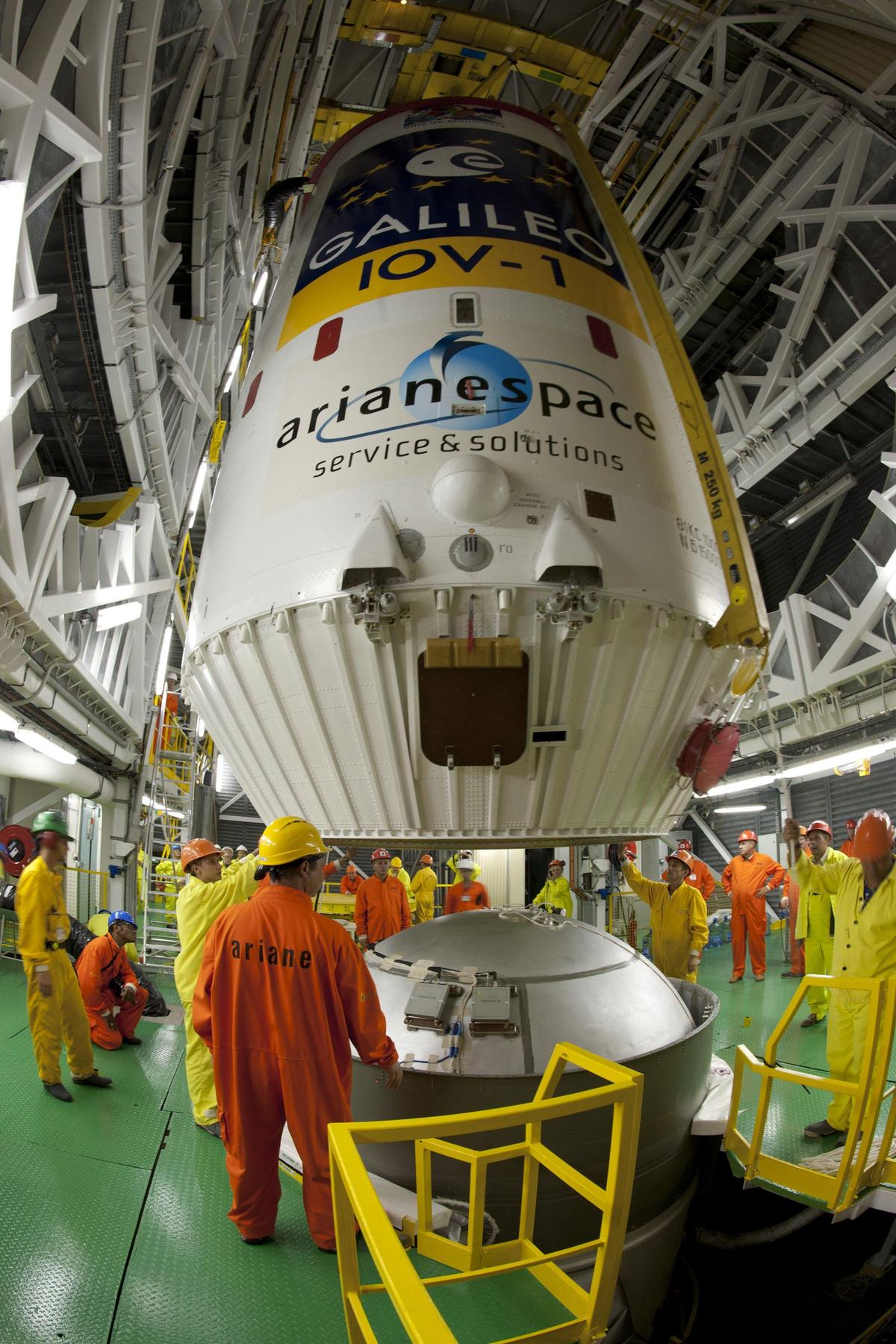
The two Galileo In-Orbit Validation satellites are encapsulated within their ‘Upper Composite’ on the vertical Soyuz ST-B launcher in this October 14, 2011 handout photo courtesy of the European Space Agency. The launch took place on October 21. | Photo Credit: REUTERS
GPS enjoys this place of prominence owing to the first-mover advantage. It was the first such major system accessible to the masses, making it most recognised as well. It certainly isn’t the only such system with Russia’s GLONASS and China’s BeiDou being other systems. While India doesn’t have a GNSS, it has a navigation system called NavIC (Navigation with Indian Constellation) that is indigenous and provides accurate position, navigation, and timing services for India and a 1,500 km surrounding region.
While the U.S.’ GPS, or China’s BeiDou and Russia’s GLONASS for that matter, is well and good during times of peace, things do change drastically when times are otherwise. As these systems are state-run and operated — meaning its control and use is supervised by the ruling government of these countries — they can choose to disable their system or make them unavailable for all as and when they choose to.
Considering that satellite navigation has turned into a sector that is crucial both strategically and commercially, the European Commission (EC) — the executive body of the European Union (EU) — and the European Space Agency (ESA) came together to reap the benefits of a satellite navigation system.
Aah, okay. I get it. So what’s their story?
It was in the 1990s, when the Galileo spacecraft was busy heading towards Jupiter and then studying its system, that the EC and the ESA started collaborating for research and development of the Galileo GNSS. Their development strategy had two main parts: EGNOS and Galileo. While EGNOS (European Geostationary Navigation Overlay Service) was a pan-European augmentation system that complemented GPS to relay information to users, Galileo was conceived as their fully autonomous, interoperable worldwide satellite navigation system.
The EC and ESA followed a staggered approach in developing Galileo. The test bed version, which performed tests to determine orbit, among other things, was started in 2002. After this, it was time for flight-testing Galileo elements for real.

A Russian Soyuz rocket carrying the test Giove-A satellite on December 28, 2005. | Photo Credit: AFP
This was done through two Giove (Galileo In-Orbit Validation Element) satellites. The first of those two satellites, Giove-A, was launched on December 28, 2005. First scheduled for December 26, the launched had been delayed by a couple of days owing to a technical problem in the ground station network.
Along with Giove-B, which was launched on April 27, 2008, two satellites were put through the rigour, testing atomic clocks, navigation signals, monitoring radiation effects on the satellite and securing Galileo’s frequencies in space. Once the first Galileo In-Orbit Validation satellites was launched on October 21, 2011 and started working well, there was no further need for the experimental Giove satellites, which were turned off the following year.
With two satellites launched in 2011 and two more joining them in 2012, the Galileo system had the bare minimum of four satellites necessary to determine position. In the years that have followed, they’ve not only been joined by more satellites, but have also been combined with a growing global ground infrastructure.
What’s the latest?
By December 15, 2016, Galileo went live, meaning it marks its official launch for public use, offering basic positioning and timing, interoperable with GPS. This was a first step towards Full Operational Capability (FOC), which aimed at an initial operational capability phase of 18 operational satellites, before heading to a full system made up of 30 satellites, European control centres, and a worldwide network of sensor and uplink stations. The high accuracy service that has been operational since 2023 allows dedicated receivers to pick up signals with horizontal accuracy down to 20 cm and vertical accuracy of 40 cm.
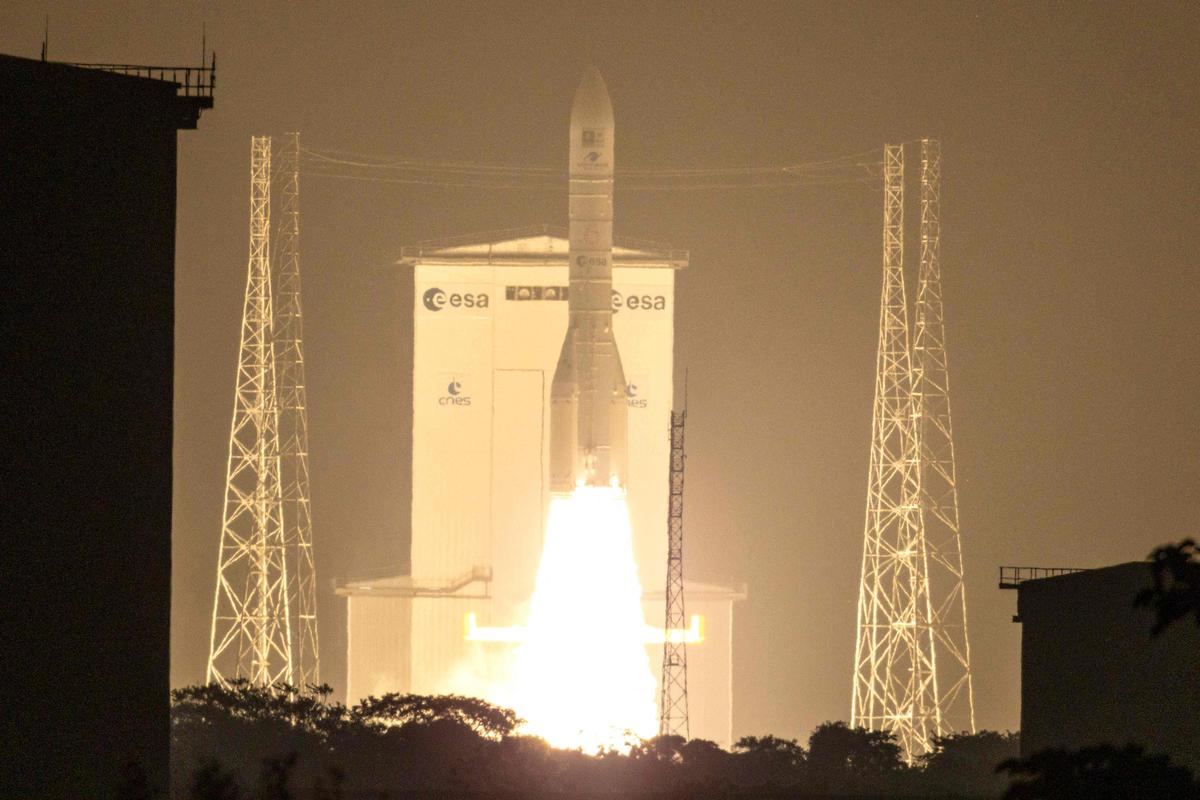
The European Space Agency (ESA) Ariane 6 rocket carrying two Galileo satellites for the the EU’s Global Navigation Satellite System (GNSS) launches at the Guiana Space Centre in Kourou, on the French overseas department of Guiana, on December 17, 2025. | Photo Credit: RONAN LIETAR / AFP
Earlier this month, on December 17, 2025, two satellites were successfully launched, marking the 14th launch for Europe’s Galileo constellation. Once it joins most of the rest of the satellites in medium Earth orbit, the Galileo constellation will have 29 active satellites in about three months time. Addition of these extra satellites to an already robust constellation not only ensures greater reliability, but also enhances accuracy in its coverage.
Activity
Would you like to make a paper model of these Galileo satellites? The European Space Agency (ESA) offers a PDF file with instructions to make a model. The file, when printed on 150 gsm papers, also serves as the material needed for the model. You can access the PDF here.
Published - December 28, 2025 12:02 am IST