- 13 Dec, 2025 *
 Ultimately, Metroid Prime 4 is a cautionary tale.
I would like to have said something along the lines of "all the constituent pieces are good, but they just didn’t come together properly". But saying that would be a lie. Let’s unpack.
First, it’s impossible to know the intricacies of the game’s development, beyond the broad strokes the public gets to know about: announced 2017 under Bandai Namco, rebooted at the beginning of 2019 under Retro Studios. That’s an almost six year development cycle if you charitably assume that all of the original work was thrown out.
For having been in development for so long, and with access to the best professionals in the industry, one might reason…
- 13 Dec, 2025 *
Ultimately, Metroid Prime 4 is a cautionary tale.
I would like to have said something along the lines of "all the constituent pieces are good, but they just didn’t come together properly". But saying that would be a lie. Let’s unpack.
First, it’s impossible to know the intricacies of the game’s development, beyond the broad strokes the public gets to know about: announced 2017 under Bandai Namco, rebooted at the beginning of 2019 under Retro Studios. That’s an almost six year development cycle if you charitably assume that all of the original work was thrown out.
For having been in development for so long, and with access to the best professionals in the industry, one might reasonably have expected Metroid Prime 4 to be a little... better.
An important note I am critical both because of my experience in the industry and because I care very much about this series of games and what I know they can bring to the table.
I’ve noted a variety of criticisms in my previous posts. These mainly centre on the game’s narrative and narrative design: its irritating tutorialisation and signposting, its poor understanding of what made its predecessors work so well, its overabundance of scannable objects. I would like to discuss a possible cause of this, but in the interest of being professional and respectful to my colleagues in the industry, I will try my very best to be delicate about it.
On a game which by its nature relies extremely heavy on well-executed narrative design, one might reasonably assume that Retro Studios would aim to build a unit comprised entirely of highly experienced game narrative personnel, as they very obviously did with the rest of the game’s team. Based on publicly available information, that very unfortunately does not seem to be the case, and one could reasonably draw conclusions from that relating to the quality of the narrative design and the writing in general. It is also worth noting that there is no narrative leadership credited on the game - only design and cinematics. In fact, there seems to be no permanent narrative staff at Retro Studios, period.
To again put it delicately, this suggests a development with incorrect priorities. I don’t think it’s useful, in this case, to point the blame at any single member of the development team who is ‘working at the coal face’, so to speak. I am quite sure that no single individual is responsible for the frustratingly generic dialogue, or the frustratingly generic characters, or the frustratingly repetitive and overdone scannables, or the disjointed and abruptly-ending narrative that assumes that players will have come to care deeply about the NPCs, or the narrative’s general overwhelming sense of insecurity. Drawing from my own hard-won decade-plus of experience in game narrative, I can confidently say that those decisions either come from or are killed by leadership. When that leadership is lacking in presence, lacking in intelligence, or simply nonexistent, this sort of outcome is not inevitable but is at least very highly likely.
It’s deeply, deeply unfortunate. Game narrative professionals are always beating our drum about this, but with very few exceptions story and narrative design are the connective tissue that holds a game together. As I noted before, it’s impossible to know what happened behind closed doors, but large cuts and reworks are frequently the culprit for this sort of outcome, and I would call Metroid Prime 4 an extremely strong example of when narrative is not prioritised in these situations. The history of games is littered with examples where failing to protect the narrative turned out poorly, and this unfortunately is no exception.
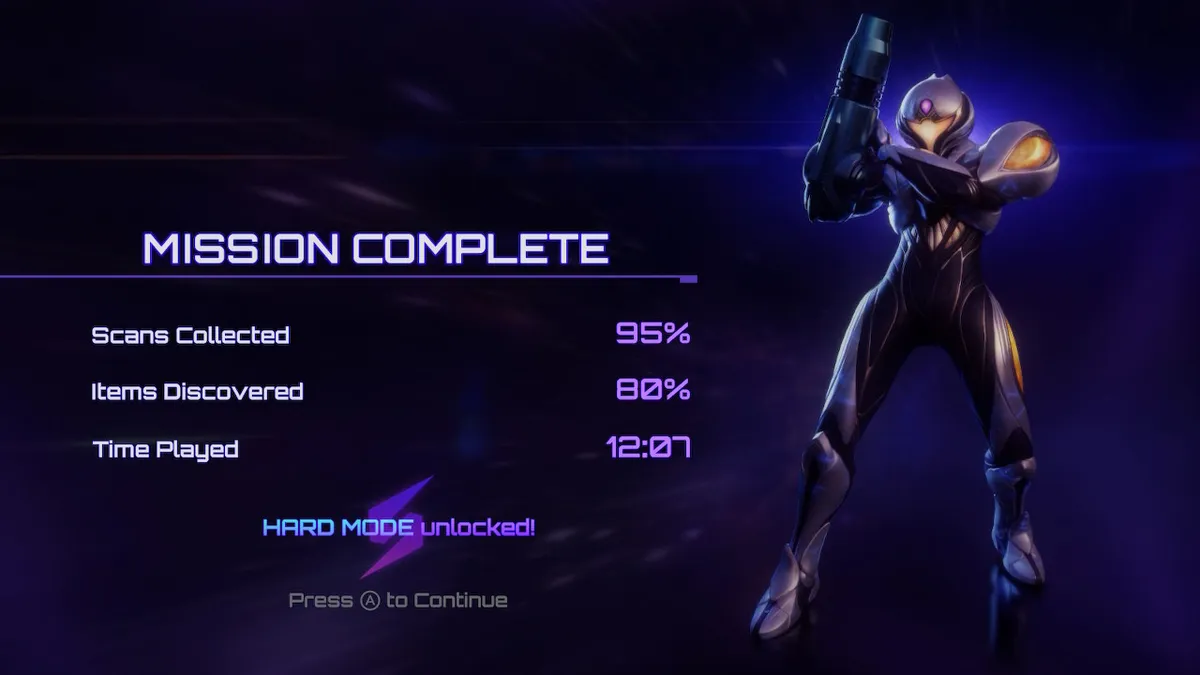
The final chapter of the game is perhaps the most egregious example of this. After working your way through each of the major areas, you are sent on a scavenger hunt for various objects. This mirrors the late chapters of the games in the original trilogy, and is in itself inoffensive, though you are frequently interrupted by the previously mentioned Irritating Radio Boy. However, immediately afterwards, you are sent to clear out hundreds of objects from the (gigantic) main hub area, a repetitive task which can take over an hour. (An assistive radar is provided to the player once 75% of the task is complete.) It is hard to believe that anyone thought this was a good idea or an enjoyable way for a Metroid Prime player to spend their time - but that’s beside the point. At a guess, the game was considered to be too short and it was an easy way to pad out playtime. But as a gameplay sequence, it is a disaster: an hour of grinding, with no real sense of progress throughout, in a game that otherwise never demands such.
This is then immediately followed by a lush and highly produced finale sequence, which is itself problematic in a few ways, but not in ones that are new or relevant to mention. Even without detail, and without seeing the game yourself, I am sure readers can understand how uneven it feels.
I waited eighteen years for this. As with any other piece of media, I’m not entitled to have it exactly how I want it. But with the benefit of a lot of time in this industry, I can make several well-educated guesses at what went wrong with it, and that’s a bit of a bummer. That’s life, I guess!
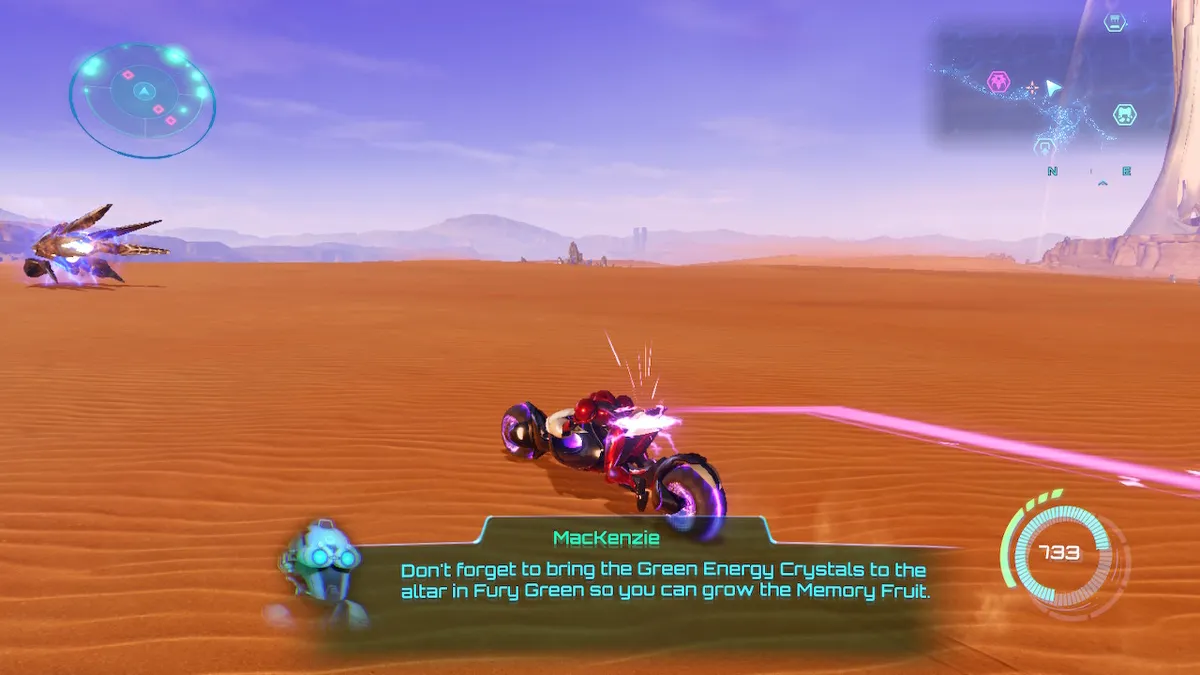
I want to be clear: overall, I enjoyed my time with it. The gameplay was the best the series has had (even if most of the boss encounters were about 20% too long), the environment art is excellent, the audio is great, and the game is a genuine technical marvel that far outdoes anything else on the Switch in terms of visual fidelity. In many ways, it’s a fantastic achievement, but even with such highs, the game’s lows are quite stunningly low. And in the end, Metroid Prime 4 does just feel... insecure of itself. Desperate to please, but not quite sure how to do so.
Oh well.