This year was a great reading year for me.
My goal was to read at least 30 books. I've already hit that mark and should get a few more before December ends. That's the most I've read in at least the last five years—and maybe ever.
Below are my rankings for each book this year, with brief summaries and links to full reviews, where applicable. I use the 20-80 scale to rank just about everything, so I'd encourage you to check out my primer on that if you're unfamiliar.
For some context, here's how I convert the 20-80 scale to a five-star scale for logging purposes and to illustrate what a grade might mean for someone unfamiliar with 20-80:
- 80 — 5 stars
- 70 — 4.5 stars ...
This year was a great reading year for me.
My goal was to read at least 30 books. I've already hit that mark and should get a few more before December ends. That's the most I've read in at least the last five years—and maybe ever.
Below are my rankings for each book this year, with brief summaries and links to full reviews, where applicable. I use the 20-80 scale to rank just about everything, so I'd encourage you to check out my primer on that if you're unfamiliar.
For some context, here's how I convert the 20-80 scale to a five-star scale for logging purposes and to illustrate what a grade might mean for someone unfamiliar with 20-80:
- 80 — 5 stars
- 70 — 4.5 stars
- 65 — 4.25 stars
- 60 — 4 stars
- 55 — 3.5 stars
- 50 — 3 stars
- 45 — 2.5 stars
- 40 — 2 stars
- 35 — 1.75 stars
- 30 — 1.5 stars
- 20 — 1 star
In general, 50 and above is a good grade for me. Average shouldn't be used as negatively—or as sparingly—as it tends to be. And elite, top-of-the-scale grades should be handed out sparingly.
I switched to Storygraph this year to log my books and love all the data they provide. Here's the distribution of my rankings for all my reads:
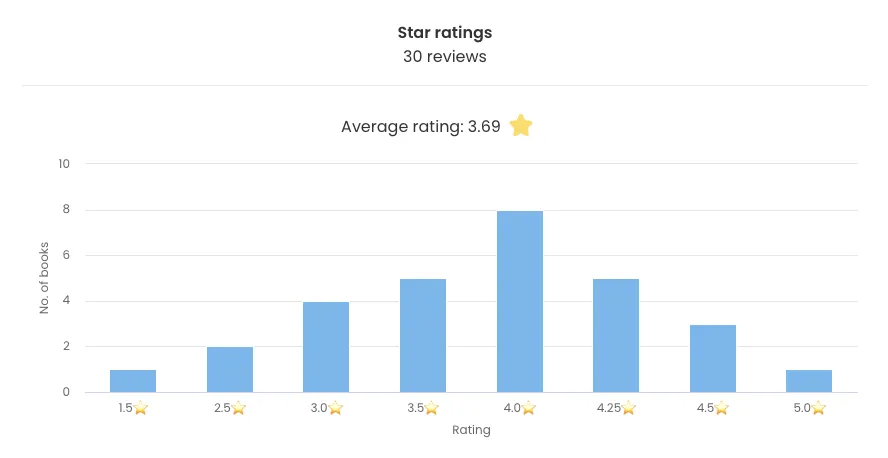
I think this sort of distribution makes sense. There's a selection bias here that should push the median closer to plus, where it is, and there's enough variance that my specific grades should be able to tell you something meaningful about how I viewed them.
Having the main cluster of grades around average would mean I'm not doing a great job picking books, and if everything was a 5-star that grade would start to lose its meaning.
OK, enough rambling. Onto the list.
80
- Ship of Destiny by Robin Hobb (Liveship Traders No. 3) — This is one of the best fantasy books, and books of any genre, I've ever read. Hobb is a master at character work and prose. You will need to give her some time to set things up and get going, but if you trust her to do that, she's always going to deliver for you.
70
- Lonesome Dove by Larry McMurtry — A deep and thoughtful Western that's written in a clean and crisp way that propels you through the story. McMurtry's characters are distinct and his dialogue is tremendous. Gus McRae is an all-time character.
- Demon in White by Christopher Ruocchio (The Sun Eater No. 3) — This is the peak of The Sun Eater series, and what I always envisioned top-tier science fiction could be. Ruocchio puts on a worldbuilding clinic with a masterfully plotted book that has action, mystery, sneaky good character work and a satisfying conclusion.
- The Fellowship of the Ring by JRR Tolkien — I don't need to describe this book to anyone, but I listened to this with the Andy Serkis narration and if you're looking to get back into Middle Earth, it's a great version to do it with.
65
- East of Eden by John Steinbeck — My first foray into Steinbeck was a blast. I couldn't put this one down and had plenty to think about and laugh about throughout it. (Full Review)
- John Adams by David McCullough — This won the Pulitzer Prize for a reason. McCullough makes history entertaining, and Adams became my favorite founding father because of this book. “In general, our generals were outgeneralled."
- Mad Ship by Robin Hobb (Liveship Traders No. 2) — This was the book where I started to realize how Hobb can do worldbuilding and magic at an elite level, in addition to her prose and character work.
- Shadows Upon Time by Christopher Ruocchio (The Sun Eater No. 7) — A more than satisfying conclusion to what has become my favorite science-fiction series. (Full Review)
- Disquiet Gods by Christopher Ruocchio (The Sun Eater No. 6) — The penultimate book in the Sun Eater series gets deeper into religious themes and further into Ruocchio's "magic system" and lore. A top-three book in the series. (Full Review)
60
- The Old Man and the Sea by Ernest Hemingway — Aside from a few short stories, this was my first entry into Hemingway. It's a simple story about a fisherman's journey but it has resonated with me since I put it down. Plus there are baseball references. (Full Review)
- Discourses and Selected Writings by Epictetus — One of the pillars of stoicism. This took me half the year to get through, but I'm not sure you're supposed to read it quickly. Epictetus has blunt, cutting and funny voice and plenty of wisdom to impart. (Full Review)
- Kingdoms of Death by Christopher Ruocchio (The Sun Eater No. 4) — Saw meets sci-fi. This is perhaps the most unique plot of the series and is by far the most brutal entry, but one that still worked really well.
- Howling Dark by Christopher Ruocchio (The Sun Eater No. 2) — The second book is where The Sun Eater really takes off and Ruocchio starts to hammer into his most interesting theme: trans humanism and the ship of theseus. Kharn Sagara is also one of the most memorable characters of the series.
- The Martian by Andy Weir — For the longest time I was fine with having just watched his movie, but kept hearing about how I had to read the book. It was a great read. Quick. Funny. Smart.
- Rubicon: The Last Years of the Roman Republic by Tom Holland — Aren't we all a little obsessed with the Roman Empire? Holland will get you a bit more informed. This is the first of a three-book series.
- The Trouble with Peace by Joe Abercrombie (Age of Madness No. 2) — More evidence that Abercrombie writes the best action sequences in modern fantasy. His character work remains top tier as well. (Full Review)
- Lying by Sam Harris — This is more essay-length than book-length, but I view that as a positive. This is Harris's case for why we shouldn't lie, with no fat. (Full Review)
55
- The Pursuit of Happiness by Jeffrey Rosen — Rosen explores the habits and virtues that the founders strove for, and what they actually meant by the pursuit of happiness. (Full Review)
- A Little Hatred by Joe Abercrombie (Age of Madness No. 1) — This book took me a while to read, partially because I was reading it in a busy work season, but it's a solid starting point to Abercrombie's second series. More of a stage-setter than anything.
- How To Be A Stoic by Massimo Pigliucci — A practical guide to stoicism that offers some history on the philosophy and a lot of personal anecdotes that showcase its utility in our daily lives. I listened to the audiobook and it was pretty quick.
- Ashes of Man by Christopher Ruocchio (The Sun Eater No. 5) — The fifth entry in this series is perhaps the biggest slog, but it also might be one of the better efforts at secondary character work. (Full Review)
- Empire of Silence by Christopher Ruocchio (The Sun Eater No. 1) — The first book in a seven-book sci-fi series I read entirely this year. It's the worst-plotted, but if you're at all intrigued with the premise of the world that Ruocchio is creating here I would definitely encourage you to push through to the next books. It only gets better from here.
50
- On the Shortness of Life by Seneca — This read was a long time coming. Its impact was probably diminished a bit for me because I've read a lot of other writers who reference and reiterate what Seneca is driving at here. (Full Review)
- Astrophysics For People In A Hurry by Neil deGrasse Tyson — A super quick listen about an inaccessible topic that Tyson makes pretty accessible. (Full Review)
- Abundance by Ezra Klein and Derek Thompson — Every good liberal had to read this book, right? Right? Klein and Thompson make the case for why democratic policy has failed and what they can do to build more.
- Essentialism by Greg McKeown — McKeown explains how and why to be an "essentialist." To figure out what's important, eliminate what isn't and develop a system to execute on the essentials. (Full Review)
45
- Range by David Epstein — This book is fine, but definitely overhyped. It's longer than it needs to be. There are tons of anecdotes about people with broad skillsets who stumble into cool discoveries.
- The 12 Week Year by Brian P. Moran and Michael Lennington — There are some useful tools here if you've never gotten your life together, but it's overbloated and covers a lot of the same ground that many productivity books cover.
- Four Thousands Weeks by Oliver Burkeman — Like with The 12 Week Year, there are some useful pieces of advice but I thought there was plenty of filler. The first third was solid and it falls off from there. Take the highlights and leave the rest.
40
- N/A
30
- The Intellectual Life by Antonin Sertillanges — This book was not at all what I expected it to be. It was billed as a book for people who are trying to live a thoughtful life of learning. I think it's just too dated, too overtly religious and far too preachy. I look forward to Jared Henderson's modern reimagining of this book.
20
- N/A