“Everything is very difficult, there’s a lot of uncertainty,” says Venezuelan taxi driver José Luis Ledezma, who works in Caracas. Ledezma has been hit hard by thecollapse in trips to Maiquetía airport, his most common route. “I used to do six trips a day to the airport. Now, if I do three a week, that’s a lot,” he explains. “I work with people of all ages, from wealthy people to very poor people. I see nervousness. I hear stories of families abroad who are sending remittances to peopl…
“Everything is very difficult, there’s a lot of uncertainty,” says Venezuelan taxi driver José Luis Ledezma, who works in Caracas. Ledezma has been hit hard by thecollapse in trips to Maiquetía airport, his most common route. “I used to do six trips a day to the airport. Now, if I do three a week, that’s a lot,” he explains. “I work with people of all ages, from wealthy people to very poor people. I see nervousness. I hear stories of families abroad who are sending remittances to people who have nothing here, in case an extreme situation arises. Most people are living day to day, just getting by. I work 24 hours a day; when I finish with the taxi line, I keep working on my own at night to earn more money.”
The crisis with the United States is making everyday life harder for Venezuelans. The Venezuelan currency is losing value at an accelerating pace, largely as a result of the political uncertainty. The gap between the official exchange rate (270 bolívares per dollar) and the parallel rate (480) has already reached 70%. The bolívar has depreciated by 80% in 2025. The word “inflation” does not exist in the government’s vocabulary, but the Venezuelan Finance Observatory — an office coordinated by a group of opposition economists — estimates that consumer price inflation will reach 590% year-on-year by the end of the year. “Everyone is wondering what’s going to happen, what January will look like,” sums up a pharmacist in the capital.
Supported by a partial recovery in oil production and an environment that is now more permissive toward the private sector, Venezuela’s economy is expected to grow by more than five percentage points in 2025, exceeding analysts’ expectations. However, currency distortions, rising prices, and tensions with the United States are reviving the specter of hyperinflation, as happened in 2018. Looking ahead to 2026, if nothing changes, the outlook once again appears bleak, with growth close to zero.
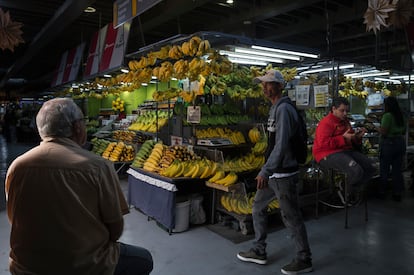
On the streets, even more than tensions with Washington or the possibility of a foreign invasion, people’s real concern is earning enough money to meet their basic needs. Venezuela’s minimum wage is barely $1 a month. Economic growth, following the collapse of the country’s productive system, has been uneven and far from sufficient, concentrated in specific activities, social groups, and sectors of the economy.
The government of Nicolás Maduro is trying to ease the strain on household finances with a subsidy it calls the “economic war bonus,” equivalent to $120 a month. This payment, along with others of smaller amounts under the so-called Patria System — such as “households of the homeland,” “family economy,” or “university scholarship” — supplements the Venezuelan worker’s meager income. It has been years since the government last raised wages nationwide.
The naval and oil blockade announced by U.S. President Donald Trump against Venezuela could, in the short term, further disrupt the country’s access to fuel. Nervousness is already being felt at gas stations. Luis Oliveros, an economist and dean of the Faculty of Economic Sciences at the Metropolitan University, estimates that Venezuela could see its current oil revenue fall by 60% if the White House enforces the blockade on the entry and exit of Venezuelan cargo ships.
“There are currently 11 large Venezuelan oil tankers stranded at sea,” explains José Guerra, an economist, academic, and former congressman. “That’s equivalent to 11 million barrels of oil. There isn’t enough storage capacity for that much crude, which is also growing. But halting production, or even just reducing it, is a difficult and costly decision that tends to dry up the oil wells. The oil wells have to be active, producing,” says Guerra. He adds that Venezuela’s state-owned oil company Petróleos de Venezuela (PDVSA) needs to import certain specific components to produce gasoline — something that was not previously the case in Venezuela.
“Few people make long-term purchases; if anything, they make them every two months. Uncertainty reigns supreme in the local market. Everyone wants to wait. This year wasn’t so bad, but nobody knows anything about next year. Many people, many companies, are waiting until January or February to decide to invest,” says María Alejandra (not her real name), an advertising manager in Caracas.
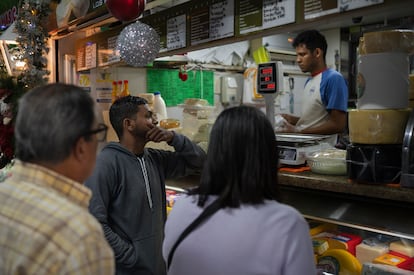
“Sales… They’re average, slow. We sell a little every day, but there’s nothing special, nothing new on Fridays like there used to be, and we don’t sell anything on the weekend,” says Regino Valladares. He works as a shop assistant in a small grocery store in the Las Delicias neighborhood of Sabana Grande and lives in the Valles del Tuy, a geographic area made up of several very modest commuter towns on the outskirts of Caracas. The store where Valladares works has to adjust prices almost daily and is required to sell its products at the official exchange rate, even though it sometimes has to buy them at the free-market rate.
“Sales have improved a bit in December. They had fallen quite a bit before the start of the school year,” says Belkis Hernández, who manages a pharmacy in the La Campiña neighborhood. Pharmacies are among the few sectors that have shown some growth and resilience in recent years. “Everyone is wondering what’s going to happen, what January will be like. I feel like that’s the question on everyone’s lips,” she says.
“A period of currency volatility and less foreign currency is approaching,” says economist Luis Oliveros. “A large percentage of Venezuela’s shipping fleet is sanctioned by the United States — 30%. Sixty percent of the country’s oil exports are through these vessels. The fiscal deficit, which is already very high, could continue to increase. The effects of an oil blockade will be very severe; they will be felt soon if things continue as they are, and people still don’t understand this.”
Sign up for our weekly newsletter to get more English-language news coverage from EL PAÍS USA Edition