The one-child policy was perhaps the greatest social experiment in human history. With the goal of curbing population growth at all costs, for just over 35 years China only allowed families to have one child. Communist leaders outlined the measures with a slogan in 1978: “One is better, two at most, leaving a three-year gap.” In 1980 it became state policy. By 1982, 96% of families in cities were having only one child, according to the Urban Household Survey.
Through a system of fines and penalties for non-compliance, the birth rate of what was then the world’s most-populous country was brought to a screeching halt. Unti…
The one-child policy was perhaps the greatest social experiment in human history. With the goal of curbing population growth at all costs, for just over 35 years China only allowed families to have one child. Communist leaders outlined the measures with a slogan in 1978: “One is better, two at most, leaving a three-year gap.” In 1980 it became state policy. By 1982, 96% of families in cities were having only one child, according to the Urban Household Survey.
Through a system of fines and penalties for non-compliance, the birth rate of what was then the world’s most-populous country was brought to a screeching halt. Until the policy itself became a problem. With the population pyramid inverting, Beijing put an end to the one-child policy in 2016, allowing couples to have two children to “balance demographic development and address the challenge of an aging population.” It hasn’t succeeded. Ten years later, the declining birth rate is one of the biggest headaches for the Chinese government.
The shadow cast is long. During its implementation, the one-child policy gave rise to horrific stories of abortions, abandonment, and children who grew up unregistered. It particularly targeted girls, whom many families rejected. At the same time, a new kind of only-child society was shaped, known as “little emperors” — hyper-developed, pampered children who have grown into adults while China’s GDP grew at an average rate of 10% and the country ascended to the pantheon of superpowers.
Ma Li, 53, raised her only daughter (now 24) hoping she would have “the same rights and opportunities as a boy.” “I raised her to be brave and know how to stand up for herself,” she says over the phone. After giving birth, she had an intrauterine device (IUD) inserted, as millions of women did during the years when birth control was widely available. She maintains that in her case it was a voluntary decision, although human rights organizations have documented that it was a widespread medical practice and, in many cases, subject to administrative pressure.
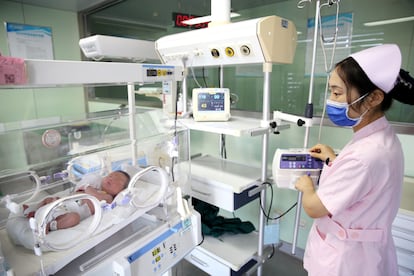
She acknowledges that, had she had the option, she would have wanted more children. But she maintains the policy “freed women from having a permanent reproductive function.” “Each era has its own logic,” she reflects. “Now many don’t want to have them. Some don’t even want to get married.”
In rural areas, the rule was not always followed with the same rigor. Distance from centers of power, the need for labor, and the demographic realities themselves meant that its application was uneven and, at times, more lax. In many villages, informal exceptions, delays in registration, or births that went unnoticed by the bureaucracy were tolerated.
Some families made decisions outside the system, like that of Ms. Mei, a 49-year-old from Sichuan. “We rural people didn’t understand the reason for the controls,” she explains in a message. She describes how almost every house in her area had several children. So, when her second child was born (her firstborn was a girl), she registered him in her sister’s family registry. She regularized the situation in 2015 — the year the policy was abolished — and paid the corresponding fine, which, she says, “was no longer comparable” to what she would have had to pay in 2003. For 12 years, in the eyes of the authorities, the child was his aunt’s son.
In Ms. Mei’s opinion, raising children used to be “simple.” “Having something to eat was enough.” She attributes the low birth rate to “enormous current demands” and a combination of factors: stagnant wages, high stress levels, and a lack of shared domestic responsibility.
In China, the fertility rate continues its freefall, despite the fact that in 2021 married couples were allowed to have up to three children. According to the World Bank, only one child is born to every woman, one of the lowest replacement rates on the planet (for the population not to decline, 2.1 children must be born per woman). In 2022, the country’s population decreased for the first time since the 1960s. In 2023, it was surpassed by India as the most populous country. China is aging rapidly, and society is sustained by a shrinking number of working-age citizens. The birth rate and the number of newborns declined for seven consecutive years before experiencing a slight rebound in 2024. The United Nations projects that China’s population will shrink from its current 1.4 billion to 633 million by 2100, a change that could hinder growth.
Thus, these issues have become a “national security” priority. “The rise and fall of major powers are often profoundly affected by population conditions,” Chinese President Xi Jinping said in a 2023 speech. “Therefore, demographic security must be incorporated into the broader framework of national security and carefully planned.” The leader advocated “shifting from primarily regulating quantity to focusing on improving quality, stabilizing the total population, optimizing the demographic structure, and enhancing population mobility.” Analysts interpreted this as a shift in approach: from control to incentives.
Authorities are now promoting what they call a “new culture of marriage and parenthood.” Policies are being rolled out on numerous fronts, from longer parental leave to tax breaks. Local governments are holding mass ceremonies to encourage marriage. Since May, couples have been able to marry anywhere in the country without needing to register the union in their home district (the so-called hukou). Officials are even available to register unions at tourist resorts, nightclubs, and music festivals.
This year, for the first time, the Government Work Report, an annual document that reviews policies and sets goals, mentioned the need to “provide childcare subsidies” and develop daycare services. In July, a nationwide aid program of 3,600 yuan (around $515) per child under three was approved. And last week, the National Health Security Administration pledged to “basically achieve” that by 2026 citizens will not have to pay out of pocket for hospital childbirth expenses, which amount to about 5,000 yuan for a vaginal delivery and 10,000 yuan for a cesarean section (around $715 and $1,430, respectively), according to the Shanghai Observer. Currently, most provinces have a co-payment system for medical expenses, including those related to childbirth.
In another sign of the changing times, starting in 2026, condoms will be more expensive: 13% VAT will be applied to condoms and other contraceptives, which had been exempt since 1993 as part of the one-child policy.
“The decline in the fertility rate is inevitable, like a giant boulder rolling downhill,” says Yi Fuxian, a researcher at the University of Wisconsin-Madison. It is a consequence of developed societies, and Asia is a prime example, with plummeting rates in Japan and South Korea. “China’s one-child policy accelerated the process,” adds the author of Big Country with an Empty Nest (2007). He believes that, despite the Chinese government’s efforts, it will be very difficult to roll that boulder back uphill.
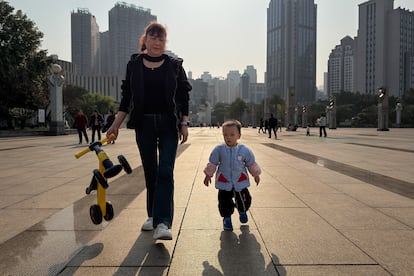
Yi believes the one-child policy has changed attitudes toward motherhood and fatherhood and “distorted moral values about life,” he writes in an email. “Having only one child or no children at all has become the social norm.” He predicts that marriages will continue to decline (despite brief upticks in 2023 and 2025) and couples will postpone having children. He doesn’t think the policies introduced will achieve much. “What China is trying to do, Japan has already done.” And unsuccessfully. The country “is aging before it gets rich,” he concludes. And “doesn’t have the financial resources to fully follow Japan’s path.”
Economist Keyu Jin, born in 1982 and an only child like the vast majority of her generation, believes that the implementation of the one-child policy led to “numerous horror stories” and has profoundly marked the country. But not only for the worse: “It can help explain the high savings rate of urban Chinese households [and] the extraordinary increase in the level of higher education,” notes this professor at the Hong Kong University of Science and Technology in *The New China Playbook *(2023). “In a surprising twist, having fewer children dramatically raised the status of women,” she adds.
Statistics show that there are about 30 million more men than women in China, an anomaly stemming from the preference for sons during the one-child policy. But those like Jin herself haven’t had to compete with siblings for resources, particularly in education. Numerous studies prove that women have, on average, received more years of schooling than men, she writes. And this has contributed to giving their peers greater social and professional standing.
It has also given rise to a generation of more independent women, both economically and personally, and more self-assured. “Now there are more ‘sisters’ who are raising their voices and showing others that we have to fight for more rights and autonomy,” says Winnie Tang, 27, founder of Spring Reel, a series production company, in an exchange of messages. For her, women’s “liberation” means “having the right to refuse and not accept imposed demands.” In her mother’s time, “starting a family was the highest destiny a woman could aspire to.” Her generation, however, prioritizes other goals, such as developing “a career we are passionate about” or enjoying “the pleasure of doing the things we love.”
Sign up for our weekly newsletter to get more English-language news coverage from EL PAÍS USA Edition