Donald Trump is leading the world into a carrot-and-stick scenario — only without the carrot — while each nation, for the moment, does what it can in response. Early Tuesday morning, as the Republican posted AI-generated images on his social media showing European leaders listening to some kind of explanation from him about the United States’ needs regarding Greenland, Mexico, a keen observer of Washington’s strategies, was preparing another mass transfer of prisoners north. The government of Claudia Sheinbaum is thus containing the threats issued by the…
Donald Trump is leading the world into a carrot-and-stick scenario — only without the carrot — while each nation, for the moment, does what it can in response. Early Tuesday morning, as the Republican posted AI-generated images on his social media showing European leaders listening to some kind of explanation from him about the United States’ needs regarding Greenland, Mexico, a keen observer of Washington’s strategies, was preparing another mass transfer of prisoners north. The government of Claudia Sheinbaum is thus containing the threats issued by the Republican, who has spent the last week and a half repeating that Mexico is ruled by cartels and that he is prepared to send troops south to exterminate them.
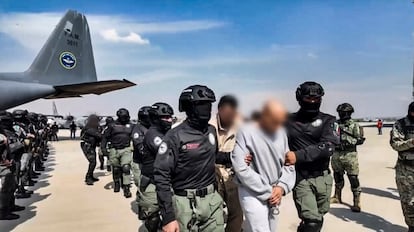
The latest transfer of prisoners — 37 in total — illustrates the current tension in the bilateral relationship, marked by the volatility of the U.S. president. The capture of Nicolás Maduro in Venezuela by U.S. troops on January 3 ushered in a period of heightened aggression from Trump, who targeted Colombia and Iran as readily as the European Union and Mexico. The transfer of alleged Mexican criminals to prisons north of the Rio Grande — the third such operation in Trump’s first year back in the White House — once again circumvents extradition laws and attempts to quell the president’s threats.
Since January 20 of last year, the Sheinbaum administration has extradited 92 high-profile prisoners to the United States, 37 of them on Tuesday, coinciding with the anniversary of Trump’s first year back in the White House. Among the latest transfer is Pedro Inzunza Noriega, alias “Sagittarius,” a key operative for one of the Sinaloa Cartel factions, accused of sending massive quantities of drugs into the U.S. Also prominent on the list are Ricardo González, alias “Ricky,” a regional leader of the Northeast Cartel, and Armando Gómez, alias “Delta 1,” head of an armed wing of the Jalisco New Generation Cartel (CJNG). These three organizations were designated as narco-terrorist groups by the Trump administration last February.
The handover of the prisoners on Tuesday can be interpreted in different ways. The first, perhaps, is the Mexican government’s efforts to take the initiative, at the cost of pleasing its neighbor. It has been a way of confining the Republican’s message, preventing him from abandoning rhetoric and turning it into action. Every time Trump raised his tone with Mexico, threatening to send troops south — under the assumption that the cartels are rebel armies, owners of specific territories, alien to the rest of the population and their spaces — Sheinbaum’s administration made a dramatic move.
The context of each prisoner transfer illuminates the above. In early February, for example, Trump announced tariffs on imports from Mexico, among other countries. “President Trump is taking bold action to hold Mexico, Canada, and China accountable to their promises of halting illegal immigration and stopping poisonous fentanyl and other drugs from flowing into our country,” the White House said at the time. Trump views Canada as a transit country for fentanyl before it reaches the U.S., and Mexico as the main producer. China is seen as the manufacturer of the chemical precursors needed to produce the drug.
The Republican has a point regarding the activities of criminal groups in both countries. The issue is the remedy — the brute force — since his return to power. In Mexico, threats are channeled through the Security Cabinet, which adheres to the opposite mantra: prudence, aware that so far it has had the means to extinguish the northern flames. In February, weeks after the tariff announcement — followed by a phone call between the two presidents — Mexico sent a first group of alleged criminals, surprising in both size and make-up. Among the 29 transferred prisoners was, for example, Rafael Caro Quintero, the DEA’s nemesis for 40 years.
With Mexican prisons overflowing with aging drug lords, the anticipation of future threats from Trump could be mitigated with new transfers. This is what happened in August, when Mexico sent a second batch of prisoners, including figures who still wielded considerable power from behind bars. This was the case, for example, of Abigael González Valencia, “El Cuini,” a former associate of CJNG leader Nemesio Oseguera, “El Mencho.” Among the new transfers are the historic leader of the Knights Templar cartel, Servando Gómez, alias “La Tuta,” and Juan Carlos Félix Gastélum, “El Chavo Félix,” son-in-law of Ismael “El Mayo” Zambada.
Since last fall, Trump’s rhetoric seems to have escalated and become a reality. In September, Washington launched its operation against drug-running boats in the Caribbean and the Pacific, which has already left more than 100 dead, about whom little or nothing is known — not even whether they were actually involved in drug trafficking. Then, the Pentagon targeted Venezuela for the alleged involvement of high-ranking government and state officials in cocaine trafficking and bombed a port. In January, the U.S. attacked the capital, Caracas, and arrested Maduro. During those days, Trump returned to his familiar refrain that Mexico cannot defeat drug traffickers, even if it wanted to.
Far from the rhetoric of other leaders, Sheinbaum has tried to avoid any kind of semantic backlash. The recent arrests in Mexico of several individuals on the most-wanted lists in the United States, the dismantling of a Tren de Aragua cell in the capital, and the subsequent transfer of 37 prisoners all follow a familiar path. The losses seem minimal. In fact, the Security Cabinet views the release of some of those prisoners recently handed over, such as Delta 1, almost as a gift, rather than a sacrifice to national sovereignty. Preventing the deployment of U.S. troops on Mexican soil appears to be a major obstacle for the president. The prison system’s capacity to retain its own criminals and the arrest of some key targets — such as El Mencho himself, or the warring sons of “El Chapo” Guzmán and Zambada — could provide her with some breathing room in the coming months.
Sign up for our weekly newsletter to get more English-language news coverage from EL PAÍS USA Edition