Brazilians have quickly become familiar with the acronym Enamed. It stands for the Portuguese initials of a national exam with which the Ministry of Education has, for the first time, assessed the training of future doctors. And its results are shocking. It turns out that a third of the medical degrees under analysis do not prepare students to practice medicine under conditions deemed minimally acceptable by the ministry. Furthermore, 25% of students failed the exam.
These results are causing alarm and apprehension among the public, as well as an intense debate on two issues: the ease of establishing university medical schools in Brazil, and how to produce adequately trained doctors to serve 212 million inhabitants in a country with many remote regions and as large as the United Stat…
Brazilians have quickly become familiar with the acronym Enamed. It stands for the Portuguese initials of a national exam with which the Ministry of Education has, for the first time, assessed the training of future doctors. And its results are shocking. It turns out that a third of the medical degrees under analysis do not prepare students to practice medicine under conditions deemed minimally acceptable by the ministry. Furthermore, 25% of students failed the exam.
These results are causing alarm and apprehension among the public, as well as an intense debate on two issues: the ease of establishing university medical schools in Brazil, and how to produce adequately trained doctors to serve 212 million inhabitants in a country with many remote regions and as large as the United States without Alaska. No other country has a larger public healthcare system than Brazil.
The first edition of the Enamed exam evaluated 350 medical programs, offered by public and private institutions, through an exam administered to nearly 90,000 students. Universities received a failing grade if less than 40% of their students were able to demonstrate the basic knowledge required to practice medicine. Particular concern has been raised by the fact that 13,000 final-year medical students flunked the official exam. This means that, barring any changes, they will soon be practicing medicine. The Federal Council of Medicine is exploring ways to prevent this.
The medicine schools with the worst scores are mostly municipally owned (created and managed by city councils) or run by private, for-profit entities. Beyond the public shaming, the students will not be penalized, but their universities will. They are prohibited from increasing the number of admissions; instead they may maintain their current number or will have to reduce it, depending on how bad their scores are.
In 1988, after the end of the dictatorship, Brazil created the Unified Health System (SUS), the largest public healthcare system in the world. It is an extremely ambitious project that, despite its imperfections, means that basic medical care reaches even the most remote corners of the country through humble health posts or professionals who arrive by land, sea, or air. “No other country with more than 100 million inhabitants has dared to offer universal access to healthcare,” recalls Drauzio Varella, one of the country’s most influential doctors, in the newspaper Folha de S.Paulo. The challenge of staffing this vast system with doctors is immense, especially in the least desirable areas.
The shortage of doctors became so critical that there was a period of intense fighting over professionals. Even the most remote municipalities competed fiercely for doctors, throwing money at the problem.
Corporatism and politicization taint many discussions about Brazilian healthcare. Because this is a tremendously unequal country, the extensive public sector coexists with a powerful and cutting-edge private sector. During the Covid pandemic, some professional associations endorsed then-president Jair Bolsonaro’s denialist position. But even before that, the Mais Médicos program, with its Cuban doctors, sparked outrage.
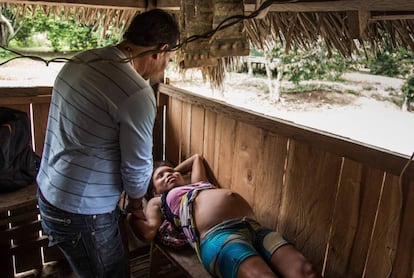
Even in the most remote Brazilian villages, there’s usually a health post with at least one nurse. It’s more difficult to bring family doctors, and even more so specialists to these municipalities.
That’s why, in 2013, then-President Dilma Rousseff created the Mais Médicos (More Doctors) program, which recruited thousands of Cuban professionals willing to settle in regions neglected by local doctors, who tend to concentrate in wealthier areas. The program ended under Bolsonaro, who criticized the Cuban regime for taking a large portion of the doctors’ salaries.
When Luiz Inácio Lula da Silva returned to power in 2023, he reformulated and expanded the Mais Médicos program, giving preference to Brazilian professionals. In the three years since, he has managed to double the number of doctors deployed to more than 27,000.
The results of the Enamed exam have led medical associations and other professional organizations to raise their voice against what they consider “an alarming scenario.” A doctor without the minimum required training “orders incorrect tests, writes inappropriate prescriptions, and often recommends unnecessary procedures.” “In addition to wasting money, it harms the patient and increases the risk of lawsuits against hospitals,” Francisco Balestrin, president of Sindhosp, the union of private hospitals, clinics, and laboratories in São Paulo, told Folha.
Amid the controversy, Education Minister Camilo Santana defended the official exam, arguing it was positive despite the poor results obtained by one in three courses. “This isn’t about harming anyone, least of all the students, but about ensuring that universities reflect on the quality of their laboratories and their professionals, so that we have well-trained professionals in the country,” said Santana, a member of the Workers’ Party. “To give you an idea, between 2016 and 2022, the number of admissions in private medical programs in Brazil practically doubled,” the minister revealed.
It’s no surprise that federal public universities have received the highest marks; they are universally recognized as the best. But the evaluation of medical programs has also revealed that tuition fees can be inversely proportional to the quality of the education being offered. Medicine schools that scored the lowest (1 or 2 on a scale of 1-5) charge each student between $1,100 and $2,600 a month, according to a detailed analysis by Veja magazine. This is veritable fortune in a country where the minimum wage is $313 a month.
Sign up for our weekly newsletter to get more English-language news coverage from EL PAÍS USA Edition