The women gather on a bench in Cenobio Moreno. There are more than 10 of them, laughing, murmuring, fiddling with the sleeves of their shirts, the loose strands of their hair in buns. It’s hot, and it’s been dark for a while now; a January heat, 36 degrees Celsius, with acceptable humidity. “Shall we do it now?” one of them says. “Let’s do it now.” And then they all begin, taking turns, to tell their stories. Deep down, that story is almost always the same: agents from one agency, or several, broke into their homes after they had already left — almost all of them, to pick lemons. They took money, dishes, Tupperware, baptismal pendants, even three piggy banks, one in the form of a pig, another a dog, and one more a lamb.
It happened in the early hours of Friday, January 23, just a …
The women gather on a bench in Cenobio Moreno. There are more than 10 of them, laughing, murmuring, fiddling with the sleeves of their shirts, the loose strands of their hair in buns. It’s hot, and it’s been dark for a while now; a January heat, 36 degrees Celsius, with acceptable humidity. “Shall we do it now?” one of them says. “Let’s do it now.” And then they all begin, taking turns, to tell their stories. Deep down, that story is almost always the same: agents from one agency, or several, broke into their homes after they had already left — almost all of them, to pick lemons. They took money, dishes, Tupperware, baptismal pendants, even three piggy banks, one in the form of a pig, another a dog, and one more a lamb.
It happened in the early hours of Friday, January 23, just a day after the arrest nearby of César Sepúlveda, alias “El Bótox,” or “Boto,” as he’s known locally. His capture was a major coup for Mexican security forces, including those in Michoacán, who had been trying to apprehend him for over a decade. Bótox is accused of extorting lemon growers in the area and of several murders, including that of Bernardo Bravo, president of one of the region’s main citrus producers’ associations. It was a significant victory, moreover, because his arrest came amid yet another back-and-forth between Mexico and the United States over the narrative surrounding the fight against organized crime.
The women don’t say much more, and then one of them leads the group to the houses the authorities entered. On some doors, the seals of the Michoacán Attorney General’s Office are still visible, bearing the inscription “property seized.” One of the few women who was home when the agents arrived says they were looking for “the boy” — that’s what they were shouting, “boy, boy!” — and then explains that this is the nickname of Bótox’s son, César Sepúlveda Valencia, who must be around 22 years old now. She also says that she’s not taking sides, but that Bótox helped people and that he’s from here, from Cenobio Moreno, that his mother sold fabrics and his father had lemon groves, and that later his mother died of cancer…
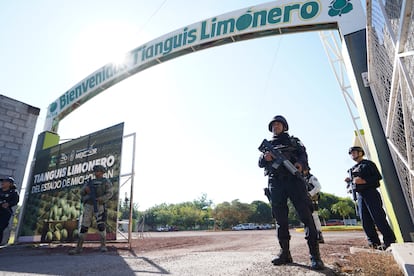
Tied to the booming lemon economy, a crop that covers around 100,000 hectares, the Tierra Caliente region of Michoacán changes without changing. The last time they were in these parts, in mid-2021, a criminal Frankenstein called Cárteles Unidos, which incorporated old self-defense groups and regional mafias, operated a checkpoint in a town just south of Cenobio Moreno, on the way to Aguililla. These lemon-rich lands then served as the stage for the battle between Cárteles Unidos and the Jalisco New Generation Cartel (CJNG). The checkpoint was run by one of the Cárteles Unidos factions, Los Viagras, old associates of El Bótox. In fact, one of the men who managed that checkpoint, who is with the women this afternoon, recognizes the reporter from one of those trips, a prodigious memory.
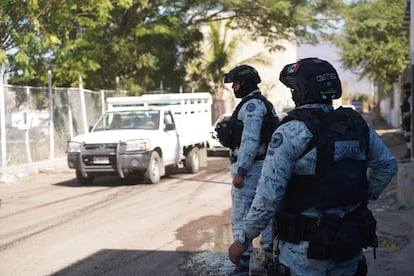
Back then, it wasn’t uncommon to encounter both Cárteles Unidos and the CJNG on the same road to Aguililla, sometimes with a “monster” — a popular term in Mexico for the homemade tanks built by criminal gangs. Now there are no more monsters, no more checkpoints, and no more Cárteles Unidos. Los Viagras, El Bótox’s gang — known as the Whites of Troy — and other groups in the area, such as the Cartel de la Virgen, joined forces with the CJNG, a group that fights relentlessly to gain access to the coast. In recent years, the fighting has been brutal in the Sierra Costa region of Michoacán, especially in Tepalcatepec, but also in Coahuayana, where a few weeks ago, the CJNG detonated a car bomb in front of the community police station.
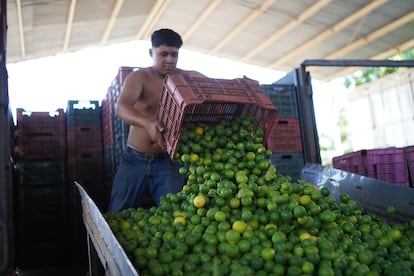
Everything changes without changing. The alliances between groups mutate, as do their loyalties. Some kingpins rise, others fall. Rather than bringing relief to the people, El Bótox’s departure from the criminal arena has sparked a multitude of questions: who will rise now, who will extort the lemon growers, how will they do it, and so on. The loot is enormous; each of the region’s 100,000 hectares can yield up to 20 tons of lemons annually, depending on the care given to the plot. That represents a profit of around 120,000 pesos, after expenses. That is, about $7,000 per hectare. Now, multiply that by 100,000. And that’s just the lemons. The criminals tax and/or regulate almost all commercial activity in the area. There are times when they set the price of meat, others when they charge extortion fees from beer and soft drink distributors, bakers... The list is endless.
As a member of the clergy consulted in Apatzingán, the region’s most important city, says, “You learn the tricks, and nobody’s going to let go of the teat.” In other words, extortion will continue, with or without Bótox, because lemons, like methamphetamine, beef, and beer distribution, are commodities for the cartels — a situation that can be exported to other regions of the country, where organized crime has incorporated agriculture and the agricultural industries into its business portfolio. The religious figure, who knows the region like the back of his hand, adds that “the only thing that’s changed these past few years is that the CJNG has swept through. It’s true that some groups still bother them, like the Tepalcatepec group or the Tena group,” he notes, referring to gangs operating in the region. “But other than that...” he says, without finishing the sentence.
The coyotes
Eustaquio doesn’t understand the situation, and in his world, that seems rather strange. “Bótox was buying yellow lemons for more than four pesos a kilo. Then he sold them to some gringo mill... Who knows how he made a profit!” he exclaims, scratching his head. The yellow lemon is the outcast of these parts, the one that ripens too much and falls to the ground, unlike the green one, the crown jewel. The yellow one is used to produce oils and essences; the green one, more expensive, ends up in taco stands, small restaurants, and bars. While he’s trying to figure out Bótox’s business — the price of yellow lemons is around two and a half pesos — a couple of men arrive and ask him about a sale. Eustaquio doesn’t know, looks at his phone, makes a call. Then he turns around and says, “Wait a moment, and we’ll be right back.”
The lemon market in Apatzingán is a kind of citrus-themed Wall Street, a vast expanse of land where ties give way to shirts unbuttoned to the midriff, and wide-brimmed hats prevail over headphones and screens. Eustaquio, a pseudonym, has a 10-hectare orchard, six of which he dedicates to lemons. He’s somewhat frustrated because his trees have barely produced any fruit these past few months, which is really his own fault. In October, the packers — “the real bosses” of the industry, he says — were paying four pesos per kilo of limes, a ruinous price. He decided to leave the land half-fallow, letting the saplings produce what they could. And four months later, it turns out that a kilo is selling for 17 pesos.
With the aim of organizing the lemon market, producers and packers in Apatzingán conceived the tianguis (a merchant market) 20 years ago, a space for conducting business. After several attempts to relocate it, they finally settled on a plot of land on the outskirts of the town. There, producers could bring samples of their product, which the packers could then buy from. These transactions would determine the price of the lemons, which those in charge of the market recorded on a board. Today in Apatzingán, producers like Eustaquio, industry professionals, and others interested in the sector point out that among the original promoters of the tianguis was Jesús Méndez, alias “Chango,” one of the founders of La Familia Michoacana, the precursor to modern organized crime in the state.
Whether or not Chango Méndez’s influence over the open-air market is real, the closeness or direct presence of organized crime in the citrus business in Apatzingán and the surrounding municipalities, especially Buenavista, is undeniable. The accusations of extortion against El Bótox or the Sierra Santana family, heads of Los Viagras, fall short. As Eustaquio and other sources consulted in the area recently explain, the extortionists demand a percentage of what the packers pay the producers for each kilo of limes — between two and three pesos. Furthermore, in the case of El Bótox, the criminals are involved in the very business they are exploiting.
Eustaquio’s orchard lies in Buenavista, 20 minutes from the open-air market. “I’ve been in the lemon business since about 1986. My dad bought me a dual-wheel pickup truck, and I’d go around the orchards offering to pick the lemons. That’s how I started out,” he says. Later, he acquired a few hectares where he planted his own trees, inherited a few more when his father died, and then bought two freight trucks to transport lemons to other regions. “To tell you the truth, we were at our best when we were with the Knights Templar,” he says, referring to the heirs of La Familia Michoacana, who amassed considerable power in the early 2010s.
According to Eustaquio, the Knights Templar set the purchase prices for lemons, and no one complained — not that they offered much in the way of choice. With the group’s subsequent fragmentation, this kind of enforced regulation ceased to function. The market was left without oversight, a space that other actors took advantage of to flourish. These are the “coyotes,” intermediaries between packers and producers, and enemies of the latter because, they believe, they take a cut of the sale price without lifting a finger. “The coyote earns whatever he wants,” says Eustaquio. “For example, he comes along and says, ‘Look, I need 40 tons, I’ll buy them from you for this price, but you have to hold off 50 cents or a peso per kilo for me.’ And then they also charge the packers,” he explains. “They take a lot; they’re exploitative.”
Bernardo Bravo
Days before he was killed, Bernardo Bravo posted a video on his Facebook account, also pointing the finger at the middlemen. As president of the Citrus Growers Association of the Apatzingán Valley, he was on the ropes. The price of a kilo of lemons was languishing at four pesos, and the producers seemed to have given up. The packing plants, which buy the fruit, wash it, wax it, and pack it into boxes to send it to wholesale markets and other distribution centers, weren’t willing to pay more. They argued that there were too many lemons on the market, and that they also had to deal with the extra tax levied by the cartels — what were they going to do? The middlemen, often sent by the packing plants, were trying to profit from the crisis. Anger was growing.
“We don’t agree with those prices set at the packaging and processing plants,” Bravo said in his video, recorded on Friday, October 17. “They don’t make sense for supporting our farmworkers and laborers… [On the following Monday] we’re not going to allow any middlemen access [to the market]… they’re doing a lot of damage to the producers,” he added. Bravo never made it to the market that Monday. El Bótox and his henchmen killed him on Sunday. They lured Bravo to one of El Bótox’s houses in Cenobio Moreno, where they killed him, according to the Michoacán Attorney General’s Office, before abandoning his body in his car in a secluded area of Apatzingán.
The murder of Bravo shocked Michoacán and the entire country. Violence wasn’t foreign to the citrus business — quite the contrary — but the attack signaled an escalation of cartel activity. It was the same thing that had happened a year earlier in Guerrero, when criminals similar to those of the Bótox or Los Viagras gangs killed the mayor of Chilpancingo. Something similar also occurred in the May 2025 assassination of two of the closest aides to the head of government of Mexico City. These were homicidal attacks, but also intimidating messages. In Michoacán, the message was very clear: anyone who gets in the way, dies.
At this point, there’s little doubt that Bótox killed Bravo, even though he denied it in a video he recorded in January and posted on social media. The question is why. Tensions in the lime market in the Apatzingán Valley were running high at the time. According to information gathered in the area recently, Bravo was planning to raise the price of a kilo of limes by decree from four to seven pesos the Monday after his death. It doesn’t seem that this directly affected Bótox, just as the criticism from the union leader and the producers — the middlemen — didn’t seem to affect him. But in that case, what?
In the hearings held this week regarding the Bravo case, with El Bótox now in custody, the Michoacán Attorney General’s Office stated that, recently, Bótox had stolen a backhoe from Bravo and was demanding 400,000 pesos for its return, according to local media reports. The criminal also demanded that Bravo hand over family orchards, some located in Cenobio Moreno. The Attorney General’s Office also stated that Bótox had held Bravo captive for several hours on October 6, before releasing him. Something else must have happened in the two weeks leading up to his murder.
In a document shared by the Michoacán Attorney General’s Office following the arrest of El Bótox, the agency included the statement of one of Bravo’s associates, also a lemon farmer, who indicated that in early October he had traveled with Bravo to Atequiza, Jalisco. There, this man, nicknamed “Pilones,” introduced Bravo to a regional leader of the CJNG cartel, René Meza. According to Pilones’ statement, which was made public by the Attorney General’s Office, Bravo asked Meza to “get rid of El Bótox because he was getting on their nerves.” According to Pilones, Bótox found out about this meeting and ordered the union leader killed.
In Apatzingán, this theory seems logical to many. A local politician, familiar with the workings of organized crime, says he had heard something similar and that it makes perfect sense. “If Berna [Bravo] went to seek support from the CJNG elsewhere,” he says, “it’s because those here were allies of Bótox. Even back then, in October, they still were, despite the murder he ordered in February of two agents from the Attorney General’s Office in his territory,” he adds. Bravo’s murder, he says, ended that support. “Besides, he was very erratic; he would suddenly call a packing plant or a mill — companies that process yellow limes — and say, ‘Hey, send me 100,000 pesos, this, that…’ In the end, he was left all alone. And in the end, criminals are like politicians: they run out of money, and that’s it,” he concludes ironically.
*Sign up for our weekly newsletter to get more English-language news coverage from EL PAÍS USA Edition *