The story of American success is full of early callings, groundbreaking ideas and media exposure. But none of that applies to Benjamin Talley Smith, 46. At first he thought he wanted to pursue a career in the movie industry, but when he found himself using computers and editing programs, he realized he missed working with his hands. From there, he jumped somewhat randomly into the world of fashion and, within the sector, dedicated himself to a seemingly unattractive sector: jeans. And, little by little, love blossomed. Today, the Vermont native is a leading expert on this peculiar subject, which he studies as if it were a science. He has been the “jeans whisperer” [for Tommy Hilfiger](https://english.elpais.com/culture/2022-10-21/tommy-hilfiger-our-fans-are-going-to-be-living-in-the-…
The story of American success is full of early callings, groundbreaking ideas and media exposure. But none of that applies to Benjamin Talley Smith, 46. At first he thought he wanted to pursue a career in the movie industry, but when he found himself using computers and editing programs, he realized he missed working with his hands. From there, he jumped somewhat randomly into the world of fashion and, within the sector, dedicated himself to a seemingly unattractive sector: jeans. And, little by little, love blossomed. Today, the Vermont native is a leading expert on this peculiar subject, which he studies as if it were a science. He has been the “jeans whisperer” for Tommy Hilfiger, Helmut Lang, Rag & Bone, and Marc by Marc Jacobs, although he also didn’t hesitate when it came to designing $27 jeans for Walmart.
Until The New York Times published a piece about it a year ago, it was the best-kept secret in the American textile industry. He prefers to keep it that way: for his independent consultancy (Talley Creative) to continue with its five employees and no more, and for him to retain the freedom to say no to companies he feels aren’t ready to launch his line of jeans. “Recently, the president of a brand told me when he met me that I wasn’t at all the way he’d imagined,” he explains, knowing he doesn’t have the airs that are often attributed to the fashion world. And he remembers how he couldn’t hold back his laughter when someone whose name he doesn’t want to remember swore revenge on a supermodel simply because she wasn’t available to them at the time.
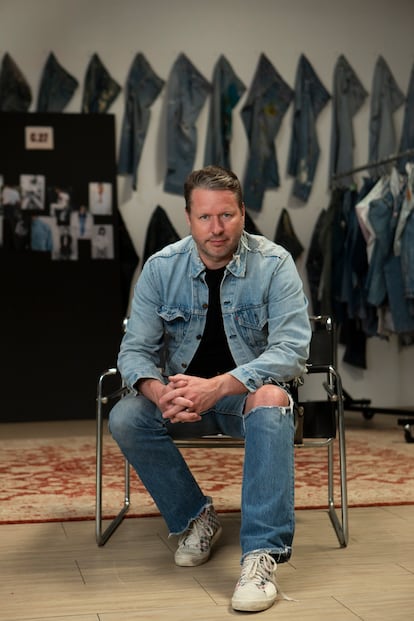
Talley Smith, with his Vermont-bred good-boy attitude and, of course, dressed in denim pants and jacket, meets us at a café in New York’s SoHo just before a meeting with Spanx, with whom he has just launched an innovative line of jeans made with Lycra that he believes could revolutionize the market. The denim market generated $45.51 billion worldwide in 2024, according to a report by Research and Markets, and is going full steam ahead: the same sources predict it will generate revenue of $67.36 billion by 2030. “It’s an emblem of the United States and it never goes out of style. At the companies I’ve worked for, the denim line represented no less than 10% of their business. If you do it right, it becomes something huge, and that’s why investors find it attractive. And, if you get it right, success lasts forever,” he argues.
We all have our favorite jeans. The ones that fit us well and to which we swear loyalty. “Once you find them and feel comfortable in them, they’re almost like armor,” he summarizes. His job is precisely to ensure that no body is left without its most flattering pair of jeans, the ones we’ll buy again when they’ve worn out or shrunk. “One of the founders of Shazam once called me asking for help because his favorite pair of jeans was no longer being made,” he recalls. But beyond this anecdote, what sets Talley apart is that he offers a vertical service in his consulting firm: from sourcing and working with materials (purchasing, design, washing) to market research and marketing campaigns. The New York Times called him “the wizard of jeans,” although he seems more like an archivist of this garment: he works surrounded by more than 2,000 pairs of jeans of all kinds in his studio, continues to seek out collector’s pieces in secondhand stores, and when he walks down the street, he recognizes each and every one of his creations. “They’re like my children,” he jokes. Although one of his most famous jeans is named not after his son, but after his wife: the Danielle, designed for Khaite. A high-waisted, straight-leg jean that Kendall Jenner wore last fall and was a hit on social media.
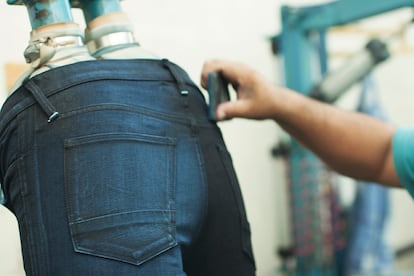
According to Talley, there’s no single secret to a successful pair of jeans, but rather respecting the nature of the process, which requires patience in trial and error and the experience that only he possesses in the industry. The first key is the wash: “It’s the most expensive part of the jean, and if you want to do it right, it has to be done by hand. That makes each pair of jeans different, almost like a fingerprint.” The second, with all due respect, is the butt. Who hasn’t contorted themselves in front of the mirror to see the effect of a pair of jeans on their rear end? If the wash is the most expensive, designing the rear of the jean is the most time-consuming. “Especially with women’s jeans. It requires fitting them on women, something I have to do myself at least five times a week for different brands. Is the pocket in the right place? Is it too small? Sometimes it’s a matter of millimeters. And you can tell when not enough attention has been paid to that process. Sometimes I’m walking down the street and say, ‘Look, that pocket isn’t placed correctly,’” he says. The third is understanding that a line of jeans requires a huge initial effort: at least nine months of preparation and a $30,000 budget, he says. The payoff comes in the medium to long term.
Although everything sounds like a production line, Talley doesn’t feel like his work is monotonous. Trends—whether wider or narrower, the challenges of sustainability, or the blurred gender barriers of contemporary society—keep him more than entertained. And talking to him, it’s tempting to trace the evolution of society through a garment created in 1873, designed, with its rivets and durable fabric, for workers in adverse conditions. Later, movie stars like Marlon Brando and James Dean popularized it when Hollywood began to tell less glamorous, more real-life stories. Despite that masculine beginning, today, Talley says, 80% of the industry is dedicated to producing jeans for women, and the big change this millennium brought is premium or luxury jeans. “In 1999, Diesel was the first to release a pair of jeans that cost $120, when the most expensive Levi’s cost around $89,” he recalls. Then came higher-end brands like Seven, which approached the $200 mark. “And that’s when it all started. In the last 10 years, we’ve entered the luxury phase,” he says, recalling how Louis Vuitton was the one that pushed the price beyond $1,000. “But whether it’s $1,200 or $20, what makes jeans unique is how often we all wear them,” he concludes.
Sign up for our weekly newsletter to get more English-language news coverage from EL PAÍS USA Edition