Exactly one year ago, in the days leading up to Donald Trump’s second inauguration, a cold front forced the ceremony indoors and cast a somber mood over Washington. One question was on everyone’s mind in a city overwhelmingly Democratic, now filled with MAGA supporters, new residents who arrived with the change of administration, and billionaires eager to do business: where would resistance to the president of the United States be this time?
After all, a bold citizen mobilization had greeted Trump at the start of his first term …
Exactly one year ago, in the days leading up to Donald Trump’s second inauguration, a cold front forced the ceremony indoors and cast a somber mood over Washington. One question was on everyone’s mind in a city overwhelmingly Democratic, now filled with MAGA supporters, new residents who arrived with the change of administration, and billionaires eager to do business: where would resistance to the president of the United States be this time?
After all, a bold citizen mobilization had greeted Trump at the start of his first term (2017–2021). At the dawn of the second, and after 10 years in which activists, Hollywood celebrities, Democratic politicians, traditional media, and the system itself had unsuccessfully tried to stop him, it seemed that half of the United States had decided to lower its arms in the face of the unequivocal victory he had achieved at the polls.
Twelve months after that inauguration, resistance to Trump is somewhat more active. And he faces a pivotal year, in which the midterm elections next November will divide his presidency in two: losing Congress, which he currently controls, would greatly complicate the second half of his term. Meanwhile, federal judges across the country continue to reject and sometimes even block his agenda in the courts, a handful of Republican congressmen are opposing him with more irritating than decisive effects, and Democrats are regaining some hope through flashes of progress, such as the election of New York’s new socialist mayor, Zohran Mamdani.
The response in the streets is also intensifying. This week, U.S. television has relentlessly broadcast images of protests in Minneapolis over the deployment of ICE immigration agents, one of whom fatally shot Renée Good, a U.S. citizen. This follows earlier protests in Los Angeles, Chicago, and Portland. All of these are Democratic cities to which the federal government has sent the National Guard, just as it has sent them to Washington itself, where they are still patrolling the streets.

Federal judges in all of these places have opposed the government’s decisions to deploy thousands of agents, another demonstration that resistance to Trump, as was warned from the beginning, is this time also (or especially) in the courts. Over these 12 months, Trump has signed 228 executive orders and decisions without congressional approval — three more than in his previous four years — and many of them have ended up in court. As of this week, there were 253 active lawsuits challenging government measures at local, state, and federal levels, according to calculations by the independent organization Lawfare. And nothing suggests that the back-and-forth is about to ease.
The court barrier to Trump’s attempts to expand executive power, however, has a crack at its highest point. The Supreme Court, with its conservative majority of six justices — three of whom were appointed by the Republican during his first term — demonstrated unwavering loyalty to the U.S. president during the past judicial term. They ruled in his favor 19 times, with decisions issued under expedited procedures.
And what about the legislative branch? Trump’s first year back in the White House was, especially in its first half, a year of congressional paralysis. In his first term, the Republican Party did push back against some of his decisions. In this second term, after a decade of MAGA influence in its ranks, the party has repeatedly bowed to the White House’s wishes.
It is true that the Democrats, who control neither chamber, have little room to maneuver. It is also true that, reeling from their electoral defeat, disoriented and leaderless, they took months to spring into action, despite calls from the influential strategist James Carville to implement what he called “the boldest political maneuver in the party’s history.” This maneuver, he argued, could be summarized as follows: “Stand back and play dead, let the Republicans collapse under their own weight.”
In the fall, Senate Democrats forced the longest government shutdown in history, which lasted 43 days and delayed the passage of a law to force the Justice Department to release documents it held on convicted pedophile Jeffrey Epstein.
When the motion was finally put to a vote, the decision was almost unanimous; only one conservative congressman voted against it. The scandal over Epstein, a longtime friend of Trump, was also the reason for the president’s break with a group of recalcitrant congress members, who in recent months joined resistance to him on matters such as extrajudicial military operations against alleged drug-running boats in the Caribbean. Trump repeatedly insults them on his social media and even forced the resignation of one of them, the former MAGA representative Marjorie Taylor Greene, who unexpectedly became a face of the opposition.
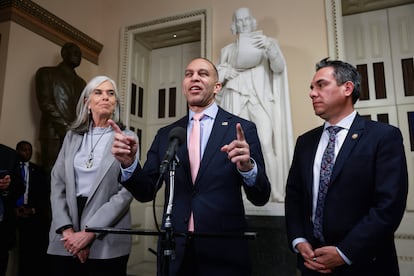
Before that, the government shutdown was a risky move for the Democrats; cutting off public funding affects essential services for citizens and leaves hundreds of thousands of public employees without pay. But it paid off for the party, which for the first time since Kamala Harris’s electoral disaster presented itself to its supporters as an organization willing to fight. The shutdown ended when eight senators from the minority conceded to the conditions to reopen the funding. Not for long: the next test comes at the end of January, and another deadlock cannot be ruled out as a pressure tactic to save certain healthcare benefits.
During those months of Democratic inaction, their strategists pleaded for patience with an eye on the midterms, the elections in which the entire House of Representatives and one-third of the Senate are renewed. That moment is now drawing closer. The midterms will be held on November 3, the most important date on the 2026 calendar, alongside July 4, the 250th anniversary of U.S. independence.
It is widely assumed that Trump — who said last week that it would be better if the elections were not held (though the White House later clarified he was “joking”) — will do everything possible to influence the outcome, by redrawing districts, placing election deniers among the officials overseeing the vote count, and questioning the legitimacy of mail-in ballots. Even so, many analysts consider it possible, 10 months before the vote, that the Democrats could regain the majority in the House of Representatives, where all 435 seats are up for election, though only about 60 can be considered competitive races.
Four-point lead
Trump’s approval ratings have been low for more than 300 days. And according to a Wall Street Journal poll published this past Saturday, which gives the Democrats a four-point lead in voter intention, a majority of Americans are dissatisfied with the state of the economy, see the government as unable to curb the cost of living, and consider the White House too distracted by international politics.
The analysis is further complicated by the unusually high number of retiring congress members in the midterms — more among the Republicans (25) than the Democrats (21) — which adds uncertainty for the conservative caucus, which holds a slim majority (218‑213).
Midterm elections are usually bad news for the party in power, although, again according to the *Journal *poll, the outlook at this point in the year was better for Democrats in 2018 than it is now. Back then, Trump faced his first electoral test and failed spectacularly.
If the House of Representatives were to flip, the Democrats would have greater capacity to block his agenda — except for the parts he pushes through by executive orders. They could also propose the semblance of an impeachment to remove him, but that could be risky. It would be the third, and the two previous attempts, far from ending Trump, only made him stronger.
Deciding whether to go all in or not is a dilemma, but it is not the only dilemma facing the American left. Last November, after a gloomy period, they received a boost of optimism with decisive electoral victories in New Jersey, Virginia, and, above all, in the mayoralty of New York City. A star has emerged there: the socialist Zohran Mamdani. Democrats will be closely watching his success or failure. The party still does not have a clear leader for the 2028 election, and Mamdani’s rise has highlighted the clash between two factions of the party: moderates and progressives.
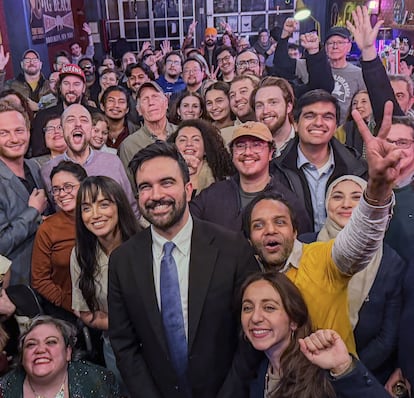
Everyone seems to have learned at least something from New York’s mayor: part of his success came from focusing on the cost of living — the “affordability crisis” that Trump has even incorporated into his own rhetoric. It will be harder, however, to emulate his extraordinary skill with social media. To connect with the young, predominantly male electorate that swung toward MAGA in the last elections, prominent figures like California Governor Gavin Newsom have adopted the tactic of getting into the mud and responding to Trump on social media with the same tools — jokes of questionable taste, memes, and personal attacks. It remains to be seen whether this strategy will serve any purpose other than channeling the frustration of facing a president who often seems unstoppable.
Newsom is arguably the best-positioned to be his party’s candidate in the next presidential race. But his change in style, and the victories last fall, are not enough to claim the party’s crisis is over, according to David Plouffe, veteran Democratic strategist, a leader of Harris’s brief campaign, and one of the most critical voices of the establishment that allowed Joe Biden to run again.
“It’s much easier to hope that the storm has passed, that the deep unpopularity of Mr. Trump and the MAGA movement and the mess they are creating will be enough to right the ship,” Plouffe writes in The New York Times. “I certainly wish it were so. But to win races in politically unforgiving, even hostile, territory will require the party to overhaul its broken brand and stale agenda, by elevating new faces and new leaders who promise to chart a course enough voters believe in.”
That’s the theory. In practice, it will almost certainly be much more difficult.
Sign up for our weekly newsletter to get more English-language news coverage from EL PAÍS USA Edition