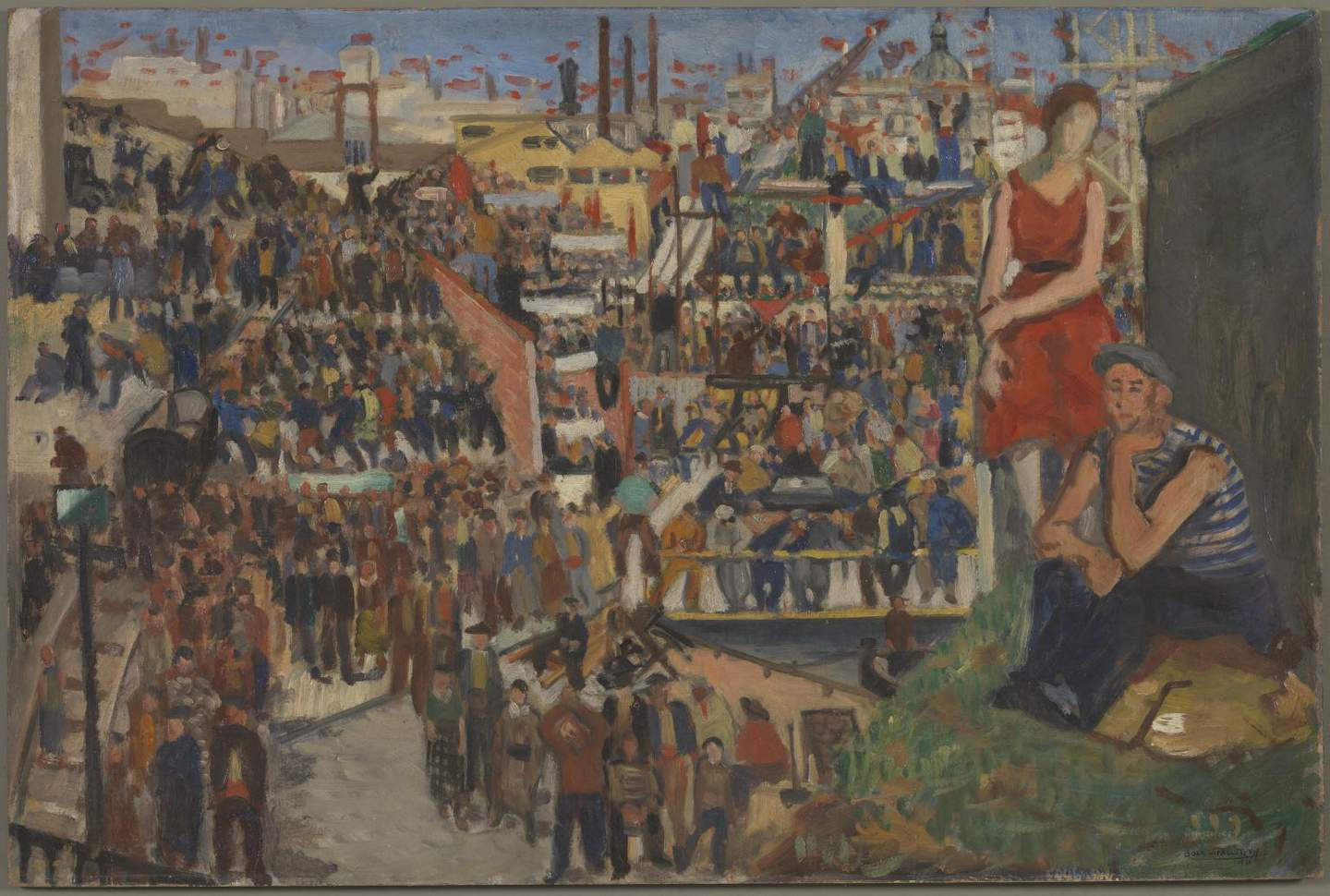
"Life is beautiful. Let the future generations cleanse it of all evil, oppression, and violence, and enjoy it to the full."—Leon Trotsky
If a time traveler had told a denizen of 1916 what the world would look like in a hundred years they would probably be thought either a charlatan or a lunatic.
If that same traveler were to recite the same story to an inhabitant of the nightmarish world order of 1962, they would at best be considered hopelessly delusional, and more than likely reported to the local political police.
But should the same temporal nomad recount their tale to a citizen of the world in the year 1975, they would simply be considered over-enthusiastic and idealistic, and …
"Life is beautiful. Let the future generations cleanse it of all evil, oppression, and violence, and enjoy it to the full."—Leon Trotsky
If a time traveler had told a denizen of 1916 what the world would look like in a hundred years they would probably be thought either a charlatan or a lunatic.
If that same traveler were to recite the same story to an inhabitant of the nightmarish world order of 1962, they would at best be considered hopelessly delusional, and more than likely reported to the local political police.
But should the same temporal nomad recount their tale to a citizen of the world in the year 1975, they would simply be considered over-enthusiastic and idealistic, and repeating their words one final time in the year 1989 would result in mild skepticism and debate over the exact date where such achievements would be within mankind’s reach.
But our time traveler would not only be an emissary of another era but of an entirely different world; one undeniably human in all the ways that matter yet utterly alien in others, one that prior generations could only glimpse in idle utopian musings and stories or the wildest dreams of visionaries and prophets.
By 2016 in the world that would become known as the "The Long March" timeline, the 4th Communist International would be entering its 41st year; barely two human generations past its founding yet encompassing all seven continents and achieving the once inconceivable dream of uniting (nearly) the entirety of Homo Sapiens under a single banner rising like a phoenix to vanquish the darkness that had taken hold of the human oversoul. A remarkable achievement for an organization that had begun merely as an economic and military alliance meant to secure a handful of backwater nations against the depravity of the German Reich and Japanese Empire, and yet now rose like a phoenix to vanquish the darkness that had taken hold of the human oversoul.
Having endured decades of hardships, trials, and tribulations, the International has nevertheless persevered against all odds and now presides over the greatest era of peace and prosperity in human history; achieving ever greater abundance, innovation, and culture with every passing day.
Beneath its aegis nearly seven billion humans enjoy a life free of the countless scourges that have plagued their ancestors in the past. Famine is now unknown, existing only in the pages of dusty history books and the stories told by Elders.
War, with all its terror destruction, and hate, has been reduced to old photos, videotapes, new films, and cybergames for youngsters to experience a gelded harmless shades of its full horror and glory (save for one dark corner of the world).
Diseases that had once been the doom of nations and familiess are now little more than nuisances or borderline extinct pathogens that exist only at the pleasure of the beings they once preyed upon. True a few ailments continue to stubbornly resist eradication efforts, (such as the long dreaded cancer) but their demise is now merely a matter of time as every year brings spews forth new discoveries, new herbs, new drugs, new technology, and new treatment methods as the average human quality health span inches ever closer towards a 100 years.
Even Death, the ever-present specter of life, is now thought of not as an inescapable law of reality but simply another malady to be tackled, dissected and inevitably defeated, a uniquely puzzling and frustrating problem to be sure but a mere problem nonetheless.
And it is quite understandable that the citizens of the Comintern and its member nations should want to evade the grim reaper, for the world they inhabit is one of endless paths, unbound wonders and so many beautiful opportunities to explore in a world that makes the visions of old utopians seem limited and pragmatic.
A human living in this world could be living in one of the countless megacities that dot the world like shining gemstones; metropolises that exude the cosmopolitanism, thrill, and ease of city life while avoiding the wretched overcrowding and pollution that defined urban life in the past even as they diverge into a hundred different paths as some become ecological landscapes that blend in seamlessly with the nature that surrounds them, others explore Metabolic architectures and other esoteric concepts that would seem alien to an urban designer twenty years ago as freedom from the constraints of scarcity allows the imagination to run rampant. Some cities may opt for the way of Babylon, seeking to create societies of utter comfort, others instead may opt for something more grounded yet still beautiful. Cities may dedicate themselves to becoming nutrition nodes, while others forgo the constraints of land for the sea or simply dig into the womb of Mother Earth, even mimicking the structures of the fellow creatures that inhabit it.
But if one is not content with city life then there is little issue; one could easily hop on one of the many train lines, solar-powered powered aero-buses, airships, buses, or sea-faring vessels and retreat to one of the many rural communes and townships scattered across the globe; places where one may find the amenities of modern life positioned over the draw and lure of simple country life; though not without some hardships and one must remember that not all such locales are the same and all have their respective contexts and eccentricities whether they be the quaint hydraulic communes of the isles, the multi-religious Soviet townships of Eurasia, the Sahara’s solar villages or one of Bharat’s Agri forest townlets.
Of course, one may not feel like settling down in one place, either temporarily or permanently, and one would be pleasantly surprised to find those wanderlust nomads too are not neglected in this world as borders are now near-forgotten relics of a more paranoid uncivilized age and passports are increasingly irrelevant as travelers now seamlessly move across cities, regions, and continents with only a single electronic record being all that is needed for one’s identity, needs and qualifications to be recognized across the International. Trains and ships are now more than transportation, having come communities onto themselves as whole families and subcultures build their lifestyles around them. If one seeks the thrill of travel without the loneliness of estrangement there are always the nomadic cities that gently travel across landscapes or one is free to sign up with one of the many roving seaborn communes that endless cross oceans whether by motor or (increasingly common) sail.
Indeed even the sea, where once humans could only be infrequent visitors, has become more and more a home for hundreds of thousands or even millions of people as oil platforms turned oceanic hamlets are joined by purpose-built platforms commissioned by all manner of folk who for whatever reason want to live their lives away from dry land, furthering the growth of an intricate ecosystem of floating cities, scientific enclaves, resource transport fleets, ecological restoration/expansion communities and ever more complex maritime societies that boggle the mind; some have even come to include non-human species in the more extreme cases.
For indeed, the light of communist victory is no longer limited to human life alone nor could it afford to, as the ecological consequencesof the previous generation’s neglect and the ecocides of some of the last dying spiteful liberal regimes have all but ensured that the human race could not afford to merely preserve what few ecosystems remain but must take an active part in the restoration of the biosphere and in some cases go beyond even that as humanity’s understanding of the complex webs and intertwined systems of the biosphere grows and intermingles with mankind’s boundless curiosity and creativity.
The Seas are now home to uncountable artificial reefs, ranging from titanic pre-fabricated structures to community and even personal projects that blur the lines between art, science, and aquaculture, all of which serve to supplement and complement the protection of pre-existing natural reef systems.
Floating cities and oil platforms now become the nerve centers of so-called "neo-pelagic" or neustonic ecosystems At first an unintentional creation of human activity but later deliberately encouraged and cultivated with floating forest skeletons and raft reefs, the food webs that have sprung up around the various floating communities or bemusingly around the depleting garbage patches that still blight the ocean. This has caused much headache and debate within ecological circles worldwide.
The debates themselves are a mark of just how far the democratization of science has gone, as they take place not just among seasoned ecologists and academics but among tens of millions of people across uncountable cafes, coffeehouses, comnet chatrooms and citizen science forums, along with almost every manner of scientific activity and research dilemmas one can think of as knowledge and academic authority no longer restricted to the privileged few who can afford to dedicate their lives and income to academia. Humankind has entered an age where its collective information, for better or worse, is something that everyone can contribute to with results as amazing as the Global ecological catalog, as vindicating as the global explosion of art, or as off-putting as the increase in misinformation and even deliberate disinformation.
Indeed, ComNet is slowly becoming a world within itself as the global proliferation of mobile cybernetic and computing devices in the late 2000s and early 2010s has transformed it from an economic planning tool into what many are dubbing the fabled Noosphere as human creativity and culture escape the confines of the material universe and bloom into something indescribable that hosts a near infinite amount of human expression. By the year 2016, almost every citizen of the world has both a material and an "online" identity with the two sometimes being wholly separate or intermingled in such a way it’s hard to determine where one begins and the other ends.
But even if one prefers the physical world, then there are still plenty of things to be done in the world of atoms; whether it be exploring the world by foot, wheel, or wing or letting it explore you by visiting one of the world’s 37 great International centers and simply taking a walk there and talking with any number of people with their myriad stories and experiences, whether by one’s polyglotism (as the majority of the world’s population speaks at least 4 languages and nearly all speak two) or using one of the many RTT (Real-time translator devices) that have become the newest must have item for a world where the boundaries of ethnicity and nations are increasingly irrelevant as a new age of the Creole, Pidgin and Hybrid shows no signs of stopping its momentum.
But perhaps one is not into any of that, and one simply wishes to lounge about some cozy and quiet place with a good movie or book at hand and just enjoy a night with one’s thoughts then one has a wide variety of housing collectives and international lodges to choose from, or if one’s desires are more culinary then they are free to sample from a wide variety of palettes and cuisines even with certain limitations placed on food transport due to ecological concerns as local cooking styles thrive even in light of innovations in vertical farming and stemriculture heralding a new age of food production that is set to be one of the many technological revolutions of the visionary 2010s. Labor and Leisure now blend as automation and compartmentalization of complex tasks all but render even the most mundane and unpleasant tasks into something tolerable and occupying a manageable chunk of one’s time while other jobs become indistinguishable from play.
One might be tempted to think of the Long March world as a utopia, a paradise free from all suffering and the culmination of history. Though it is a world that is undoubtedly better than most and has achieved much and will surely achieve more in the future, it is still a world of mortal beings, and such worlds can never truly be perfect barring some universal alteration of the human collective psyche that would no doubt come at too great a cost.
Murder, both cold and hot-blooded, still occurs. Families are torn asunder by abuse or differences in opinion. Not to mention that for every 99 perfectly fine isolated communes there is always the one that happens to be a murderous brainwashing cult or a half-dead enclave clinging to old prejudices. ; and of course, this is without mentioning the abomination that is Freedonia or the uncountable little struggles and problems that arise from merely possessing emotions.
But none of this should distract one from the sheer achievements that the people of this universe wear with pride, to have seen their world sink to the lowest depths of human depravity and yet still fight on despite it defying all reason and logic, and in the process daring to create something novel, bizarre and wonderful….
| Let us take a look at this brave new world, shall we? |
**Brazil: The Kingdom of Carnivals **

"Trying to put Brazil into a single neat classification is akin to trying to stuff the sun into a box"
Brazil is unlike anything else in the world.
This is not merely some fanciful boast but a simple statement of fact as the self-proclaimed cosmosocialist entity has evolved over its years of class struggle, economic restructuring and cultural waves into something that really cannot be lumped with anything else in the world, rivaling even the Eurasian patchwork in its peculiarity.
Which is an impressive feat when one remembers that Brazil is considerably more centralized than Eurasia (although not nearly as unitary as the likes of the PUC or the Commonwealth) and had started out as a relatively mundane socialist republic.
But in the aftermath of the Metade years and the rise of the situationists to power, everything would change as the most populous nation in the new world embraced the so-called Socialismo Carnavalesco or "Carnival Socialism" (or Carnivalism as it is usually called in short) , which espoused ideals of social liberty even more progressive than the ultra-radical doctrines of the time, combined with an ethos of artistic expression, a lifetime of pedagogical education and an embracement of technology in all aspects of life conjoined to a mass-line powered Central government.
The following years would see Brazilian society so utterly transformed and remodeled that everything from street names, city layouts and even the language would be nigh unrecognizable to someone from even just fifty years ago, the last part cemented by Brazilian Portuguese or Brasili as it is more colloquially known becoming recognized as an official language separate from peninsular Portuguese, made distinct by its continuous adoption of loan words, sounds and in some cases grammatical rules from its diverse communities and migration waves to create a Frankenstein of a language to rival English and Romanian.
Indeed Brazil probably would have stayed more conventional if not for its dual policies of embracing its latent multifarious cultural heritage of European, African, Amerindian and Asiatic peoples and its open encouragement of migration and formation of new established societies from abroad to create an affluent melting pot that puts even of that the US to shame and has shaped every aspect of Brazilian society; a society which can trace its years by the number of cultural fads that have come and gone, whether they be Arabic, Japanese, Russian, Cantonese, Yoruba, Romanian, Hungarian, Javan, MÄori, Tibetan, Buryat, as well as local Amerindianmanias.
The cultural soup is reflected well by Brazilian cities, the once iconic favelas now gone save for a few culturally significant ones preserved for posterity and replaced by far better planned and organized urban areas, known as so called Ambiscapes that skillfully weave human architecture into the environment while wrapping around it and into itself to create cities that truly earn the nickname of concrete jungles, even if these days they are equally formed of dirt, soil, metal, grass, glass, and paint as would be expected from the cities that pioneered the very first ecological modernist schools and the country that was the birthplace of the ecological village movement, both of which intertwined and crystallized in the massive autonomous zone of Amazonia where millions of native peoples and others redefine what it means to live with rather within nature.
Indeed in the megalopolises of Brazil such as Rio or Brasilia, or the newly built Guyanan capitals, it’s often difficult to determine where the city begins and the surrounding wild country end,s if not for landmarks such as the Thousand Plant Tower in Rio or the Mountain of a Thousand Chains in Brasilia.
Though it can be said that almost every building in the land of carnivals is a work of art or monument in of itself, as can be expected from a people who value self expression and education as the Brazilians do, for whom life long education is not merely a goal to aspire to but a way of life, whereupon every dwelling doubles as a pedagogical school, with universities and schools now transcend the material and permeate virtually every space in society through cybernetic clouds that allow anyone anywhere to learn about anything they wish with a tap of a button or on a screen, letting them set up a classroom with as much ease as posting a picture on GloShot, leading to a society where one can stop any kid on the street on discuss the basics of quantum mechanics or have a thrilling conversation on the African-American arts with a fellow commuter on one of the many trains that connect the sprawling nation’s population hubs.
One could also reasonably expect that any Brazilian would also be well versed in politics and sociology, for the very simple reason that almost any Brazilian could at any time find themselves in a position where such information is crucial thanks to the country’s embrace of sortition in every level of government as a means of never allowing any suffocating status quo to set in and to allow for regular infusions of new blood and fresh ideas into the political scene that are in tone with the popular mood.
This means that a man you saw driving a bus or setting up solar panels or plumbing one day could tomorrow have an executive seat in the municipal, regional or even central government, with even the position of president being temporarily up for grabs at random times every year.
This rather bizarre arrangement has proved workable thus far, and has produced more than its fair share of talented men, women and non-binary comrades who have went beyond the call of civic duty as well as many mediocre ones, and not too few who unfortunately held onto reactionary views, as is want to happen with any system based on random chance with the struggles arising from these events ranging from nasty but quick to long and bitter.
For yes, though Brazilian society has achieved much and will achieve more, even the cutting edge of International ultra-radicalism is not without flaws and shortcomings; not least of which is its foreign cultural manias that are often seen as appropriation as much as they are celebration or the still controversial annexation of the Guyanas and the polarizing debates about ecological management, rights and other contemporary matters.
And it goes without mentioning that the corridor of sorrow still casts a shadow over the colorful nation, as the integralist genocide and gendericide has left the region an underpopulated and still ecologically vulnerable mess that stands out like a sore thumb.
These obstacles aside, Brazil still remains standing as a relatively small but agile titan in the world, always ready with something new to dazzle and surprise the world with, and ever welcoming to those who wish to add their voice into its lively multi-sonous chorus.
| No more masters, No more kings, no more tyrants |
Eurasia: The Harlequin’s Dominion

"Nothing is ever simple in Eurasia, that is what makes it so special"
Eurasia is either a vision that all of mankind should aspire to, an entangled nightmare of various overlapping institutions and systems that needs to be done away with or simply just a place that has developed its own unique way and shouldn’t be thought of as something to be exported or maligned.
But all agree that the world’s largest nation (if one does not count the International territories as one entity) is also by far its weirdest, in a manner that could only produced by an long complicated history of being empire, socialist revolution, empire again and then another socialist revolution in less than a century and Eurasia’s unique position on the cultural peripheries of the continents where its name comes from (even as many wonder if the name is not outdated with the inclusion of American territories)
If one wishes to know Eurasia, then one would need to travel it from one end to the other, a journey that would take one from the fairytale forests of Northern Europe all the way across sixteen different time zones and more peoples and biomes than one can imagine to the very tip of the Pacific Imperial border.
Most of those who chose to go through the "Eurasian Trek" or "Pokho" as some call it begin at the very north western tip of Suomi; where they are likely to spend time in the Sami territories; which extend all across Northern Europe in one of the many experiments with intra-border sovereignty experiments and consist of a mixture of Arcticvogue communes and townships interlacing with roving communes of reindeer herders whose nomadic lifestyles are updated to a modern style with GPS trackers, mobile phones and clinics among other seemingly anachronistic devices.
Moving further to the east and south the travelers would find themselves at the "Finnish Heartland" or the region where Suomish culture predominates; though said culture would be unrecognizable to a Finn from a century or even fifty years ago as communities of Sami, Estonians, Baltians, Swedes. Russians, Tartars, Jews, Germans, Nepalese, Arabs and more intermingle and intercalate in the fabric of Finnish society after decades of Austro-Marxist legalization has all but ensured that true cultural purity is impossible.
Said society that at present is governed under the auspices of a very centralized regional government that paradoxically operates by a system of E-democracy and governed interlocking city states that form the unofficial southern Finnish megalopolis centered around Helsinki, the Tundra metropolis that many have termed the invisible city due to just how much its architecture and layout overlaps with its surrounding biome that it’s almost impossible to tell where the city ends and the wild begins as wooden skyscrapers and buildings act as homes and places of gathering for man, pollinator and beast alike.
As our travellers move further to the east they would cross the porous threshold to the Karelian region and its unique mixture of pseudo-Soviet and indigenous designs scattered across dozens of factory towns, mining communities and small cities, the region having the distinction of being the birthplace of the Rusfinn culture group as a result of the long complicated history of conflict, coexistence and intermixing between the old Finnish and Russian regimes, now these creoles co-exist with Karelians, Russians, Finns and more recent migrants from East Asia and Pacific North America, loosely organized around anarcho-syndicalist lines.
Further East and the trekkers would soon find themselves in the hustle and bustle of the west Russian cultural capital of the sprawling Union: Saint Petersburg, a city that by its proximity to the Baltic and International Eastern Europe has become a mega-city that truly lives up to its nickname of "the little Eurasia", as it is home to over a hindered different peoples and a thousand tongues throughout its varied neighborhoods and living blocs, and the city’s long damaged landmarks now stand rejuvenated alongside dozens of new monuments; some grand, some humble and others downright bizarre but all a testimony to the thriving cultural scene of the pseudo-city state whose inhabitants govern it through a typical Eurasian style of overlapping democratic institutions and associations with an attempt at mapping the city’s governing structure estimating at least 49 different major organizations involved in the daily runnings of the region, to say nothing but of the more obscure and minor ones.
From there on, our trekkers may opt to take a detour to the south through one of the famous Rotodyne routes through the Cacauses mountains and gaze upon the eclectic religious scene of the world’s most ethnically and linguistically diverse regions that are only semi-coherently brought together in the form of many municipalities , ASSRs and autonomous zones under the auspices of the Cacasusion Soviets Sub-Union. Here they can witness sights such as Buddhist monks meditating over Quranic verses, Muslims paying homage to Christian saints while Baha’is offer salvation to all unconditionally, though our travellers would need to be either exceptionally well versed in either Russian, Turkish, Farsi or some of the local languages if they are ever to understand the true nuances of these syncretic theologies and universal translator devices have yet to develop enough to allow that level of conversation for many of the local tongues.
However if our travelers instead opt to go East then they have many options for their travellers, though all but the most committed eschew the option of going through the entire journey on of the many nomadic cities that roam freely across the Eurasian plains, mega-convoys of thousands of prefabricated mobile homes and public buildings that serve as traveling trade hubs and points of connection between the disparate locales of the vast Siberian hinterland and the rest of Eurasia.
But if our travelers took a train instead they may quickly find themselves immersed in a wonderfully complicated world of politics, as Eurasian trains are more often than not communities in of themselves with their own histories, traditions, attached communities and even recognized soviet government structures, with them being one of the reasons that Eurasia is considered by many Qitarat people to be the closest analogue they have to a homeland.
From then on the journey of our nameless allegorical protagonists would take them across a vast landscape of idiosyncrasies, marvels and oddities, whether it be the city of Moscow and its seeming paradoxical mix of uniform buildings, vast gardens and colorful murals, the Ural Belt and its hyper-industrial cities that could only be efficiently run by recent advances in cloud computing, the many quaint communally luxurious indigenous republics of the Siberian interior or its myriad of multi-faith multi-religious Rurban communes that dot the landscape, the relatively mundane steppe Soviet republics, the every polarized politics of the Nestor Corridor and the still steadily recovering communities of the far east with their mix of local peoples and exiles from the death throes of the American and Japanese empires as Yakuts, Siberians, Pacific-Russians, Mongolians, Asian peoples, Sango creoles, Ainu and hybrid peoples attempt to find a place for themselves between the Eurasian, American and Pacific worlds.
And as they dismount at the very edge of Kamtcka our travelers would have also witnessed many great natural sights as well, from the Aral Sea (which thanks to restoration efforts now resembles something of its former glory), the wonders of Lake Baikal or the herds of camels, horses, bison, Moose, reindeer and musk oxen that are transforming the very landscape; and if our travelers are especially lucky (or have planned their journey exceptionally well) they may catch a live glimpse of something not seen since the days of their spear throwing ancestors as Eurasia is also now home to the revived Woolly Mammoth in the form of a small 14 strong herd under constant monitoring by ecological restoration authorities.
From Kamtchka the journey would cross the Bering strait by boat, encountering the quaint Aluet communities of the islands along with the massive sea platforms and derelict floating bridges that the US attempted to construct to link itself to its colonial Asian additions. The platforms are still inhabited, having become homes and hubs for many people who wish for relative isolation from the world even as they act as points of contact between Eurasia and the Commune-Fleets that roam the seven seas and oceans.
As the travellers set foot on the shores of the North American continent they enter the latest regional addition to the Eurasian patchwork but one that is by no means any less impressively bizarre than that its old world counterparts as the Alaskan or Alyaskan territories are a patchwork in of themselves, governed by a mixture of councils, associations communal collectives and pseudo-city states under the auspices of the Regional Cooperative Council, an organization that consists of elected representatives from all the major regional players.
Alaska itself has become something of a point of pride for Eurasia due to the successes of its indigenous sovereignty restoration movement, with the region becoming a symbol of the aboriginal modernity movement with their unconventional but effective approaches to environmental protection and land management while keeping the peace amid the various peoples that call Alaska home (from the indigenous peoples such Aleut and Tlingit among others to the Russians, Russian and Asiatic Creoles, the Japanese and the Anglo-Americans that remain) with the land being a puzzle of seeming paradoxes as indigenous peoples practice the rites and customs that their ancestors did for generations while Arctic Arcologies and Indigmodern ecovillages dot the land in an anachronism stew that baffles outsiders but the citizens of the land treat with complete nonchalance.
Moving across the borders of the greater Alaska region, our travellers would finally find themselves at the edge of the Eurasian world, with either the slowly rejuvenating lands of the American Commonwealth to their East or the borderlands with the Pacific Imperials to their south and the latter remains under joint Eurasian and Comintern administration as one of the last militarized borders on the planet, even if it is a less hard divide than what would be natural even a decade ago.
Of course even this account of a trip across Eurasia glosses over many things, our imaginary adventurers having never gotten to know the triumphs and struggles of the Eurasian Jews, the grazing conflicts between Mongolian, Turkic and Siberian indigenous herders, the language debate or any of the other societal issues that Eurasian society is going through, and their trip in other circumstances may have been made slower by being unlucky enough to deal with the Eurasian bureaucracy on one of its bad disorganized or spiteful days or even have the misfortune of being caught in a miniature inter-village warfare that is all too inevitable to happen in a system as decentralized as this one.
Indeed many would point out that for all the wonder, beauty and flowerings it inspired the so-called Eurasian System is also riddled with many flaws and shortcomings that may yet spill its end one way or another, as various ideologues within and without have proclaimed without fail since 1984. But though the patchwork has gone through its fair share of trials, reforms and changes it remains in place and for now the Eurasians are largely content with it, some even proud of what they built warts and all, for while Eurasia might not be as stable or friction free as other socialist societies, it is something that through the very constant maintenance needed to keep it alive has brought many disparate peoples together and united them in keeping their corner of the world spinning, and perhaps, they say, this is why Eurasia continues to defy all odds.
**| The Patchwork twists and turns, ever complex and unpredictable and birthing new varieties each day | **
**The American Commonwealth: The Recovering Promise **

"The time has come where we must wake up from the American dream, so that we may finally build something better in reality"
The North American Commonwealth is a young nation.
Not just young in the fact that it has existed for less than a generation but also young in the age of its inhabitants; with more than half of its population being somewhere between infants and teens, just barely on the precipice of adulthood.
The reasons for this are as varied as they are awful; from the breeding manias that preceded the fall of America and the post-Canadian states, CDN child relocation programs, the cocktail of epidemics ranging from ancient and haunting (smallpox, measles, malaria and tuberculosis) to recent and terrifying (ICS, the Cambodian flu, the hyper-nipah and monkey pox) that cut down entire populations in weeks (their job made easier by the utter dismantlement of the US healthcare system) and the simple flight of so many into Freedonia or the Pacific State in the wake of the communist revolution.
It is this very reality that has come to define the nature of the socialist state that now builds itself on the largest monument to capital’s folly and has created challenges and (morbidly) opportunities in equal measure, as the New York centered commonwealth deals with the baggage of a long sordid history even as it finds itself in a situation that isn’t too different from the founding fathers it so detests: having to make a new nation out of the disparate, distrusting and traumatized remains of an empire.
If nothing else, at least the NAC is quite unlike the FF when it comes to treatment of the original inhabitants of Turtle Island, going out of their way to include members of the First Nations into the new order’s governing structure, something that was equal parts genuine decolonial sentiment and pragmatism; since Amerindians once again are the majority in large parts of the continent, in part due to the new adoption system employed by some nations but largely due to the simple fact most other people in the region simply perished in the Great Dying or migrated elsewhere.
The same would be applied to the long suffering African-American population, and naturally their Asian and Latino counterparts as well, though the prominence of minorities in government was a given seeing as how disproportionately present they were in the left-wing movements and parties that preceded the fall of the States; it has nonetheless ensured that the second reconstruction period would be far more successful and lasting than its half hearted predecessors as land back, slavery reparations, affirmative action programs, cultural restoration campaigns (which also applied to long suppressed "white cultures" such as Poles, Finns, Russians, Italians and even Germans), feminist socialization drives, anti-child marriage sweeps and many other decolonial policies would take up almost half of the NAC’s governing capacity in its formative years.
The second half of course would be dedicated to the physical aspects of reconstruction, a prospect that while relatively more straightforward than their social counterparts were no less easy as the NAC had to deal with the opposing challenges of having to retool the still significant but outdated and decayed American industry (and its almost non-existent post-Canadian counterparts) and build infrastructure from scratch in some cases while also maintaining its ecological restoration obligations.
The commonwealth would handle these challenges ironically enough with gusto, zeal and determination that so typically archetypal of old America, though their successors at the very least lacked the xenophobia and arrogance that often accompanied such attitudes, and certainly were far more capable of backing up their rhetoric with action; as evidenced by the great ecological mobilization campaigns of the 2000s (with such ambitious goals such as the eradication of the earth worm and the restoration of the Mississippi river), the Great Red Society, the setting of America’s first truly intercontinental railway system, the Cyberification Act, the Turtle Islander Campaign and a hundred more projects with grandiose names and even more grandiose goals.
Of course all these grand schemes and ambitions may not have been possible had it not been for what is arguably the most decisive break between the commonwealth and the old United States, the former’s adoption of a centralized unitary system, one that puts it on the center line of the centralism vs decentralization debate that rages across the world, standing with the the likes of China and Latin America.
This choice was consciously made while laying the foundations of the new socialist state by those who had seen first hand just how much the only two tier system had served to only entrench reactionary interests and prop up bastions from which they can overrule popular sentiment and crush progressive opposition by wielding state rights as a hammer.
So where does all this leave the somewhat idiosyncratically named commonwealth in the here and now?
Well it is safe to say that the entity that stretches from the Arctic circle to the Great Plains would be utterly unrecognizable to any of its predecessors from just 30 years ago, while still retaining aspects that would be all too familiar.
Perhaps most notable would be that the NAC is a melting pot of nations like the old States, only unlike them it has truly embraced that idea, unshackled by petty xenophobias, vicious imperialism and the logic of labor supply, allowing the commonwealth to surpass its predecessors a thousand fold as a nation of nations that is quickly catching up with old socialist bastions of internationalism.
The half dead communities of the northern west hemisphere are now revitalized by the arrival of millions of migrants, who come for reasons that range from the ideological to the self-interested but all inevitably become participants in what is the second largest reconstruction endeavor in living memory.
From then on an ever intricate lattice of communities both established and new began to take shape, as Luddye began to settle in on the eastern coast, Romanians moved into the interior, Levantines found the former Canadian heartlands to their liking and many other stories that cannot be recounted in a single chronicle.
And these are just the tales of the immigrants, for one would be remiss to not mention the reinvention and rethinking of the long standing Anglo-French-Latin communities, from which now emerge the ecologically minded and hybrid francophone Arcadians, the dynamic Solivrians and the restless Elytherrans, all of whom are borne from a mix of conscious nation making and simple cultural rifts brought upon by the upheavals of the previous half century as even the Christian core of the nation finds itself infused with Native American traditions, Islamic Revolutionary theology and neo-Hindu thought as old and new world thoughts clash and mix.
Nowadays children living in the lands that were Columbia and Canada grow up learning and speaking not just English, Spanish, French, Italian and German but less spoken European tongues like Finnish, Yiddish and Ukrainian, the original tongues of turtle island such as Ojibwe and Mohawk, tongues from across Asia such as Arabic, Hebrew, Korean, Farsi, Nipponese and Bengali or even pidgins and constructed languages like Zapadon Luddye or Esperanto.
They will grow up in a land where new shining cities built for humans and nature rise ever steadily from the ground, skyscrapers now replaced with vertical farms and parking lots made into pollinator parks while trains criss cross the lands and coastal cities begin to inch forward into the sea and the embrace of the growing Pan-Atlantic thessalic communities, where the howls of wolves once again fill the night and the plains are shaken by herds of buffalo.
That is not to say that their lives will be free from struggles, for the commonwealth still has ways to go in its reconstruction and old hatreds have yet to vanish completely (queerphobia and anti-Asian racism in particular proving difficult to dislodge even if efforts are starting to bear fruit), even with the neo-klan insurgencies decisively broken in 2009, and politics remain as polarized as ever as ultravisionaries and ecological modernists vie for votes in the next election while the effects of ecocide continue to be felt in ever present natural disasters.
The North American Commonwealth is a young nation indeed, still clumsily trying to find its way and prove itself to the adults in the room, but with youth comes the capacity for change and opportunity for development to the better, and the people of North America are yet writing their own stories into the book of humanity.
| Give me your tired, your poor |
Europa: The Garden of many Lights

"An ideal European city should have French painters, Dutch cyclists, Irish farmers, Romanian teachers, Russian musicians, German mechanics, Ukrainian engineers, Zapadoslav militiamen, Romani artisans, Italian ecologists and a Jewish government"
The dream of a United Europe has beckoned its inhabitants ever before a concept of Europe ever existed.
First the dream was one of unity under the cross with the converted ruins of the western Roman Empire and the remaining pagan strongholds/peripheries being carved into one whole under the spiritual dominion of the papacy whether by the book or by the sword. Though eventually almost the entirety of Europe would follow the word of Christ one way or the other, the dream of a United Christendom was laid to ruin by the natural forces of geographic and cultural separation colliding with political realities to result in one schism after the other leading to cracks in the supposedly mortally divine edifice.
As such the dreams of a Europe united by the cross soon came to be eclipsed by one where the continent was bound by blood, the blood of the crowned heads by whom’s whims untold lives were decided, but those dreams proved no more feasible or lasting than the theocratic visions before them as the inbred self-aggrandizing royals predictably all fought one another in the race for who can be the one to rule them all.
As the twin dawns of capitalism and liberalism came, the monarchists’ vision was soon usurped by merchants, ideologues, visionaries, pragmatists and humanitarians who believed in a Europe united through ideology, trade, science, law or carefully crafted alliances and real-politicking; only for these dreams to turn into nightmares of apocalyptic scales as their reckonings with reality ushered in the horrors of high imperialism and the First World War that would leave chunks of the world a vision of hell and millions of psyches bent, broken or undone.
And from these nightmares would emerge the most nightmarish vision of a United Europe, one where instead of a regular cross it would be a crooked one casting its baleful shadow across the second smallest continent and the rest of the globe. In a fit of bitter irony, the mid twentieth century would see Europe approach the point where it was closest to unification under the auspices of a regime that abhorred the very notion of transnational politics as it sought to burn down and remake the patchwork of peoples and communities built over the centuries into a single homogenous slob of fascist perversion and volkish madness; only to be laid to ruin by its own contradictions and cruelty never to rise again to a form so terrible and world shaking.
But amid all the wreckage there would be another vision of an undivided Elysian continent, the one that simmered within hundreds of multi-ethnic communities and the hopes, writings and actions of millions of common decent people who dared to dream that there was something better to be had than the petty murderous fairytales of nationalism or the authoritarian self righteousness of feudal lords or even the cold heartless logic of the industrial capitalist machine. Their dream would be one of a Europe that has transcended the ghosts of its violent past through fraternity and reconciliation between nations, through shared labor in the building of a new kinder world and the betterment of all.
Where the Caesars, Popes, Kings, Robbers and Fuhrers have all failed it would be the Proletariat of Europe that would finally achieve the dream that drove many to the height of excellence and madness in equal measure as the Union of European Council Republics, or "Pan-Europa" as it was commonly known, an idea that gestated in the wave of the dancing 90s and would grow and mature as the logics of socialist ideology and the laws of economics brought the red nations of Europe ever closer; with the Last Jihad seeing the final obstacles to a true union finally removed as the last of the fascist beastly states and American neo-colonial outposts were swept aside by a red flood.
Today Pan-Europa is a titan that despite its relatively small size can stand head and shoulders with the likes of the American Suprastates and not feel too humbled by the likes of Bharat or China, its borders stretching from the coasts of the Black Sea to the very semi-Arctic northern reaches of Alba and from the volcanic Icelandic landmass to the Carpathian Mountains constrained only by the International European territories in Andalus and the so called teal belt in the East.
Within its rather porous and nigh meaningless borders lies a flowering awe-inspiring garden of culture and technology that make all the previous failed dreams of tyrants and hypocrites look farcical and sickly as the nations of Europe, both grand and small, intermingle and cohabit in uncountable communities ranging from the grand megalopolises of Paris, London, Sarajevo (the national capital) or Dublin, the recovering metropolises of Warsaw, Stockholm, Oslo and Zurich or in one of the thousands of communes scattered all over from the hydraulic townships of Albion to the eternally carnivalistic hamlets of southern Italia, each either steadily recovering or finding their way towards comfortable abundance and almost all a delightful mangerie of peoples from all corners of Europe and beyond.
Indeed the imperial cosmopolitanism of the Habsburgs and Ottomans is a mere echo when compared to the heights achieved in pan-Europa as Javans, Brazilians and Watuni cycle through the streets of Amsterdam as Ukrainians, Serbs, Amoronians, Kurds, Jews and Lithuanians frolic in the rural German hinterlands while across the Rhine in France one sees Occitans, Bretons and Parisians work side by side with Bosnians, West Africans, Vietnamese, Arabs, Haitians and Mexicans; and to the south in the quasi-Eurasian patchwork that was Italy one finds ethnic and ideological diversity in equal measure as regional parties with ideas found nowhere else (such as the neo-socialists, universalians or dafelnists) compete with bog standard Marxists, Bordigists, anarchists and syndicalists. All the while all the continental corners and tapestries are tied to each other through the expansive networks of Luddye, Jewish, Roma and other international communities that serve as bridges and connections as well as nations in of themselves some rooted in one place while others stride across the breadth of the continent wherever they please whether on land, sea or air when they do not exploit one of the myriad telepresence technologies blossoming in the Fourth Industrial Revolution.
On the topic of politics, Europa is something of a contradiction in Comintern politics being the place that hosts some of the last holdouts of some of the more conservative strains of societal organization while also giving birth to some of its most radical. It is a state that looks to the future to recover its past and looks to the past to glimpse its future.
All of which is to say that while Europa is perhaps considered among the more boring states of the world along with the UNCCS that is only by comparison to the likes of Eurasia, Brazil and Bharat and perhaps the result of Europe being one of the regions of the world that has yet to fully recover from decades of fascist, liberal and imperialist inflicted-devastation, ensuring that it hasn’t yet escaped the grip of old world problems.
Nevertheless the land of Elysium are currently in a state of flux as the recent elections have seen an unexpected victory for a last minute ecological bloc and situationist alliance that seems set to change the current status quo of revolutionary militant dominance that has reigned since the union’s very foundation (though to be fair that itself was barely more than a decade ago).
And the ecological-situationist bloc have their work cut out of them as they take charge of a Europa whose differences are becoming more obvious by the day and where much baggage of the past remains, the repopulation of Central Europe in the aftermath of the Sterben, whether it be the sha